
Artist
Junior Walker
Blytheville, United States · 1931 – 1995
Junior Walker is a musician from Blytheville, United States, active 1931–1995. Their discography on Gatefold includes 2 records. They also recorded with Jr. Walker & the All Stars.

14
Albums tracked
27
In collections
1931
Since
Biography
Autry DeWalt Mixon Jr. didn't sound like any of the polite, polished kids Berry Gordy was grooming at Motown. He blew his Selmer tenor saxophone so hard you could hear the spit rattling in the mouthpiece, completely overloading the cheap microphones on the Detroit studio floor. While the rest of the label's roster wore matching suits and worked with formal choreographers, Walker and his All Stars brought the grit of the Midwest screaming onto the charts. It was loud, greasy, and completely devoid of church-choir manners. Harvey Fuqua originally signed the band to his Harvey label, which Gordy swallowed whole in '63. That merger brought the All Stars to Motown's Soul imprint, a sub-label built specifically for the artists too raw for the main pop crossover push. Walker was a screaming vocalist who only sang when he absolutely had to, preferring to let his horn do the shrieking. That horn became the signature weapon of the early Motown sound, cutting through the heavy tambourine and bass mixes like a chainsaw through sheetrock.
Bio from The Clerk
The Arc of Junior Walker
The pivots — what forced Junior Walker to reinvent.
The Raw Soul Imprint Years
When Motown absorbed Harvey Fuqua's labels in 1963, they inherited a band that was already a seasoned live weapon in the Midwest chitlin' circuit. Walker and the All Stars refused to use the Funk Brothers for their rhythm tracks, insisting on keeping their own locked-in touring unit of Willie Woods on guitar, Vic Thomas on organ, and James Graves on drums. The result was 'Shotgun' in 1965, a track supposedly born when the scheduled vocalist didn't show up, forcing Walker to step to the mic. That record established a dirty, dance-floor-shaking groove that bypassed the polished pop structures of the main Motown stable.
The Late-Seventies Solo Shift
By the mid-1970s, the classic All Stars lineup had fractured, and Motown was desperately trying to fit Walker into the emerging disco and quiet storm markets. The 1976 album Sax Appeal tried to smooth out his jagged edges with slicker studio production and outside arrangers. It was a massive departure from the sweat-soaked Detroit basements of the sixties. You can hear him fighting the softer, synthesized arrangements, trying to punch his signature grit through a wall of commercial studio gloss that didn't suit his style.
The Foreigner Assist and Final Blowout
In 1981, rock producer Robert John 'Mutt' Lange needed a blistering saxophone solo for Foreigner's track 'Urgent' and called Walker into the studio. Walker blew a white-hot, frantic solo that became a massive radio hit, instantly introducing his sound to a whole new generation of rock fans. Motown capitalized on this sudden resurgence by putting Walker back in the studio with producers like Hal Davis for 1983's Blow the House Down. That record leaned heavy into big, brassy eighties production, giving him one last victory lap before he hit the nostalgia circuit for good.
Influences
- Illinois Jacquet — Jacquet pioneered the honking, screaming 'screech' style of tenor saxophone playing during his tenure with Lionel Hampton's big band. Walker took this aggressive, high-register yelling technique and made it the absolute centerpiece of his lead instrumental style. You can hear the direct lineage on Walker's frantic solos on 'Shotgun' and 'Cleo's Back.'
- Louis Jordan — Jordan's jump blues layouts defined how a horn player could lead a small, high-energy rhythm section while delivering gritty, shouting vocals. Walker patterned the entire setup of the All Stars on Jordan's Tympany Five, combining frantic instrumental breaks with call-and-response vocal hooks. The DNA of Jordan's 'Choo Choo Ch'Boogie' is plastered all over the All Stars' early instrumentals.
- Earl Bostic — Bostic was a master of a heavy, growling alto sax tone that favored a fierce rhythmic drive over delicate jazz phrasing. Walker, who started out playing both alto and tenor, copped Bostic's aggressive attack and the relentless, driving tempo of his r&b hits. The raw, sandpaper edge of Walker's tone is a direct adaptation of Bostic's signature growl.
- Gene Ammons — Ammons possessed a massive, instantly recognizable tone that bridged bebop sophistication with deep, blues-soaked soul. Walker studied Ammons' ability to carry a melody with immense weight and physical presence. You can hear this influence on Walker's slower, more melodic tracks like 'What Does It Take (To Win Your Love).'
- Bill Doggett — Doggett's organ-led rhythm and blues instrumentals, particularly his massive 1956 hit 'Honky Tonk,' set the blueprint for the Midwest roadhouse sound. Walker's early bands were modeled directly on this sound, relying on Vic Thomas's prominent Hammond organ to glue the groove together behind the sax. The structural layout of 'Cleo's Mood' is a direct nod to Doggett's foundational grooves.
Junior Walker — solo
Their records — most-collected first.


Jr. Walker & the All Stars
A project Junior Walker was part of.
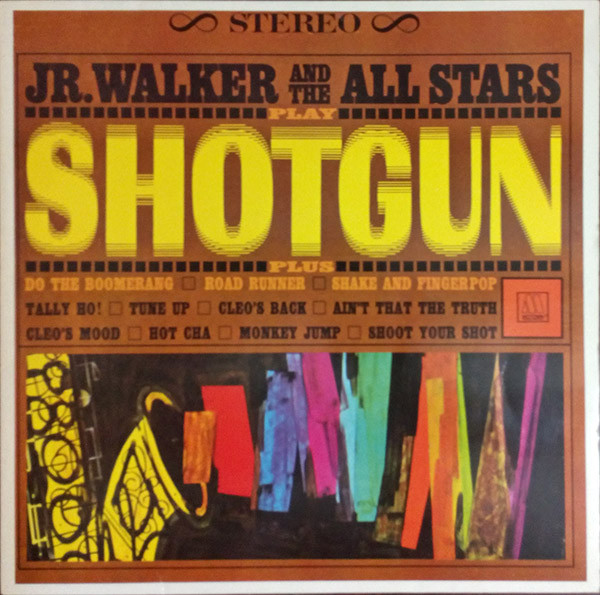
Shotgun
1965

Peace & Understanding Is Hard To Find
1973

Home Cookin'
1969

Road Runner
1966

Rainbow Funk
1971

Greatest Hits
1969

Jr. Walker & The All Stars "Live"
1967

Live
1970

(I'm A) Road Runner
1966
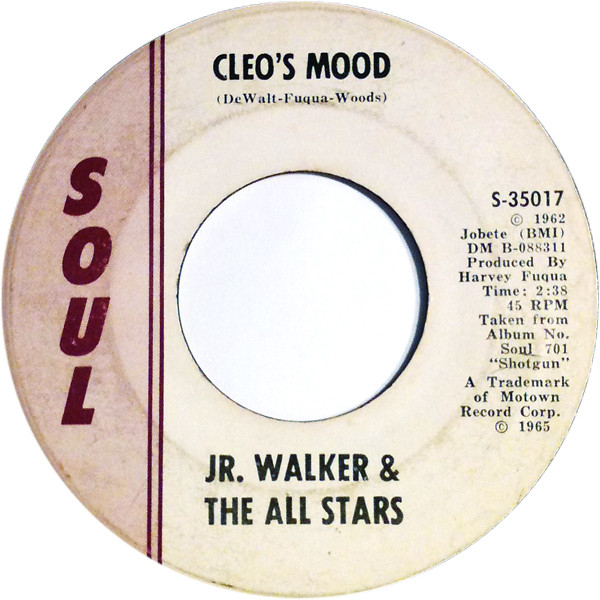
Cleo's Mood / Baby You Know You Ain't Right
1965

Motown Special Jr. Walker And The All Stars
1977

Shotgun & Road Runner
1973
Related artists
Frequent collaborators
Around the web
Follow every record they touch.
Start your shelf and Gatefold tracks Junior Walker's new pressings, tour dates, and the whole discography — automatically.
Start your shelf →Free forever. Works with 10 records or 10,000.