
Artist
Broken Social Scene
Toronto, Canada · Formed 1999
Broken Social Scene is a music group from Toronto, Canada, active since 1999. Their discography on Gatefold includes 18 records.

18
Albums tracked
171
In collections
1999
Since
Biography
Dave Newfeld ran the board in his Toronto basement studio with broken gear, cheap mics, and fifteen musicians tripping over each other's instrument cables. That total structural disorder was the whole point. Kevin Drew and Brendan Canning built the thing out of ambient post-rock sketches, then brought in half of the Ontario indie scene—members of Metric, Stars, and Feist—to turn chaotic four-track loops into horn-heavy communal explosions. It was a rotating collective disguised as a rock group, running on zero budget and insane ambition. The miracle is that it held together without imploding during the self-titled follow-up. When everyone in the room has a solo career taking off simultaneously, you either get a mess or a monument. They handed out tambourines, layered five guitars playing against the beat, and made communal catharsis sound like an actual working method.
Bio from The Clerk
The Arc of Broken Social Scene
The pivots — what forced Broken Social Scene to reinvent.
The Ambient Basement Duo
Drew and Canning started out tracking nearly beatless instrumental drifts with a guitar, a four-track recorder, and an ancient sampler. 2001's Feel Good Lost was practically a bedroom ambient record with zero ambition to fill a festival tent. It laid down the melodic skeleton and post-rock textures before the rest of the Toronto scene got invited into the room.
The Communal Breakthrough
Dave Newfeld crammed fifteen players into his cramped living room space and somehow turned conflicting egos into 2002's You Forgot It in People. Leslie Feist, Emily Haines, and Amy Millan layered vocals over blown-out distortion pedals and brass arrangements. It defined the Toronto indie-rock explosion and gave the Arts & Crafts label its entire commercial foundation.
The Sprawling Maximalist Burnout
The 2005 self-titled LP pushed the communal concept right to the edge of collapse with seventy-minute runtimes and dense walls of sound. Everyone was exhausted, their other projects were blowing up globally, and the studio sessions felt like corralling a dozen solo artists at once. You can hear the glorious, noisy strain across every track before the band finally hit pause.
The Tortoise Connection Rebuild
To break the internal pressure, Drew and Canning took the band to Chicago to track 2010's Forgiveness Rock Record with John McEntire. McEntire stripped away the muddy mid-range and imposed tight, polyrhythmic post-rock discipline on their rambling songwriting. It traded basement sweat for precision engineering and proved the collective could survive outside of Toronto.
Influences
- Tortoise — Kevin Drew explicitly cited Chicago post-rock as the foundation for the band's rhythmic structure, eventually hiring Tortoise drummer John McEntire to produce their 2010 record. You hear their jazz-inflected dual-drumming and interlocking vibraphone lines all over the early instrumental loops. McEntire tightened the band's loose ends without scrubbing their grit.
- Pavement — Drew repeatedly credited Stephen Malkmus's loose, slacker vocal delivery and unpolished guitar tunings as a prime structural influence. That off-kilter phrasing and casual lyricism anchors sprawling vocal tracks like 'Stars and Sons' and 'Almost Crimes.' It kept the collective from sounding like a slick chamber-pop orchestra.
- My Bloody Valentine — The band leaned heavily on Kevin Shields' glide guitar technique and massive multi-tracked fuzz walls during the Newfeld basement tracking sessions. You hear that gauzy shoegaze bleed everywhere under the brass and acoustic guitars on You Forgot It in People. It turned standard indie pop into a physical wall of noise.
- Sonic Youth — Canning and Drew built their sound on the dual-guitar interplay, alternate tunings, and sudden structural dynamic shifts pioneered by Thurston Moore and Lee Ranaldo. The noisy, feedback-drenched climaxes in their live shows trace straight back to Daydream Nation. It gave their melodic hooks a sharp, dissonant spine.
- Talk Talk — Drew referenced Mark Hollis's studio improvisations on Laughing Stock as the blueprint for assembling sprawling albums out of loose group jams. The quiet ambient dynamics and acoustic open spaces on Feel Good Lost owe everything to Hollis's late-era minimalism. They understood that space makes the noise hit twice as hard.
Discography
Their records — most-collected first.
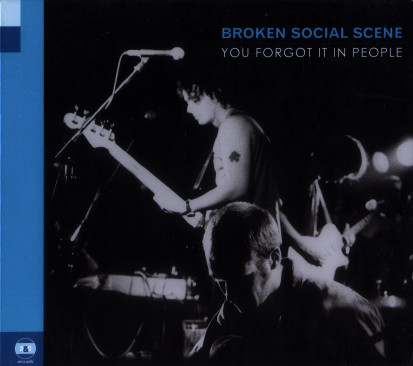
You Forgot It In People
2002

Broken Social Scene
2005

Forgiveness Rock Record
2010

Hug Of Thunder
2017

Feel Good Lost
2001

Remember The Humans
2026

Spirit If...
2007
Let's Try The After Vol 1&2
2019
Backed Out On The...
2007

Live At Third Man Records
2020

Bee Hives
2004
Old Dead Young (B-Sides & Rarities)
2022

Something For All Of Us...
2008

Tbtf
2007

7/4 (Shoreline)
2006

Fire Eye'd Boy
2006

Ibi Dreams Of Pavement (A Better Day)
2005

Stars And Sons / KC Accidental
2003
Related artists
Members
Frequent collaborators
Around the web
Follow every record they touch.
Start your shelf and Gatefold tracks Broken Social Scene's new pressings, tour dates, and the whole discography — automatically.
Start your shelf →Free forever. Works with 10 records or 10,000.