
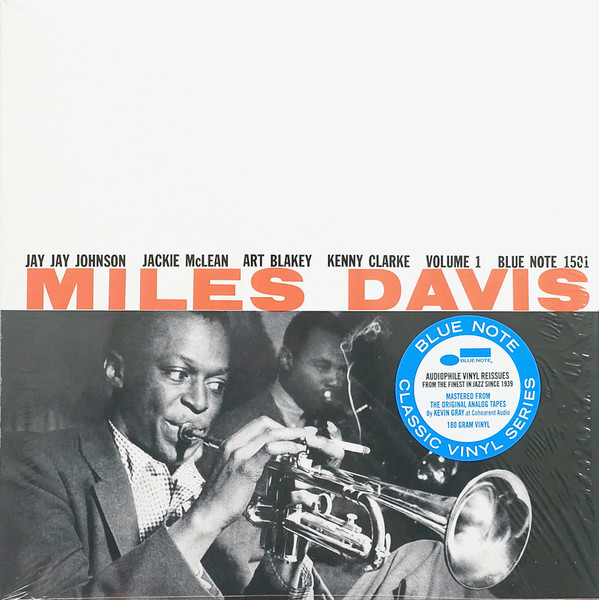
Volume 1 is a Jazz album by Miles Davis, originally released in 1955. On Gatefold: 105 pressings tracked, owned by 13 collectors.
About
These early Blue Note sessions are amazing works of musical alchemy fleshing out Miles' post-<i>Birth of the Cool</i> evolution. With leaner arrangements and a smaller combo, these tracks take a deliberate pace that moves even further from frenetic bebop. Kenny Clarke's measured drumming on lilting Swedish folk song "Dear Old Stockholm" and an easygoing take on Dizzy Gillespie's "Woody 'n You" keeps the tempos at a simmer. Lovely ballads like the melancholy "Enigma" and wistful "How Deep is the Ocean?" drop the temperature even further.
via Apple Music
The Clerk says
The Clerk knows this whole record — the pressing quirks, the credits, the take.
Tracklist
- 1Tempus Fugit3:48
- 2Kelo3:16
- 3Enigma3:21
- 4Ray's Idea3:43
- 5How Deep Is the Ocean4:39
- 6C.T.A.3:16
- 7Dear Old Stockholm4:10
- 8Chance It3:01
- 9Yesterdays3:42
- 10Donna3:09
- 11C.T.A.3:31
- 12Woody'n You3:22
Sound DNA
- Jazz
- Bebop & Hard Bop
- clean
- driving
- urban
Release Date: 1955
Recording Period: May 1952 - Apr 1953
Label: Blue Note
Miles Davis, Trumpet
J.J. Johnson, Trombone
Jimmy Heath, Tenor Saxophone
Gil Coggins, Piano
Art Blakey, Drums
Percy Heath, Bass
Jackie McLean, Alto Saxophone
Oscar Pettiford, Bass
Kenny Clarke, Drums
Some releases contain tracks from Volume 2 and vice versa.
Miles Davis – Volume 1 & Volume 2
2 LPs, 23 tracks, an hour and a half of music, 3 sessions spread over 3 years. These recordings constitute the entire output of Miles Davis on Blue Note with exception of his later, Columbia-era session with Cannonball Adderley, Somethin' Else (US 1958) (opens in a new tab) in 1958.
The material runs the gamut from straight bop (Dizzy Gillespie’s “Woody’n You”) to complex Birth Of The Cool (UK 1957) (opens in a new tab)-style arrangements (J.J. Johnson’s “Enigma”) to standards (“How Deep is the Ocean” by Irving Berlin) to a Swedish folk tune (“Dear Old Stockholm”).
Many of the tracks are familiar tunes masquerading under different names: Jackie McLean’s “Donna” recorded for Prestige the previous year as “Dig”, “Take-Off” is actually “Deception” from the Birth of the Cool sessions (which itself is based on George Shearing’s “Conception”), “Lazy Suzan” is Tadd Dameron’s “Lazy Bird”, “Weirdo” would be re-recorded just a month later as “Walkin’” and then return even later as “Sid’s Ahead” on Milestones (US 1958) (opens in a new tab).
Origins:
Columbia introduced the 10-inch vinyl LP along with 12-inch LP in 1948 with the idea that the shorter duration would be better suited to popular music while the 12-inch LP would be reserved for Classical and other “serious” forms of music.
Alfred Lion’s Blue Note label launched their 5000 “Modern Jazz” 10-inch series in 1951, but by the end of 1954 the 10-inch format was dying. In 1955, Blue Note introduced what is arguably the most important series of American Jazz LPs, the 12-inch “1500” series.
Eleven titles in the new 1500 series consisted of reissued 10-inch material. Because of the introduction of the variable pitch lathe, it was now possible to cut the contents of two 10-inch LPs onto a single 12-inch LP. Often, to fill up the extra space on the new 12-inch collections, Alfred Lion added “alternate masters” of selected tracks.
The first two releases in the 1500 series were Volume 1 and Volume 2 (US 1956) (opens in a new tab) (BLP 1501 and 1502). These two LPs consisted of material from three sessions which had earlier been issued as three separate 10-inch LPs:
1952 – Young Man With A Horn (BLP 5013)
1953 – Vol. 2 (BLP 5022)
1954 – Vol. 3 (BLP 5040)
Three Sessions:
The 1952 and 1953 sessions were recorded almost a year apart by Doug Hawkins at WOR Studios, 1440 Broadway in Manhattan.
For his first Blue Note session, Miles brought along altoist Jackie McLean (just a few days shy of his 21st birthday) as well as pianist Gil Coggins. Both Coggins and McLean were part of the band with which Miles had just wrapped up a week-long engagement at Birdland. Coggins (who left music permanently not long after these sessions to pursue a career in real estate) and trombonist J.J. Johnson are heard on both of the WOR sessions. The rhythm section is rounded out by Oscar Pettiford and the godfather of bop drumming, Kenny Clarke.
The 1953 session substitutes Jimmy Heath on tenor joined by his brother Percy on bass and Art Blakey on the drums.
The bulk of these two sessions make up the material on “Miles Davis Volume 1”. Side 1 consists largely of tunes from the ’53 session with all but one track on side 2 being drawn from the ’52 session.
The ’54 session is different in several ways:
By 1954, Alfred Lion was relying on the services of Dr. Rudy Van Gelder, an optometrist located in the suburb of Hackensack, NJ. Van Gelder was moonlighting as a recording engineer in a home studio built into his parents living room especially for this purpose. Miles’ final Blue Note session (he had now signed an exclusive contract with Bob Weinstock’s Prestige label) was also among Van Gelder’s earliest for Alfred Lion.
Van Gelder would record and personally cut the masters for almost the entirety of the Blue Note catalog up until Lion’s departure in 1967 (Van Gelder also remastered the ’52 and ’53 recordings and cut the masters for these LPs).
Perhaps more importantly, at the beginning of 1954, Miles had locked himself in a hotel room in Detroit for twelve days and finally emerged free of the heroin addiction which had been plaguing him throughout the early 1950s and slowly destroying his hitherto promising career. Like so many of his contemporaries in the bop scene, Miles had picked up a habit in 1949 and despite being arrested for “internal possession” in L.A. in 1950 and forcibly going cold turkey after being locked in a jail cell by the local sheriff at the behest of his father not long after the ’52 Blue Note session, Miles had continued his downward spiral.
Miles’ mentor and idol, Charlie Parker, would succumb to his addictions just a year later in 1955 at the age of 34.
The ’54 session is also distinct in that it’s a quartet date featuring Miles as the sole horn. While Percy Heath and Blakey are held over from the ’53 session, but this marks Horace Silver’s first appearance with Miles Davis. Silver and Blakey would go on to form the the seminal Hard Bop ensemble, Art Blakey & The Jazz Messengers.
Fittingly, the final track, “It Never Entered My Mind”- a Rodgers & Hart tune- features one of Miles’ earliest usages of the Harmon mute which would go on to become his trademark. Miles would subsequently re-record this tune twice more in 1956, first with Sonny Rollins and Tommy Flanagan and finally with Miles Davis Quintet, The.
Credits
The people behind it.
Performers
- Art BlakeyDRUMS
- Gil CogginsPIANO
- Horace SilverPIANO
- J.J. JohnsonTROMBONE
- Jackie McLeanALTO SAXOPHONE
- Jimmy HeathTENOR SAXOPHONE
- Kenny ClarkeDRUMS
- Miles DavisTRUMPET
- Oscar PettifordBASS
- Percy HeathBASS
13 collectors on Gatefold own this · 105 pressings tracked on Gatefold
Start your shelf.
Track your pressings of Volume 1, get the Clerk's take, and see what the record is worth — free.
Start your shelf →Free forever. Works with 10 records or 10,000.