
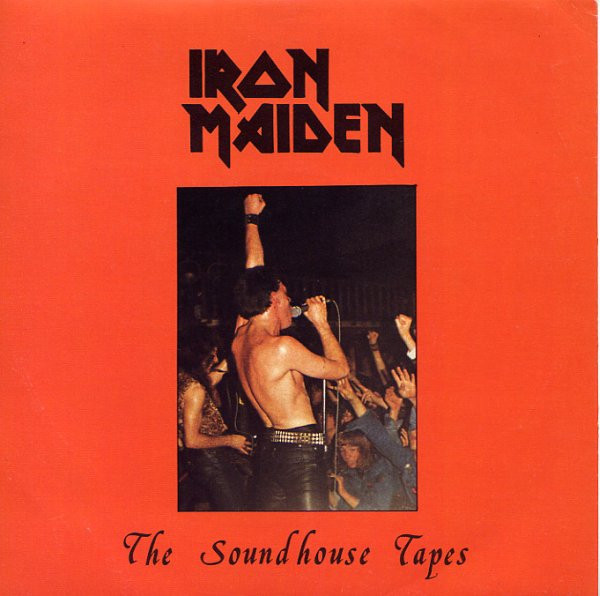
The Soundhouse Tapes is a Rock album by Iron Maiden, originally released in 1979. On Gatefold: 89 pressings tracked.
About
"The Soundhouse Tapes" is the debut EP by Iron Maiden and contains the band's earliest released recordings. It was released on 9 November 1979 and features three tracks taken from a demo recorded at Spaceward Studios on 30 and 31 December 1978. The songs, "Iron Maiden", "Invasion" and "Prowler", appear in an earlier, less refined form compared with later studio versions recorded for the band's debut album and subsequent singles, as they were recorded in a single session. Although interest from major retail chains reportedly led to requests for large quantities, the EP was limited to 5,000 copies and distributed by mail order only. It sold out within a few weeks and later became a collector's item, with copies reported to have been sold for up to £1750 on online auction sites. During a period when punk rock was prominent in the UK, Iron Maiden had difficulty securing gigs outside London's East End and decided to record a demo to promote themselves. The band chose Spaceward Studios in Cambridge after becoming aware of recordings made there by V1, the band of former vocalist Dennis Wilcock. Although recording in Cambridge was more expensive than options in London, bassist Steve Harris stated that they considered it worthwhile for quality reasons. The band booked a session over the New Year weekend of 30 and 31 December 1978, costing approximately £200, and recorded four songs: "Prowler", "Invasion", "Strange World" and "Iron Maiden". According to Harris, the band entered the studio with limited prior experience but found that the songs were already well rehearsed from live performance, allowing them to be recorded quickly, often in early takes. After the initial session, the band had planned to return for remixing and additional recording. However, guitarist Dave Murray later stated that the studio requested additional payment for the master tape, which the band could not provide at the time. When they returned later, the original tape had been overwritten. As a result, the recordings were released from the original session without further studio modification. The engineer Mike Kemp later stated that the studio could not afford to store multitrack tapes indefinitely and typically retained them only until payment or further arrangements were made. Following the recording, bassist Steve Harris and guitarist Dave Murray gave a copy of the tape to DJ Neal Kay, who ran the Bandwagon Soundhouse heavy metal club in Kingsbury, London. The tape received regular airplay at the club, and "Prowler" reached number one in the Soundhouse charts published in Sounds magazine. The exposure contributed to increased attention for the band and helped bring the demo to the attention of Rod Smallwood, who later became the band's manager and assisted in securing a recording contract with EMI Records in December 1979. In late 1979, while awaiting the EMI contract, Iron Maiden decided to issue the demo recordings themselves on their own label, Rock Hard Records. The EP was named after the Bandwagon Soundhouse club. According to Harris, the release was prompted by demand from fans who had seen the band perform and were aware of the demo recordings but had no official release to purchase. The track "Strange World" was excluded from the EP due to the band's dissatisfaction with its production quality. The initial pressing of 5,000 copies sold quickly, with 3,000 reportedly sold by mail order in the first week. Demand exceeded expectations, and some retailers, including HMV and Virgin, reportedly attempted to order additional copies in large quantities. Despite this demand, the band chose not to increase production, prioritising its limited nature ahead of their forthcoming deal with EMI. The EP is regarded as a notable early release in Iron Maiden's discography and is considered a collector's item. In 2011, Record Collector reported that copies of the original release had sold for up to £800. The recordings from the EP, along with the previously unreleased version of "Strange World", were later included on the 4-LP edition of the band's compilation "Best of the Beast". Commentary from Götz Kühnemund, former editor of the German magazine Rock Hard, has described Iron Maiden as a significant influence on a range of heavy metal subgenres, including power metal, speed metal, thrash metal, death metal and black metal, and has noted their role in shaping later developments in heavy rock and metal.
via Last.fm
The Clerk says
The Clerk knows this whole record — the pressing quirks, the credits, the take.
Sound DNA
- Rock
Original versions can be identified by the following criteria compared to counterfeits:
1) 7" black vinyl record with a square picture sleeve measuring just a shade over 7 1/8 inches across and 7 1/4 inches vertically.
2) The picture sleeve is made of heavy paper identical to the sleeve of the UK version of the 'Running Free' release. This is the only similarity of the two.
3) The picture sleeve has the opening from the top. The cutout on the back of the sleeve and at the opening is exactly 3 11/16 inches long. The cutout is curved and has diagonal cuts on either end. Fakes that mimick this cutout are extremely rare.
4) The picture sleeve inside paper is off white in colour. An aged look, almost beige color is seen at the cutout on the top of the back of the sleeve. Fake sleeves have the colour often pure white.
5) The picture sleeve is orange in color. In original copies, the colour varies very little and only because of exposure to light. Fakes are often too red in color.
6) The picture sleeve back has flaps that extend from the front cover that fold and wrap around to the back of the sleeve where they are glued. The wrap around flap has diagonal cuts which are approximately 22 degrees on all four corners of the back sleeve. Most of the fakes do not have the cuts on an angle or never at the right angle. One tell-tale sign of a fake is if the flap corner cutoffs are too smooth. On the originals, there is always an 'ear' left from the die cast on where the diagonal cuts were made which is almost impossible to fake with modern day equipment.
7) The cutout on the back sleeve at the opening has a curved shape extending downward. There is usually a small hit of orange gap between the lowest point of the cutout and Paul DiAnno's photo. It's a myth that this gap appears on every single original copy and it should not be used as a sign of a fake if it does not appear. Depending on the diecast and how the paper sat at this procedure determined how the sleeves look.
8) The black vinyl record paper label's orange colour is darker than the picture sleeve. While the sleeve is orange the paper labels are almost a light red in color. Fakes often have the labels and picture sleeve use the same orange colow or the paper labels are even in a lighter orange.
9) The black vinyl record side 1 and side 2 have markings in the run off grooves. These markings beyond anything else will tell you if you have an original. They have not been faked so far.
10) The black vinyl record side 1 markings in the runoff grooves are
*EG* SA LYN 7627 - IT ROK - 1 - A
While most of the markings are quite easy to see, the LYN 7627 - IT is not. By having very good light and turning the record into the light is the only way to catch the markings with the bare eye.
11) The black vinyl record side 2 markings in the runoff grooves are
ROK - 1 - B LYN 7628 - IT *EG* SA
Again, the LYN markings are barely seen with the bare eye without turning the record to catch the light of these markings. Fakes try to copy the original markings and all don't come close as they are scribed crudely into the vinyl.
Credits
The people behind it.
Performers
- Dave MurrayGUITAR
- Doug SampsonDRUMS
- Paul CairnsGUITAR
- Paul Di'annoVOCALS LEAD VOCALS
- Steve HarrisBASS BASS GUITAR BASS, DESIGN , ARTWORK BY, WRITTEN-BY
- Adrian SmithGUITAR
- Clive BurrDRUMS
- Dennis StrattonGUITAR
- Tony ParsonsGUITAR
89 pressings tracked on Gatefold
Start your shelf.
Track your pressings of The Soundhouse Tapes, get the Clerk's take, and see what the record is worth — free.
Start your shelf →Free forever. Works with 10 records or 10,000.