
Album
The Other Side Of Make-Believe
2022 · Rock
7 collectors on Gatefold own this
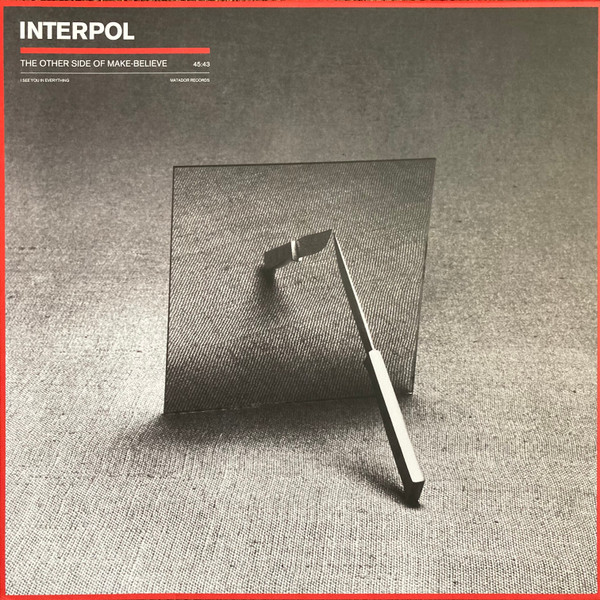
The Other Side Of Make-Believe is an Alt/Indie album by Interpol, originally released in 2022. On Gatefold: 10 pressings tracked, owned by 7 collectors.
About
Once, New York City’s Interpol was thought of as the progenitor of the early-2000s post-punk revival, known for their ability to distill vintage sounds and morph them into nostalgic innovations. But a couple decades, endless world tours, and international success can change a few things. <i>The Other Side of Make-Believe</i> is singer/bassist Paul Banks, guitarist Daniel Kessler, and drummer Sam Fogarino’s seventh studio album (recorded with their longtime collaborator Alan Moulder, and their first time working with producer Flood), their first written remotely. It is also an evolution for the band, who made room to experiment with piano-forward songwriting (“Toni,” “Something Changed”); huge, layered drums (“Renegade Hearts”); mathy time signatures (“Into the Night”); and experimental bass (“Passenger”). It’s Interpol like you’ve never heard them before. Thematically, the album—and its title—reflects the unstable status quo of modernity, its optimistic qualities and its detrimental ones. “I'm very fascinated with musing on the human imagination and our proclivity to come up with stories to make sense of reality,” Banks tells Apple Music. “On the one hand, that's beautiful, distinguishes us from other species, and allows all of fiction and film and art, this abstract thinking as a way to wrestle chaos into sense. But I feel like there’s something of a downside to it—self-delusion and self-deception that takes over with reality is too cold and frightening. The world we live in right now, there’s a lot of tension between what is true and what is false.” Below, Banks walks Apple Music through Interpol’s seventh studio album, track by track. <b>“Toni”</b> “‘Toni’ is one of two songs that Daniel wrote with a piano as the core. It was actually one of the songs that we wrote remotely, then we got together for in-person sessions: 10-day, two-week stretches of just jamming all day. ‘Toni’ was a song that really took shape in one of those live sessions. We got Daniel mic’d up on a piano and had to make a decision: Are we going to make this a rock song? Is this going to have electric bass and electric guitar? Or is it just going to use sound effects? We decided we were going to use traditional instrumentation, and what it turned out to be is fun. It felt like a natural beginning to a record.“ <b>“Fables”</b> “This one has a very fun drumbeat. What Sam does on the drums is probably one of my favorite elements of the record. And I love that it's not in a hurry. The world was so messed up while we were writing this record, with the pandemic. Some of these songs feel hopeful, and those themes of resilience and strength and human ingenuity felt more appropriate for me to write about. 'Fables' is one of those songs that has a message of construction rather than destruction, which I think would often characterize my lyrics.” <b>“Into the Night”</b> “It was a real challenge to work with Daniel's strange time signature with this. It’s a 13-beat bar and sometimes it's a 15-beat or a 13-beat loop. Trying to write a bassline and a vocal to what Daniel had done was really cerebral. Daniel’s part had this great Zeppelin swag to it. Or, like, The Mars Volta, this real hot-blooded thing. It came about in a nice organic way, all around and lyrically. It's one of my favorites and it has an emotional payoff that I've hoped to achieve. I don't know if we always do, but this song does.” <b>“Mr. Credit”</b> “It’s a fever dream about relationships and power dynamics. That one is odd. The first-person character is not to be trusted in that song.“ <b>“Something Changed”</b> “[‘Something Changed’ and ‘Toni’] weren’t written as partners, but they were the two songs based around piano. I think it got some people talking like, 'Is this going to be a piano record? What's going on? Is this the new Interpol sound?' And no, it's part of the new Interpol sound, but it's not all of it. I just feel like that was a good idea. I also think both those songs sound mature and very self-fulfilled.“ <b>“Renegade Hearts”</b> “This is one song that Flood had not been 100% sold on what we were trying to do. He felt like the song could do something else, and that focused on drums. He wanted to explore different rhythmic expressions to underpin the chord progression. So he and Sam worked closely and came up with what you hear. It was no easy or simple task. Flood put in work on that song. It's still one of my favorites, I just wouldn't have anticipated it was going to go where it went.” <b>“Passenger”</b> “As the song ends, you hear Daniel’s guitar switch from a verse to a chorus again as it fades, and I think that change is one of the most beautiful things that he's written. It’s a very effective guitar line. I love how the vocal and Daniel’s guitar diverge from the verse to the chorus. I hear it like a flower blossoming. I hear this weird Sabbath-y hip-hop influence, a sort of scary drum loop. If you start that drum loop two beats later, it becomes a bit more of a conventional rock thing. And it was just one of these times where it was like, 'Guys, turn it off and listen to it from this downbeat.'” <b>“Greenwich”</b> “That's another one of those times where Daniel's guitar riff is very intellectual and strange. I wanted to find some swaggy way to do a bassline over it, which I think really worked out, actually. It's one of my favorite songs on the record. I love the chorus. It is very sunny. The post-chorus was difficult: Right now, you hear a male and a female voice in the outro and they're doing something that's quite low-key, satisfied, and content.” <b>“Gran Hotel”</b> “We had a chorus going into rehearsals and we had the intro and we had most of the music, but that was it. When we had Daniel's guitar and we had the drums and it was time for me to deliver the bass, the engineer Richie Kennedy, I think he said it literally as blunt as 'Do you have anything else?' It sparked something in me. We rolled another take, and I wrote the bassline on the fly. The entire outro happened in 45 minutes after everyone had gone home one day; it’s just a new bassline and two new guitar parts. It was a pretty cool moment.” <b>“Big Shot City”</b> “It’s one of Daniel's coolest riffs on the record; it evokes the choreographed waving of a matador's red flag that they use to tease a bull. It evokes this velvety substance to me, blowing in the wind. We had a lot of discussion about how the song should be laid down. Daniel was very committed to the idea of the bassline staying in one lane until the outro, and I think that makes the payoff even more special.” <b>“Go Easy (Palermo)”</b> “Daniel’s working title was ‘Palermo.’ I wanted the bass to sound like The Cure, where the bassline unto itself is something you might want to hum. I don’t know if I accomplished that, but it was what I was aspiring to. I used to envision an audience singing along, and it was really a profound thing. I regret indulging in that. It felt like a premonition, singing that song and having an audience singing it back. It would always give me literal chills. The lyric was very resonant for me, this idea of going easy, meaning to be kind to yourself on your journey.”
via Apple Music
The Clerk says
The Clerk knows this whole record — the pressing quirks, the credits, the take.
Tracklist
Side A
- A1Toni
- A2Fables
- A3Into The Night
- A4Mr. Credit
- A5Something Changed
Side B
- B1Renegade Hearts
- B2Passenger
- B3Greenwich
- B4Gran Hotel
- B5Big Shot City
- B6Go Easy (Palermo)
Sound DNA
- Alt/Indie
- Alternative Rock
- jangly
- wistful
- urban
Notes from the original pressing. Later editions may differ.
Presented in a matte sleeve and with a printed inner sleeve featuring lyrics.
The interior section of the sleeve is printed black. This also applies to the inner sleeve.
Package came shrink-wrapped.
Pre-order copies from Matador included a set of six postcards wrapped in a matte black card envelope which is sealed with a red card band.
Runouts are etched
Credits
The people behind it.
Performers
- FloodVOCALS
- Jacob TresidderVOCALS
- Juliet SegerVOCALS
- Richie KennedyVOCALS
7 collectors on Gatefold own this · 10 pressings tracked on Gatefold
Start your shelf.
Track your pressings of The Other Side Of Make-Believe, get the Clerk's take, and see what the record is worth — free.
Start your shelf →Free forever. Works with 10 records or 10,000.