
Album
Mekanïk Destruktïẁ Kommandöh
1973 · Jazz, Rock
5 collectors on Gatefold own this
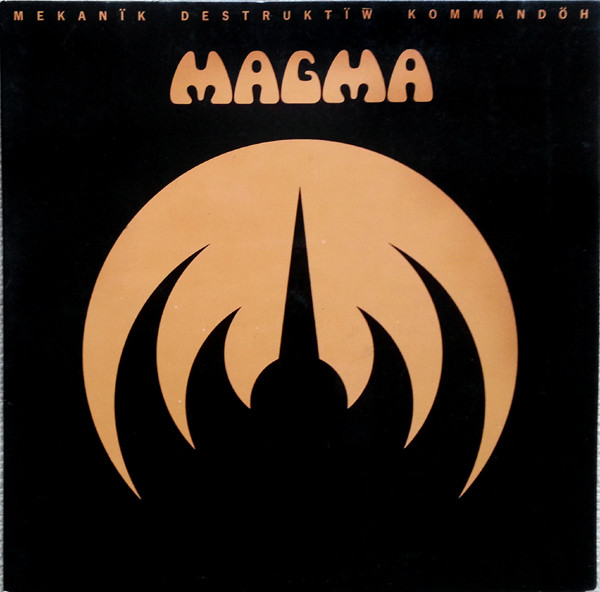
Mekanïk Destruktïẁ Kommandöh is a Rock album by Magma, originally released in 1973. On Gatefold: 45 pressings tracked, owned by 5 collectors.
About
"Mekanïk Destruktïẁ Kommandöh" (often abbreviated as "MDK") is the third studio album by the French band Magma, released on 6 May 1973. A concept album and rock opera, it forms part of the band's broader Kobaïan mythology and narrates the story of a prophet whose message of spiritual transformation provokes a mass movement on a war-torn Earth. The album marked a significant stylistic development for Magma, moving away from the jazz-rock influences of their earlier work towards a more choral, theatrical, and orchestral sound that became closely associated with the Zeuhl genre. The album was developed over a period of approximately two years. It originated as the final movement of "Theusz Hamtaahk", a trilogy composed between 1970 and 1973. Although it was the last part of the trilogy to be written, it became the first to be released. The first movement, "Theusz Hamtaahk", was initially composed in 1970 and later appeared on live recordings, while the second movement, "Ẁurdah Ïtah", was released in 1974. Early versions of the work were composed and performed under the title "Mekanïk Kommandöh". An initial studio recording made in 1971 was released as a single in 1972 and later reissued on the compilation album "Simples". This version differed substantially from the final composition, featuring a bossa nova-influenced introduction and provisional lyrics. A more developed version was performed live in Brussels in November 1971 and was later released on "Concert 1971, Bruxelles: Théâtre 140". The composition underwent extensive revisions before its structure was finalised in early 1972. During this period, Magma experienced substantial personnel changes. Founder Christian Vander recruited vocalist Stella Zelcer and bassist Jannick Top, both of whom became important contributors to the group's evolving sound. Top's distinctive bass playing, in particular, became associated with the darker and more dramatic character of the music. An initial version of the album intended for release was recorded in January 1973. Featuring choir-centred arrangements and predominantly acoustic instrumentation, it was rejected by the band's record label, A&M Records. This recording remained unreleased until 1989, when it appeared under the title "Mekanïk Kommandöh". The final version of the album was recorded in April 1973 at Oxford Manor Studios and Aquarium Studio in Paris. Additional instrumentation, including electric guitar, brass, flute, bass clarinet, vibraphone, xylophone, and expanded vocal arrangements, was incorporated to create a more forceful and rock-oriented sound. The revised title, "Mekanïk Destruktïẁ Kommandöh", reflected these changes. The album's narrative is set after the departure of the Kobaïans, a fictional civilisation central to Magma's mythology. Earth is depicted as a world trapped in recurring disasters and perpetual warfare. The prophet Nëbëhr Ğudahtt urges humanity to abandon conflict, embrace mutual understanding, and pursue spiritual purification. His message is condemned by the authorities, leading to a mass demonstration organised to find and kill him. As the march progresses, the participants undergo a gradual transformation. Experiences interpreted as spiritual revelations lead many of them to reconsider Ğudahtt's teachings. The demonstration evolves into a symbolic journey towards enlightenment, during which the crowd embraces the principles associated with Kobaïa and seeks transcendence. Eventually, Ğudahtt appears and announces humanity's ascension. The narrative concludes with the inhabitants of Earth attaining a higher state of existence. Musically, the album established many of the characteristics later associated with Magma and the Zeuhl genre. Its compositions combine repetitive rhythmic structures, extensive choral passages, brass arrangements, complex time signatures, and contrapuntal vocal and instrumental lines. Compared with the band's earlier albums, "Magma" (1970) and "1001° Centigrades" (1971), which were more strongly influenced by jazz-rock, "Mekanïk Destruktïẁ Kommandöh" presented a more unified compositional approach centred on Vander's vision. The album has been widely regarded as Magma's most influential and recognised work. It was ranked 33rd in a list of the greatest French rock albums published by the French edition of Rolling Stone and was placed 24th on Rolling Stone's 2015 list of the "50 Greatest Prog Rock Albums of All Time". Over subsequent decades, the composition was performed and recorded in numerous arrangements of varying lengths and instrumentations. In the 1990s, Vander adapted the work into "Baba Yaga La Sorcière", a shortened version intended for children's choirs, with revised lyrics written by Gaston Tavel. A recording of a 1995 performance was released in 1996. To commemorate the album's fiftieth anniversary, Magma released the box set "Magma une histoire de Mekanik Coffret 50 ans Mëkanïk Dëstruktïw Kömmandöh" in September 2023. Limited to 2,000 copies, the collection included multiple recorded versions of the composition spanning the period from 1972 to 2021.
via Last.fm
The Clerk says
The Clerk knows this whole record — the pressing quirks, the credits, the take.
Sound DNA
- Rock
- Prog Rock
- dense
- intense
- cerebral
Third movement of Theusz Hamtaahk.
For the original January 1973 recording, unreleased until 1989, see Mekanïk Kommandöh.
Credits
The people behind it.
Performers
- Christian VanderCOMPOSED BY, DRUMS, VOCALS, ORGAN, PERCUSSION DRUMS, VOCALS, ORGAN, PERCUSSION DRUMS, VOCALS, ORGAN, PERCUSSION, COMPOSED BY
- Claude OlmosGUITAR
- Doris ReinhardtVOCALS
- Evelyne RazymovskiVOCALS
- Jannick TopBASS BASS, CELLO, VOCALS, PIANO
- Jean-Luc ManderlierPIANO, ORGAN
- Klaus BlasquizPERCUSSION, VOCALS VOCALS, PERCUSSION
- Michèle SaulnierVOCALS
- Muriel StreisfeldVOCALS
- René GarberBASS CLARINET, VOCALS CLARINET , VOCALS
- Stella VanderCHOIR, CHORUS MASTER CHOIR, PERFORMER VOCALS
- Teddy LasryBRASS, BRASS , CONDUCTOR , FLUTE BRASS, FLUTE BRASS, FLUTE , BRASS
5 collectors on Gatefold own this · 45 pressings tracked on Gatefold
Start your shelf.
Track your pressings of Mekanïk Destruktïẁ Kommandöh, get the Clerk's take, and see what the record is worth — free.
Start your shelf →Free forever. Works with 10 records or 10,000.