
Album
Days Of Future Passed
The Moody Blues With The London Festival Orchestra Conducted By Peter Knight
1967 · Rock
98 collectors on Gatefold own this
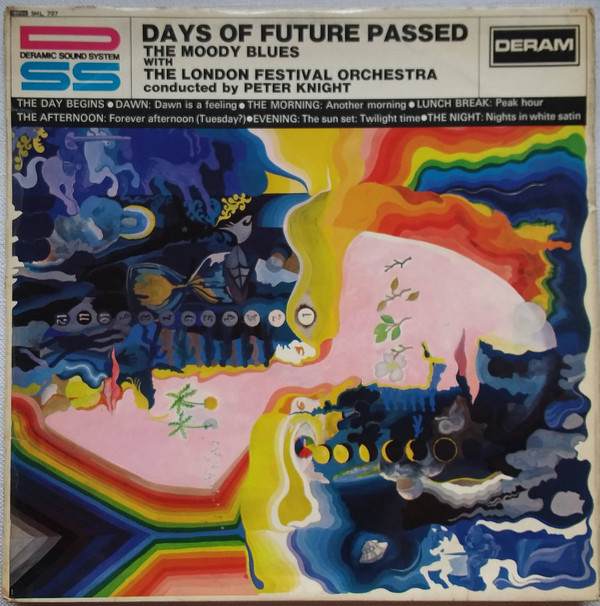
Days Of Future Passed is a Rock album by The Moody Blues With The London Festival Orchestra Conducted By Peter Knight, originally released in 1967. On Gatefold: 344 pressings tracked, owned by 98 collectors.
About
<i>Days of Future Passed</i> is a very 1967 affair. A musical description of a single day, with poetic interludes, it was made in collaboration between The Moody Blues and the London Festival Orchestra. Melancholy pop songs such as “Dawn: Dawn Is a Feeling” and “The Afternoon” increase their emotive weight with sparkling Broadway arrangements, while the mournful “Nights In White Satin” gives way to the lush romance of “Late Lament,” linked only by a few well-chosen words about the ending of the day.
via Apple Music
The Clerk says
The Clerk knows this whole record — the pressing quirks, the credits, the take.
Tracklist
Side A
- A1The Day Begins5:45
- A2Dawn: Dawn Is A Feeling3:50
- A3The Morning: Another Morning3:40
- A4Lunch Break: Peak Hour5:21
Side B
- B1The Afternoon: Forever Afternoon (Tuesday?) / Time To Get Away8:25
- B2Evening: The Sun Set: Twilight Time6:39
- B3The Night: Nights In White Satin7:41
Sound DNA
- Rock
- Prog Rock
- lush
- serene
- cinematic
Second studio album released 10. November 1967 / released remastered 2017.
The English rock band The Moody Blues was active in the years 1964–1974 and 1977–2018.
During this time they released 16 studio albums.
From Wikipedia: ( https://en.wikipedia.org/wiki/Days_of_Future_Passed )
Days of Future Passed is the second album and first concept album by English prog rock band the Moody Blues, released in November 1967 by Deram Records in the UK and March 1968 in the US. With its fusion of orchestral and rock elements, it has been cited as one of the first examples of progressive rock.
The album was recorded at a time when the Moody Blues were suffering financial difficulties and lack of critical and commercial success. Their parent label, Decca Records offered them a chance to record a stereo LP that combined their music with orchestral interludes. They decided to compose a suite of songs about the life of everyday man, with the group and orchestra mostly playing separately and mixed together. It was a moderate success upon release, but following steady radio airplay, particularly of the hit single "Nights in White Satin", it became a top ten US hit in 1972. It has since been listed among the most important albums of 1967 by Rolling Stone.
Original and later mixes
In July 1978, it was discovered that the UK master tapes for Days of Future Passed had deteriorated. As a result of this, the album was remixed in its entirety in August 1978, which was used for reissues between 1978 and 2017. Some compilations, however, continued to use the original 1967 stereo mix for certain songs. The album's original mix was eventually released in its entirety on Compact Disc in November 2017.
The ways in which the later mix departs most noticeably from the original are:
==> After the orchestral intro, "Dawn Is a Feeling" begins more abruptly, and there is less echo on Mike Pinder's vocal on the bridge, making it more prominent.
==> On "Another Morning" Ray Thomas's double vocals are spread left and right in the stereo channel. The flute interlude is also played twice towards the end of the song before the orchestral segue.
==> The orchestral intro "Lunch Break" goes on about 20 seconds longer before fading out.
==> The bridges to "(Evening) Time to Get Away" have John Lodge singing alone; all the backing vocals on that part have been lost.
==> The end of "(Evening) Time to Get Away" is missing a Mellotron part and only repeats twice, instead of three times.
==> "The Sun Set" is missing some piano parts, percussion parts, and the reverb on "through the night" is different.
==> "Twilight Time" begins more abruptly after the orchestral interlude.
==> The backing vocals on "Twilight Time" are heard through the entire song instead of only coming in at certain points.
==> At the beginning of "Nights in White Satin", as the orchestral prelude ends, there is one less beat of time before the rhythm section starts in.
==> Some of the strings near the end of "Nights in White Satin" (before "Late Lament") are out of sync with the main body of the song.
Credits
The people behind it.
Performers
- Graeme EdgeBAND, DRUMS DRUMS, PERCUSSION DRUMS, PERCUSSION, VOCALS
- John LodgeBAND, BASS GUITAR, VOCALS BASS GUITAR, ELECTRIC GUITAR, VOCALS BASS GUITAR, VOCALS
- Justin HaywardACOUSTIC GUITAR, ELECTRIC GUITAR, PIANO, KEYBOARDS, VOCALS ACOUSTIC GUITAR, ELECTRIC GUITAR, PIANO, SITAR, VOCALS BAND, VOCALS, GUITAR
- London Festival OrchestraACCOMPANIED BY, ORCHESTRA GUEST, ORCHESTRA ORCHESTRA
- London Symphony OrchestraORCHESTRA
- Mike PinderBAND, KEYBOARDS , VOCALS, VOICE KEYBOARDS, MELLOTRON, PIANO, VOCALS MELLOTRON, PIANO, TAMBURA, GONG, VOCALS
- Peter KnightCOMPOSED BY COMPOSED BY, CONDUCTOR CONDUCTOR
- Ray ThomasBAND, FLUTE, VOCALS FLUTE, HORN, PERCUSSION, KEYBOARDS, VOCALS FLUTE, PERCUSSION, PIANO, VOCALS
- RedwaveCOMPOSED BY
98 collectors on Gatefold own this · 344 pressings tracked on Gatefold
Start your shelf.
Track your pressings of Days Of Future Passed, get the Clerk's take, and see what the record is worth — free.
Start your shelf →Free forever. Works with 10 records or 10,000.