
Artist
24‐Carat Black
Ohio, United States · Formed 1973
24‐Carat Black is a music group from Ohio, United States, active since 1973. Their discography on Gatefold includes 4 records.

4
Albums tracked
10
In collections
1973
Since
Biography
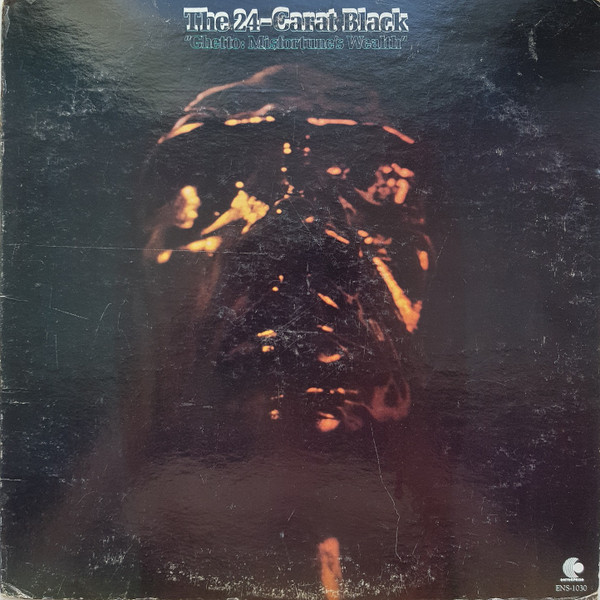
Dale Warren was basically Stax royalty because his uncle was Estelle Axton, but he didn't want to write radio hits. He took a group of teenagers from Cincinnati called The Dapps, renamed them, and dragged them into the studio to record a soul opera about the systematic crushing of the Black working class. The label didn't know what the fuck to do with a record that had more in common with a bleak stage play than a dance floor. It’s a heavy, nihilistic piece of work that makes most 'conscious' soul from '73 look like a Hallmark card. They tracked Ghetto: Misfortune's Wealth with massive orchestral arrangements that Warren wrote himself, leaning on his experience arranging for Isaac Hayes. The band was tight as a vice, but the record bombed because it was too honest and too cinematic for the charts. After the collapse of Stax, the master tapes for the follow-up sat in a basement for decades while the band evaporated into the humid Ohio air. It took thirty years for the crate-diggers and producers to realize Warren had mapped out the entire blueprint for cinematic hip-hop before the genre even had a name.
Bio from The Clerk
The Arc of 24‐Carat Black
The pivots — what forced 24‐Carat Black to reinvent.
The Stax Concept Experiment
Dale Warren moved the group from the funk-oriented backing work of The Dapps into a high-concept orchestral soul unit. Recording at Ardent Studios in Memphis, he utilized his background as an arranger to layer bleak, sweeping strings over deep-pocket grooves. The result was Ghetto: Misfortune's Wealth, a record that prioritized narrative flow over individual singles. It was a massive gamble for Stax that failed commercially, leaving the band stranded when the label's financial house started to burn down.
The Vault Years
After the Stax collapse in '75, the group's second album, Gone: The Promises of Yesterday, was shelved and left to rot in storage. The band splintered and Warren moved on to other arrangement gigs, leaving their most melodic work unheard for over three decades. When the Numero Group finally unearthed the tapes in 2009, it revealed a shift toward a more song-oriented, albeit still melancholic, soul sound. You can hear the transition from the sprawling social commentary of the debut to a more intimate, skeletal form of R&B that was decades ahead of its time.
Influences
- Isaac Hayes — Warren spent years as the primary orchestrator for Hayes at Stax, most notably on the Hot Buttered Soul sessions. You hear that same widescreen, symphonic approach to funk in the arrangements on Ghetto. It’s the sound of a student taking the teacher's formula to a much darker, more political place.
- James Brown — Before they were 24-Carat Black, they were The Dapps, the white-hot funk outfit that backed Brown on tracks like 'I Can't Stand Myself (When You Touch Me).' That disciplined, James Brown-enforced rhythm section is exactly why they could handle Warren’s complex orchestral shifts. They had the tightest fundamentals in Cincinnati.
- The Temptations — Norman Whitfield's 'psychedelic soul' era with the Temptations, specifically tracks like 'Papa Was a Rollin' Stone,' provided the atmospheric template. The use of long, moody intros and multiple vocalists trading verses on 24-Carat Black records mirrors Whitfield's cinematic production style. It moved the vocal group dynamic from the street corner to the film set.
- Curtis Mayfield — Mayfield’s score for Superfly set the standard for using soul music as a gritty, urban sociological report. Warren followed this lead by abandoning standard love songs for a concept-heavy look at poverty and addiction. The DNA of Mayfield's social realism is baked into every lyric on their debut.
- Burt Bacharach — Warren was obsessed with classical theory and high-level pop composition, often citing Bacharach as a master of the craft. You hear it in the weird time signatures and the sophisticated chord voicings that shouldn't work in a funk context. He wanted to prove that soul musicians could play as smart as any conservatory grad.
Discography
Their records — most-collected first.


Related artists
Members
Around the web
Follow every record they touch.
Start your shelf and Gatefold tracks 24‐Carat Black's new pressings, tour dates, and the whole discography — automatically.
Start your shelf →Free forever. Works with 10 records or 10,000.