
Artist
Rodgau Monotones
Germany
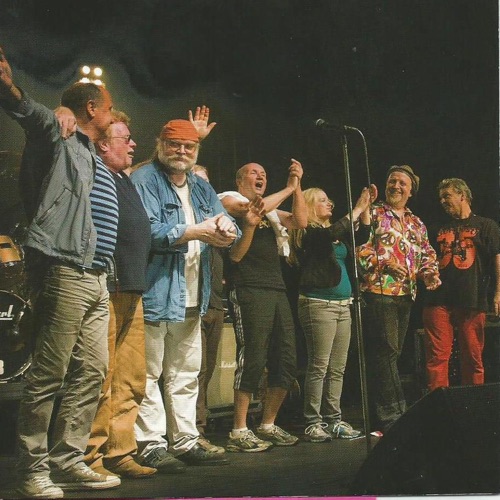
Rodgau Monotones is a music group from Germany. Their discography on Gatefold includes 8 records.
8
Albums tracked
2
In collections
—
Since
Biography
The Monotones didn't give a shit about the cool-kid aesthetics of the Neue Deutsche Welle. While everyone else in West Germany was buying synthesizers and cutting their hair into geometric shapes, these guys from Rodgau were lugging heavy Ampeg stacks and brass sections into the studio to make what was basically barroom R&B with a German accent. They leaned into a blue-collar, Hessian identity that should have been too local to travel, but then they hit the 1984 WDR Rockpalast stage and suddenly the whole country realized they were actually a tight-as-hell garage rock machine. By the late '80s, the joke started to wear thin as the production got that glossier, digital sheen common to the era. The shift from the raw energy of Volle Lotte! to the slicker sounds on Schön, reich und berühmt felt like a band trying to keep up with a industry that was moving toward pop-metal and high-end FM radio. They never quite lost their soul, but they definitely started spending more time in the editing suite than at the pub, and it shows in the compression of those middle-period records.
Bio from The Clerk
The Arc of Rodgau Monotones
The pivots — what forced Rodgau Monotones to reinvent.
The Hessen Invasion
Between '82 and '84, the band operated as a high-velocity pub rock outfit that accidentally became the voice of a region. Tracking Volle Lotte! with producer Ronald Prent gave them a massive, guitar-driven sound that made 'Die Hesse komme!' a genuine radio hit despite its dialect-heavy lyrics. It was the sound of a band that spent years playing American GI clubs, mixing classic rock 'n' roll structures with a deadpan, working-class humor.
The High-Gloss Pivot
By the time they reached 1988's Schön, reich und berühmt, the scrappy garage energy was swapped for the big-budget expectations of EMI. The lineup was stable, but the arrangements became increasingly complex, incorporating more session-style polish and a tighter, more commercial brass sound. You can hear the change in the snare hits and the way the guitars sit further back in the mix to make room for Hendrik Nachtsheim’s more polished vocal delivery.
The Late-Game Grind
After a massive hiatus and various side projects like Badesalz took off, the 2008 return with Ein Leben für Lärm saw them strip away the '80s artifice. They went back to being a heavy-hitting live act, prioritizing the interplay between Ali Neander’s guitar work and Peter Osterwold’s grit. It’s a louder, less ironic version of the band that focuses on the fact that they are simply one of the longest-running rhythm sections in the country.
Influences
- The J. Geils Band — The Monotones modeled their high-energy, harmonica-driven stage show directly on the J. Geils blueprint. You hear it in the frantic pace of 'Ei Gude Wie' and the way they use the brass section to punch through the guitar riffs.
- Dr. Feelgood — Before they were famous, the band was obsessed with the greasy, no-nonsense pub rock coming out of the UK. The sharp, staccato guitar work Ali Neander employed in the early '80s is a direct descendant of Wilko Johnson’s choppy style.
- The Rolling Stones — They’ve covered 'The Last Time' and 'Jumpin' Jack Flash' in their early sets to establish their rock 'n' roll bona fides. That loose, swinging rhythm section on the 1982 debut is a blatant homage to the Exile on Main St. era.
- Status Quo — The band has frequently cited the Quo's relentless boogie-rock shuffle as the foundation for their own songwriting. The heavy, repetitive guitar chugging on tracks like 'Frauen' is the German equivalent of the Rossi/Parfitt playbook.
- Wilson Pickett — The soul influence wasn't an accident; they grew up playing to American soldiers who demanded R&B. The Monotones' use of a heavy brass section was their way of injecting Stax-style power into a German rock context.
Discography
Their records — most-collected first.


Related artists
Around the web
Follow every record they touch.
Start your shelf and Gatefold tracks Rodgau Monotones's new pressings, tour dates, and the whole discography — automatically.
Start your shelf →Free forever. Works with 10 records or 10,000.