
Artist
Power Trip
US thrash metal/crossover band
Dallas, United States · Formed 2008
Power Trip is a music group from Dallas, United States, active since 2008. Their discography on Gatefold includes 5 records.

5
Albums tracked
72
In collections
2008
Since
Biography
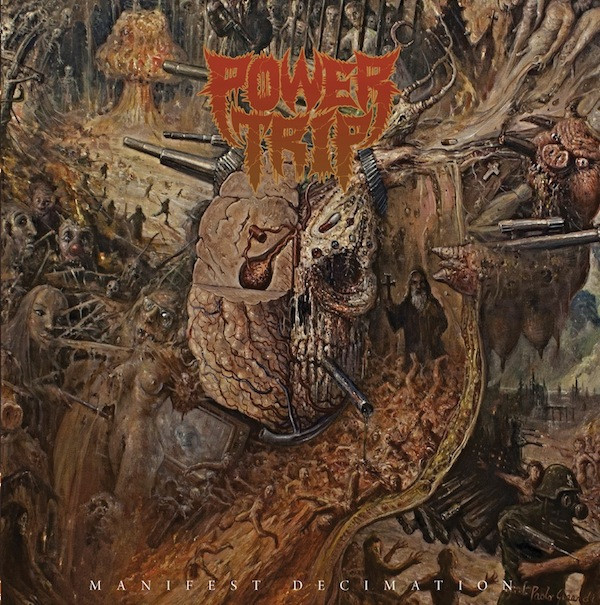
Riley Gale used to say he wanted to write a song as big as 'Enter Sandman' but with the ethics of a DIY basement show. They didn't start in a studio—they started in the Dallas hardcore scene, playing fast enough to piss off the metalheads and heavy enough to scare the punks. By the time they tracked Manifest Decimation with Arthur Rizk in 2013, they’d figured out how to make a modern record sound like a 1987 VHS tape found in a dumpster behind a Texas barbecue joint. It wasn't about being retro; it was about that specific, suffocating reverb and a guitar tone that felt like a serrated blade. They didn't sell out when the bigger labels came knocking. They stayed with Southern Lord because Greg Anderson understood that you don't polish a diamond this jagged. The band was a fucking unit—Blake Ibanez and Nick Stewart traded riffs that felt like heavy machinery while Chris Ulsh, who they poached from Mammoth Grinder, kept the drums sounding like a goddamn war zone. They were the first band in a generation that managed to get the guys in patch vests and the kids in windbreakers to stop hitting each other and start hitting the pit together.
Bio from The Clerk
The Arc of Power Trip
The pivots — what forced Power Trip to reinvent.
The 808 Hardcore Years
Before they were the kings of the festival circuit, they were a scrappy hardcore band experimenting with rap-influenced production on their 2008 demo and the Armageddon Blues EP. You can hear Marcus Johnson’s hip-hop leanings in the way those early tracks hit, using 808 sub-bass drops to punctuate breakdowns in a way that felt more like a warehouse rave than a thrash show. This era was defined by local Dallas shows and a raw, muddy sound that prioritized energy over technical precision. It was the sound of a band figuring out that you could be heavy as hell without adhering to the strict rules of any one subculture.
The Rizk Factor
Everything changed when the band linked up with producer Arthur Rizk at Solomon’s Gate to record Manifest Decimation. Rizk treated the guitars like industrial noise and drowned the vocals in a cavernous, artificial reverb that became the band's signature calling card. The transition was fueled by Blake Ibanez’s obsession with the 'big room' sound of early Metallica and Sepultura, but executed with a low-budget, gritty edge that avoided the sterile polish of modern metal. It turned Power Trip into a stadium-sized force that still smelled like a sweaty club basement.
The Nightmare Logic Ascent
By 2017, the band trimmed every ounce of fat off their songwriting, resulting in Nightmare Logic—the record that finally pushed them past the underground. They moved away from the sprawling, mid-tempo dirges of their debut in favor of lean, four-minute ragers designed for maximum carnage. The production got tighter, the solos got sharper, and Riley Gale’s lyrics pivoted from general angst to a sharp, satirical bite on social decay. This was the moment the industry realized a crossover thrash band could actually headline major stages without changing a single thing about their sound.
Influences
- Cro-Mags — Riley Gale constantly cited The Age of Quarrel as the gold standard for blending street-level aggression with heavy metal structures. You hear it in the rhythmic bounce of their breakdowns and the way they bridged the gap between the mosh pit and the headbanger.
- Exodus — Blake Ibanez has frequently pointed to the Gary Holt school of riffing as the primary blueprint for the band's dual-guitar attack. The frantic, percussive picking style on tracks like 'Executioner’s Tax (Swing of the Axe)' is a direct descendant of the Bonded by Blood era.
- Sepultura — The band toured with Max Cavalera and covered 'Arise,' showing their deep debt to the mid-period Brazilian thrash sound. The way Power Trip utilizes tribal-esque drum fills and low-end groove is pulled straight from the Schizophrenia and Beneath the Remains sessions.
- Integrity — The two bands shared a split 7-inch in 2016, and the influence of Dwid Hellion’s dark, apocalyptic hardcore is all over Power Trip's earlier EPs. They took Integrity's metallic hardcore DNA and injected it with a much higher dose of Bay Area thrash speed.
- Nuclear Assault — The band’s crossover appeal and political undercurrents mirror the 1980s East Coast thrash scene, specifically the grit of Nuclear Assault. You can hear that frantic, barely-contained chaos in the way they structured their fastest tracks, prioritizing speed and snarl over melodic comfort.
Discography
Their records — most-collected first.



Related artists
Around the web
Follow every record they touch.
Start your shelf and Gatefold tracks Power Trip's new pressings, tour dates, and the whole discography — automatically.
Start your shelf →Free forever. Works with 10 records or 10,000.