
Artist
Jo Privat
12th arrondissement of Paris, France • 1919 – 1996
Jo Privat is a musician from 12th arrondissement of Paris, France, active 1919–1996. Their discography on Gatefold includes 2 records.

2
Albums tracked
0
In collections
1919
Since
Biography
It would be difficult to find an accordion player who represented the classic mix of Parisian Musette and gypsy music more fully and with more joy than Jo Privat. His phrasing and musical sensibility is enchanting; creating in an instant, a beautiful Parisian cafe or dance-hall in the mind of any listener who closes his eyes and lets his thoughts wander where they will. Jo played with all the greats and can be heard on many albums - sometimes credited and sometimes not - but fans can recognize his musical voice.
The Arc of Jo Privat
The pivots — what forced Jo Privat to reinvent.
The Bal-Jo Residency
From 1937 onward, Privat anchored himself at the Bal-Jo, turning a small Parisian dance hall into the headquarters for the musette-jazz mutation. He spent decades refining a style that blended the traditional valse with the swing influence he picked up from the Django-adjacent crowd. This era is defined by the physical reality of the room—tight, loud, and requiring a rhythmic precision that wouldn't let the dancers miss a step. You hear this in his early recordings where the accordion isn't just melody, it's the entire engine of the track.
The Manouche Fusion
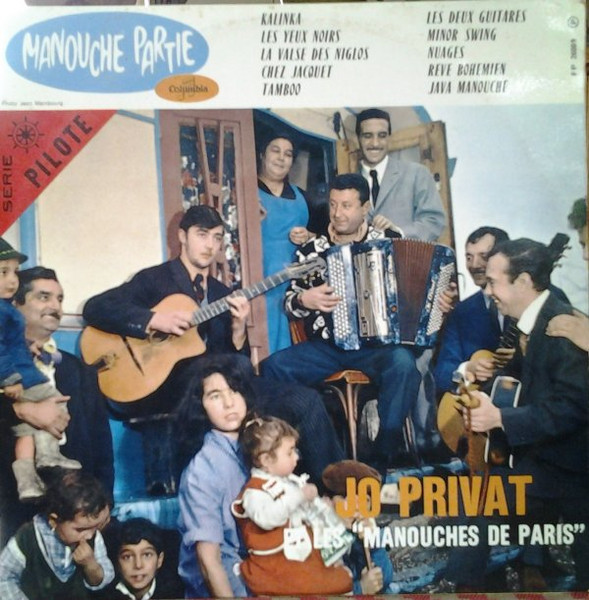
By the time he got to the sessions that would eventually lead to Manouche Partie, Privat had fully integrated the Sinti swing aesthetic into his repertoire. He brought in players like Matelo Ferret to provide that percussive, metallic guitar backing that transformed his sound from simple folk dance to sophisticated jazz. The accordion lines became more chromatic and aggressive, mirroring the bebop language happening across the Atlantic but keeping it rooted in the Parisian streets. This is the sound of a guy who realized his instrument could fly as high as any saxophone if he had the right rhythm section behind him.
Influences
- Django Reinhardt — Privat was a regular in the same Parisian circles and eventually hired Django’s closest collaborators, the Ferret brothers, for his own sessions. You hear it in the way Privat phrases his solos, mimicking the quick-fire arpeggios and rhythmic displacements of the Hot Club style. He took the gypsy jazz blueprint and mapped it onto the bellows of an accordion.
- Gus Viseur — Viseur was the first to really prove that the accordion belonged in a swing ensemble, and Privat took that baton and ran with it for five decades. The influence is evident in Privat’s move away from the 'whiny' musette vibrato toward a cleaner, jazz-focused tone. Without Viseur breaking the glass ceiling of the genre, Privat would have stayed a wedding singer.
- Jean Vaissade — Vaissade was the guy who popularized the 'musette' style in the 20s and 30s, providing the technical foundation Privat eventually modernized. Privat kept Vaissade's structural discipline but stripped away the polite veneer to make it hit harder. It's the DNA of the Parisian valse, just updated for a rowdier crowd.
- Matelo Ferret — A frequent collaborator and mentor-figure in the Manouche style who played on Privat's most essential recordings. Ferret's sophisticated harmonic sense pushed Privat to move beyond three-chord structures and into more complex, diminished territory. The interplay between them on record is a masterclass in tension and release.
- Émile Vacher — Vacher was the undisputed king of the early musette and the man who literally invented the genre's standard repertoire. Privat covered Vacher’s standards throughout his career, maintaining the fast-fingered 'style perlé' that Vacher pioneered. It's the baseline speed that Privat used as a springboard for his later jazz improvisations.
Discography
Their records — most-collected first.

Related artists
Frequent collaborators
Around the web
Follow every record they touch.
Start your shelf and Gatefold tracks Jo Privat's new pressings, tour dates, and the whole discography — automatically.
Start your shelf →Free forever. Works with 10 records or 10,000.