
Artist
ESCAPE‐ISM
United States
ESCAPE‐ISM is a musician from United States. Their discography on Gatefold includes 4 records.

4
Albums tracked
5
In collections
—
Since
Biography
Ian Svenonius recorded the first Escape-ism tracks on a four-track cassette recorder with nothing but a guitar, a microphone, and a primitive drum machine. This isn't a full band trying to sound sparse; it’s a veteran of the D.C. scene stripping every bit of artifice away until there’s nothing left but a rhythmic pulse and a sermon. After decades fronting The Nation of Ulysses and The Make-Up, Svenonius realized he didn't need the gospel-soul choreography or the post-hardcore chaos to get a point across. The gear is cheap and the fidelity is questionable, which is exactly why it works. Most people can't pull off the 'man and a machine' act without sounding like a demo tape that should've stayed in the drawer. Svenonius avoids that trap by leaning into the physical limitations of the hardware, treating the hiss of the tape and the stiff, mechanical thud of the drum machine as primary instruments. It’s performance art disguised as a garage-rock minimalist revival. He’s not playing to the back of the room anymore; he’s whispering and shouting directly into the red on the VU meter.
Bio from The Clerk
The Arc of ESCAPE‐ISM
The pivots — what forced ESCAPE‐ISM to reinvent.
The Found-Object Manifesto
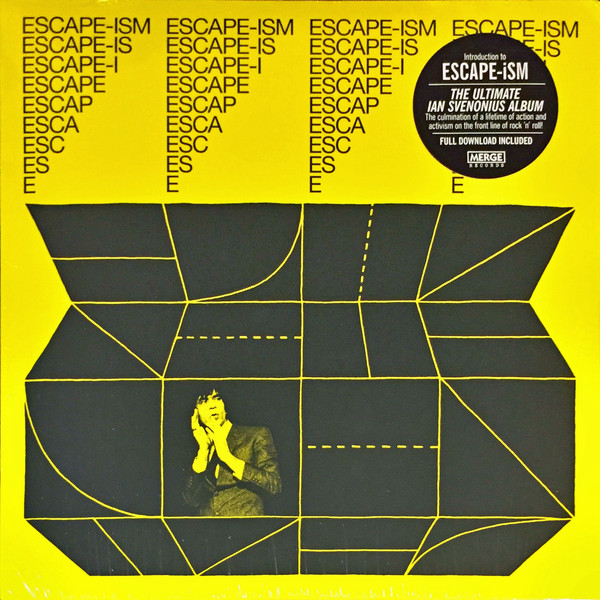
When Introduction to Escape-ism dropped on Merge in 2017, it felt like a sharp left turn from the polished indie production of the era. Svenonius tracked it with a single-minded focus on the ‘found-sound’ aesthetic, using repetitive loops that feel more like a haunted jingle than a standard song structure. You can hear the lack of a proper studio environment in the way the vocals sit right on top of the mix, dry and confrontational. It forced the listener to deal with the lyrics as a series of slogans rather than melodies, establishing a blueprint of anti-music that he’s poked at ever since.
Influences
- Suicide — Svenonius has explicitly cited the duo of Alan Vega and Martin Rev as the primary architects for his minimalist stage setup. You hear it in the way he uses cold, unwavering drum machine pulses as a backdrop for highly theatrical, Elvis-on-acid vocal deliveries. It’s the same confrontation-via-repetition tactic they used at CBGB.
- The Fall — The repetitive, circular guitar riffs and the 'prole-art-threat' delivery are straight out of Mark E. Smith’s playbook. Svenonius mirrors Smith’s penchant for using the microphone as a weapon of critique rather than a tool for singing. The lyrical density and the refusal to offer a traditional hook are total Fall moves.
- Public Enemy — Svenonius frequently references the 'Bomb Squad' production style and the rhetorical power of Chuck D in his interviews and books. He treats his lyrics like a broadcast, using the music as a high-frequency vehicle for a specific ideological message. It’s about the urgency of the noise more than the arrangement of the chords.
- Jonathan Richman — The stripped-down, 'Modern Lovers' approach to rock and roll—where the sincerity feels almost uncomfortable—is a huge part of the Escape-ism DNA. Svenonius shares Richman’s obsession with the primitive power of a basic rhythm and a simple idea. It’s the sound of someone refusing to grow out of the garage.
- James Brown — Even without a horn section, the 'on the one' rhythmic philosophy dominates these records. Svenonius has spent his entire career, from The Make-Up onwards, obsessing over the Godfather of Soul’s structural discipline. In Escape-ism, that influence is boiled down to the sheer, hypnotic repetition of a single groove held until it breaks.
Discography
Their records — most-collected first.


Around the web
Follow every record they touch.
Start your shelf and Gatefold tracks ESCAPE‐ISM's new pressings, tour dates, and the whole discography — automatically.
Start your shelf →Free forever. Works with 10 records or 10,000.