
Artist
Django Reinhardt
French jazz guitarist and composer
Pont-à-Celles, Belgium · 1910 – 1953
Django Reinhardt is a musician from Pont-à-Celles, Belgium, active 1910–1953. Their discography on Gatefold includes 24 records.

36
Albums tracked
65
In collections
1910
Since
Biography
A 1928 caravan fire fused the third and fourth fingers of his left hand together, leaving him with a grip that should have ended a career before it started. Instead, he worked out a system using his index and middle fingers for solo runs and his thumb for the bass notes, forcing a verticality and speed that no 'healthy' player could touch. He wasn't some refined conservatory project; he was a guy playing dance halls and street corners who accidentally reinvented the mechanics of the guitar because he had no other choice. When he teamed up with Stéphane Grappelli to form the Quintette du Hot Club de France, they did something suicidal for the 1930s: they ditched the drums and horns for an all-string ensemble. It turned the guitar from a background rhythm chugger into a lead instrument that could cut through a room with nothing but wood and wire. The guy was a total headache for promoters—skipping gigs to play billiards or go fishing—but the second he hit the strings, all that drama didn't matter. He played with a nervous, percussive energy that made the rest of the jazz world sound like they were stuck in mud.
Bio from The Clerk
The Arc of Django Reinhardt
The pivots — what forced Django Reinhardt to reinvent.
The Hot Club String Revolution
In 1934, the decision to strip the band down to just three guitars, bass, and violin changed everything for the European jazz scene. Without a drummer to hide behind, Django’s rhythm playing became an aggressive, percussive 'la pompe' style that drove the band forward like a piston. This era is defined by that acoustic crunch and the telepathic interplay with Grappelli, where every solo felt like a high-wire act. You hear it on the early 'Minor Swing' takes where the space between the notes is just as loud as the attack.
The Electric Pivot and the Ellington Tour
After the war, Django went to America to tour with Duke Ellington and had a rude awakening when he realized his acoustic Selmer couldn't compete with the volume of a modern big band. He started messing with early electric pickups and heavy Gibson archtops, a move that purists hated because it traded his crisp acoustic bite for a thicker, more distorted sustain. The recordings from this period show him struggling to find his footing in the new bop landscape, often playing at blistering speeds to overcompensate for the change in tone. It’s a messy, fascinating look at a master trying to catch up with a world that had moved on while he was stuck in occupied France.
The Rome Sessions and the Bop Turn
By the early 50s, Django had finally absorbed the language of Dizzy Gillespie and Charlie Parker, trading his older swing phrasing for jagged, chromatic bop lines. He returned to a smaller group format and leaned into a more fluid, amplified sound that felt closer to what the kids in New York were doing. These final sessions in Rome show a guy who had finally made peace with the electric guitar, playing with a relaxed, modern maturity that was light years away from the gypsy jazz tropes he’d invented twenty years earlier. It was a total stylistic overhaul that was cut short just as he was getting interesting again.
Influences
- Louis Armstrong — Django heard Armstrong's 'West End Blues' in the early 30s and it allegedly brought him to tears, prompting him to pivot from banjo-mandolin to serious jazz guitar. You hear it in the way he mimics Satchmo's trumpet phrasing and vibrato on his lead lines. He took the idea of the solo as a dramatic narrative directly from Louis.
- Eddie Lang — Lang was the first guy to prove the guitar could be a sophisticated solo voice in a jazz setting, and Django studied his duets with Joe Venuti religiously. The violin-guitar chemistry of the Hot Club is a direct expansion of the blueprint Lang and Venuti laid down in the late 20s. You can hear Lang’s chordal influence in Django’s early rhythm accompaniment.
- Duke Ellington — Django spent years obsessing over Ellington's arrangements, eventually touring with him in 1946. He treated his guitar like a miniature orchestra, often using thick, multi-voiced chords to replicate the density of Ellington’s horn sections. The sophisticated harmonic shifts in Django’s compositions like 'Nuages' are pure Ellingtonia.
- Nick LaRocca — As a member of the Original Dixieland Jass Band, LaRocca’s records were some of the first jazz imports to hit France after WWI. Django learned the basic vocabulary of syncopation and 'hot' playing by ear from these 78s. The frantic, high-energy pacing of his early work reflects that initial Dixieland exposure.
- Jean-Philippe Rameau — Django grew up with the sounds of French classical composers, and he specifically cited Rameau as a source for his melodic sensibilities. You hear this in his use of formal counterpoint and his tendency toward 'galloping' baroque-style runs. It’s the secret sauce that kept his playing from sounding like just another American jazz copycat.
Discography
Their records — most-collected first.

Django Reinhardt
1967
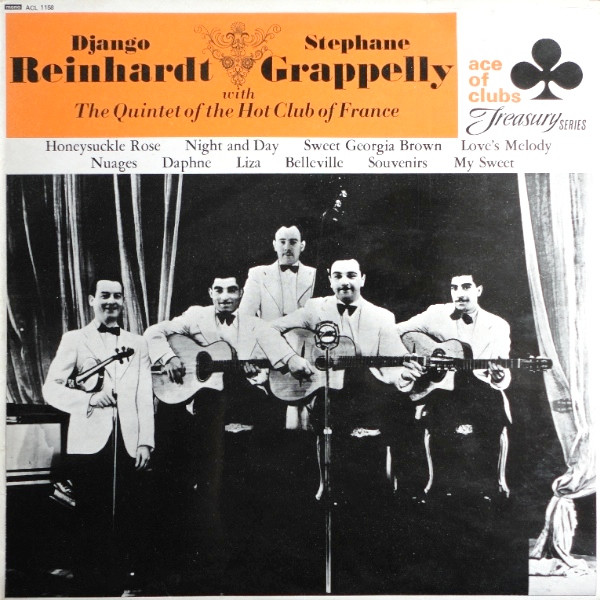
Django Reinhardt & Stephane Grappelly Avec Le Quintette Du Hot Club De France
1964
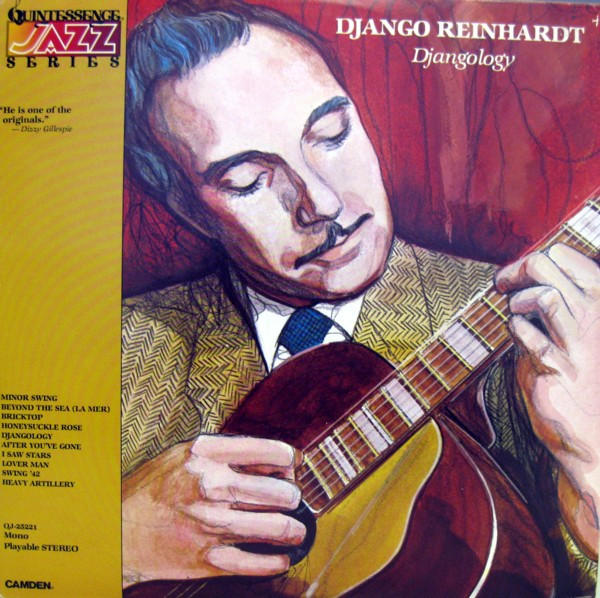
Djangology
1961

Best Of Django Reinhardt
1961

Django Reinhardt (Volume II)
1969

The Versatile Giant
1978

Django Reinhardt Joue Avec Les Guitars Unlimited
1968
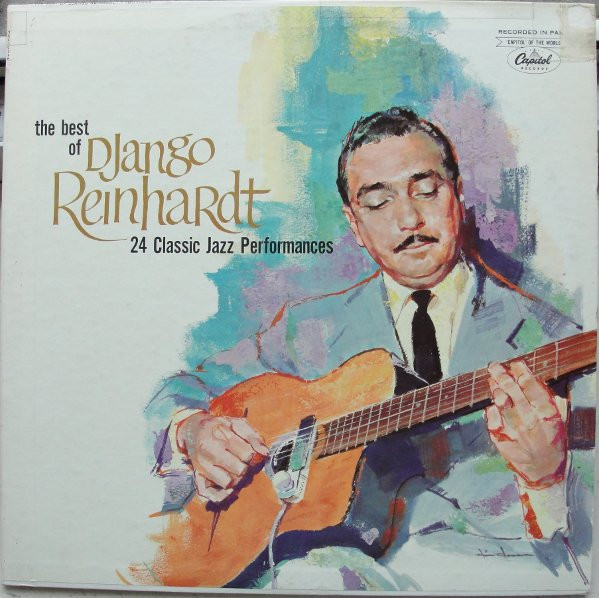
The Best Of Django Reinhardt
1960

Volume 2
1957
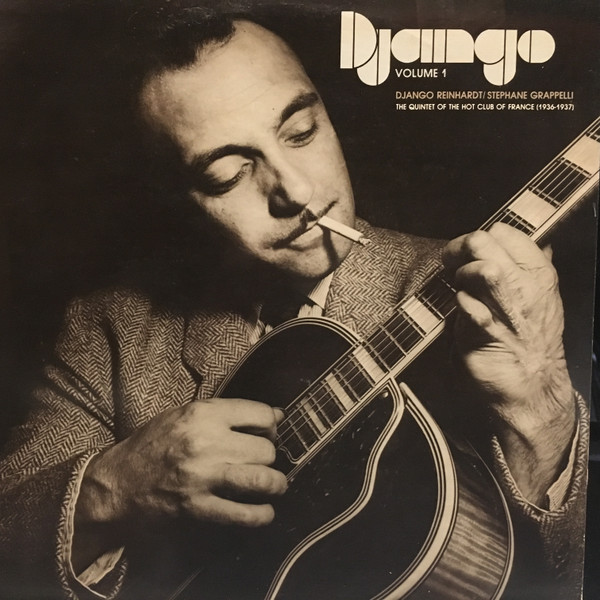
The Quintet Of The Hot Club Of France (1936-1937) Django Volume 1
1980

L'Inoubliable
1961
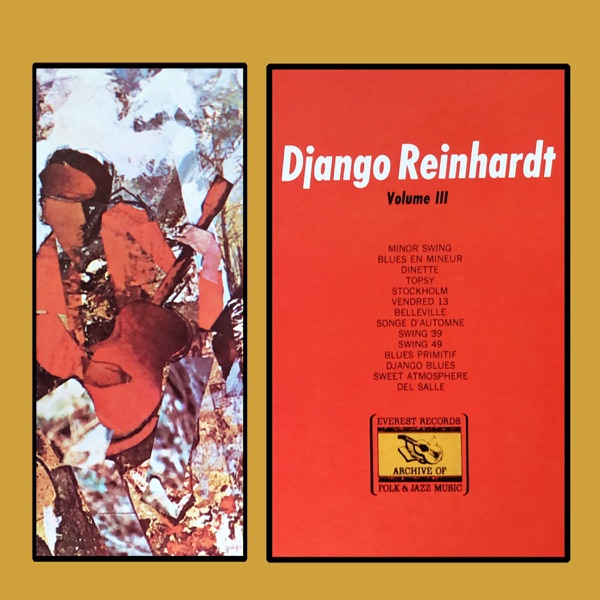
Volume 3
1958
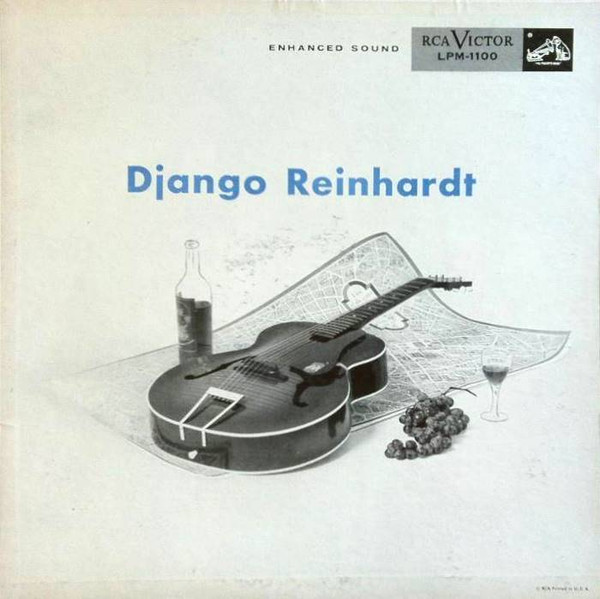
In Memoriam 1908-1954
1955
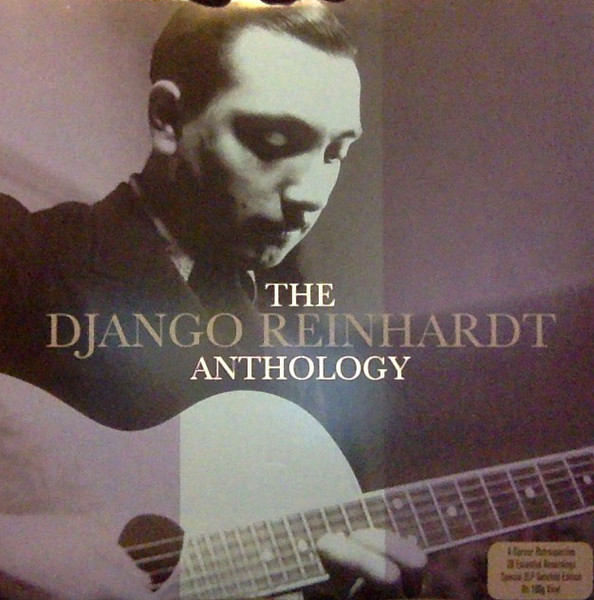
The Django Reinhardt Anthology
2009
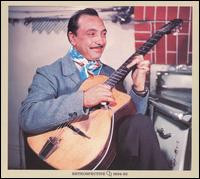
Rétrospective Django Reinhardt 1934-53
2003

Swing From Paris
1990

Django Reinhardt
1976

Django's Music
1974

Star Edition
1974

Djangologie 19
1971

Django, Mon Frère
1969

Paris 1945
1968

Concert À Bruxelles 1948
1964

Le Dernier Message De Django Reinhardt
1961
Related artists
Frequent collaborators
Around the web
Follow every record they touch.
Start your shelf and Gatefold tracks Django Reinhardt's new pressings, tour dates, and the whole discography — automatically.
Start your shelf →Free forever. Works with 10 records or 10,000.