
Artist
Baccara
Spanish female vocal duo, original lineup
Madrid, Spain · 1977 – 1981
Baccara is a music group from Madrid, Spain, active 1977–1981. Their discography on Gatefold includes 20 records.

20
Albums tracked
16
In collections
1977
Since
Biography
Rolf Soja heard two Spanish flamenco cabaret dancers singing for tourists in a hotel in Fuerteventura and decided they were going to be Europe's next disco monster. Mayte Mateos and María Mendiola barely spoke conversational English, but Soja and lyricist Frank Dostal parked them in a studio in Hamburg, drilled the vocal phonetics into their heads, and turned their heavy Spanish accents into the ultimate Euro-disco weapon. RCA dropped "Yes Sir, I Can Boogie" in 1977, and it shifted sixteen million copies on the back of lush strings, rigid Bavarian session grooves, and breathy whispered spoken-word intros. The polish was impenetrable for about two years. They had the crisp black-and-white visual identity down cold—Mateos in black, Mendiola in white—and every track was calibrated for maximum continental radio saturation. But by 1981, behind-the-scenes legal warfare over vocal mixes and royal payouts blew the entire operation apart. The duo fractured into competing touring versions, leaving behind a brief, absurdly tight run of late-seventies camp disco that defined the Munich-to-Hamburg studio axis.
Bio from The Clerk
The Arc of Baccara
The pivots — what forced Baccara to reinvent.
The Hamburg Disco Explosion
Producer Rolf Soja signed the duo straight out of hotel lounges and paired their accented, breathy delivery with rigid German studio musicianship. The self-titled 1977 debut and 1978's 'Light My Fire' produced monolithic hits like 'Yes Sir, I Can Boogie' and 'Sorry, I'm a Lady', relying on clean four-on-the-floor stomps and glossy orchestral disco charts. They owned European television and charts through meticulously coordinated black-and-white gowns and high-camp theatrical choreography.
Eurovision and Pop Ambition
Representing Luxembourg in the 1978 Eurovision Song Contest with 'Parlez-Vous Français?' proved they could operate in high-stakes pop pageantry without breaking character. They leaned harder into dramatic European pop balladry on 1979's 'Colours', attempting to stretch past club anthems into adult contemporary orchestrations. The tracks sounded bigger and more ornate, but the European disco market was already beginning to cool around them.
The Mix Lawsuit and Fracture
The wheels came off entirely during the recording sessions for the 1981 single 'Sleepy-Time-Toy'. Mendiola was furious that her vocal track had been dropped low in the mix compared to Mateos, leading to a bitter lawsuit against RCA and Soja. The resulting album, 'Bad Boys', flopped commercially while the legal dispute drained the partnership dry, causing the original lineup to permanently split into rival touring acts by the end of 1981.
Influences
- Silver Convention — Producer Michael Kunze proved the Munich Sound model—German studio arrangements backed by theatrical female vocals singing minimalist English lyrics—could conquer world charts. Baccara's entire Hamburg production style was modeled directly on this high-gloss Euro-disco framework. You hear it immediately in the sweeping string arrangements and metronomic four-on-the-floor backbeats of their 1977 debut.
- ABBA — The Swedish powerhouse set the gold standard for twin female vocal leads driving high-energy continental European pop throughout the mid-seventies. Baccara built their image and vocal interplay around the same two-woman contrast, trading verses before locking into unison harmonies. Tracks like 'Sorry, I'm a Lady' borrow heavily from ABBA's precision hook delivery.
- Donna Summer — Summer's groundbreaking work with Giorgio Moroder in Munich proved that breathy, whispered, sexually charged vocals could drive European club records to multi-platinum status. Mateos and Mendiola lifted that exact whispered vocal approach for the spoken intro to 'Yes Sir, I Can Boogie'. It became their absolute sonic calling card across all four of their studio records.
- The Doors — Baccara tackled Jim Morrison's classic 'Light My Fire' as the sprawling title track of their 1978 sophomore album. They retooled the psychedelic rock standard into an extended, uptempo Euro-disco suite layered with orchestral stabs and dancefloor percussion. It proved their producers were mining late-sixties American rock staples to keep the dancefloor catalog moving.
- Lola Flores — Both original members were formally trained Spanish folk and flamenco dancers before ever cutting a record. That dramatic Spanish copla and cabaret performance style formed the backbone of their sharp stage presence, hand choreography, and visual drama. You hear that theatrical flair bleeding straight into their accented phrasing on dramatic numbers like 'Cara Mia'.
Discography
Their records — most-collected first.
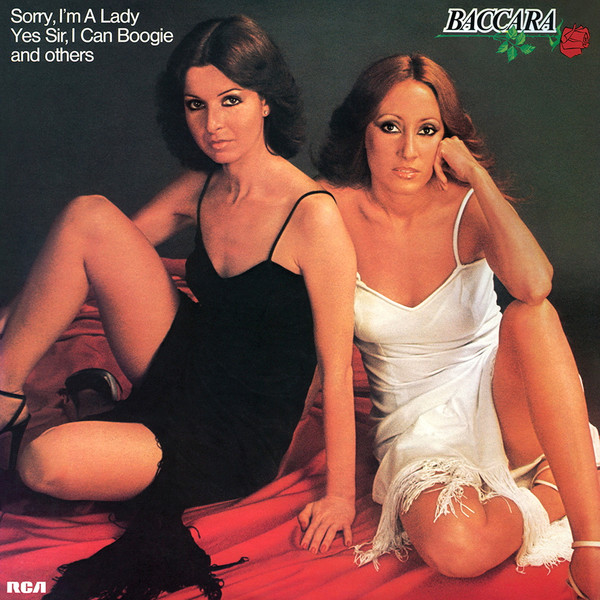
Baccara
1977
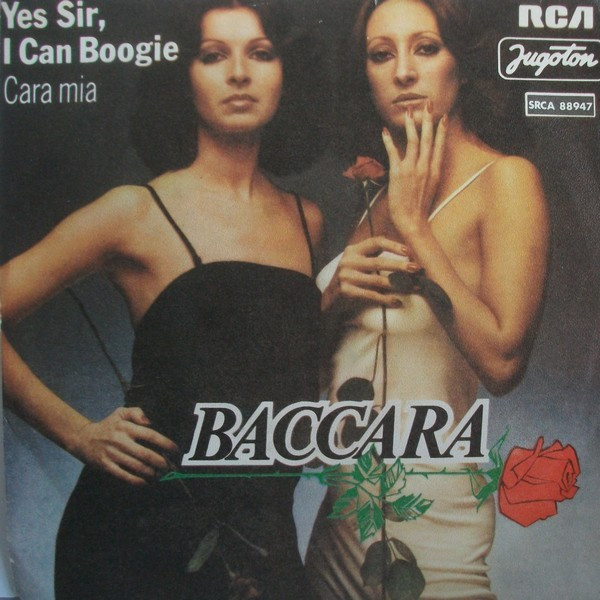
Yes Sir, I Can Boogie
1977
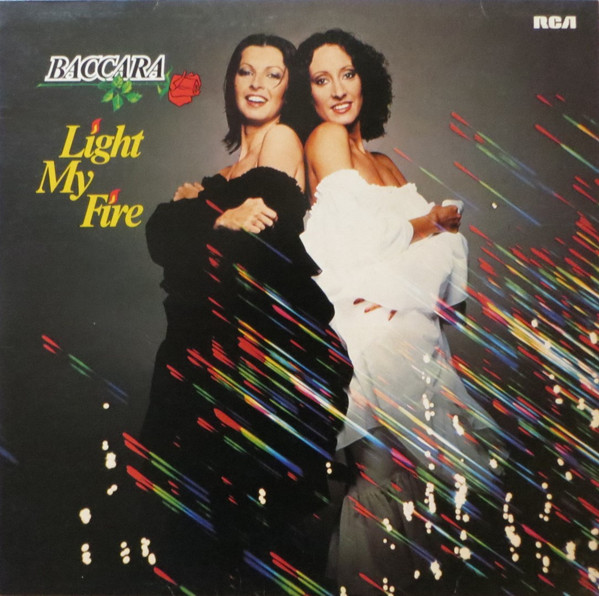
Light My Fire
1978

Colours
1979

Darling
1978

Sorry, I'm A Lady
1977

Evolution
2025

I Belong To Your Heart
2017

Satin ....... In Black & White
2008

Greatest Hits & Remixes
2007

Soy Tu Venus
2004

New Projects (Hits & Unreleased Tracks)
2003

Greatest Hits 2003
2003

Made In Spain
1999
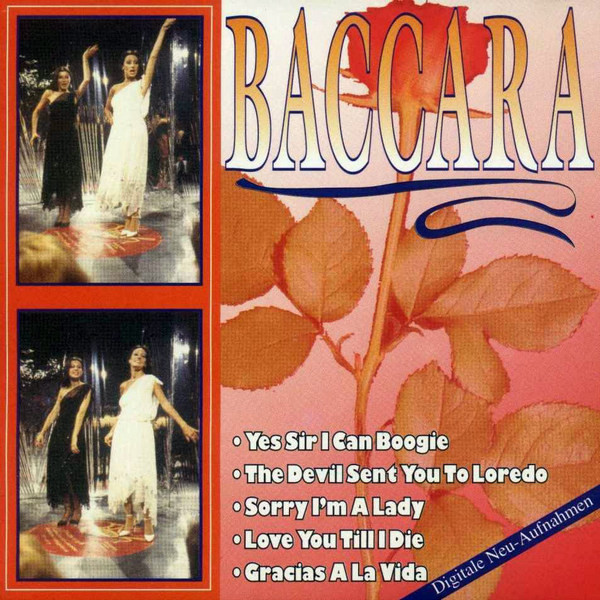
Our Very Best !
1994

The ★ Collection
1993

Bad Boys
1982
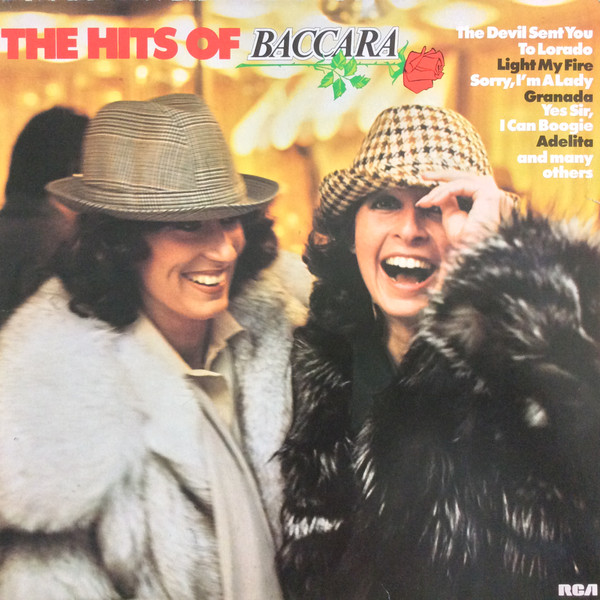
The Hits Of Baccara
1978

Discomania

Star Gala - Yes Sir, I Can Boogie
Related artists
Around the web
Follow every record they touch.
Start your shelf and Gatefold tracks Baccara's new pressings, tour dates, and the whole discography — automatically.
Start your shelf →Free forever. Works with 10 records or 10,000.