
Artist
Allan Sherman
Chicago, United States · 1924 – 1973
Allan Sherman is a musician from Chicago, United States, active 1924–1973. Their discography on Gatefold includes 14 records.

14
Albums tracked
9
In collections
1924
Since
Biography
Warner Bros. Records took a massive gamble in 1962 when they let a fired television producer record a live set of song parodies in a Hollywood living room with just a grand piano. Jimmy Hilliard produced that first session. He captured the raw, echoing room sound of drunk industry insiders losing their minds at Jewish cultural parodies. Allan Sherman wasn't a musician. He was an executive who realized that post-war suburban anxiety was hilarious when set to traditional folk tunes and classical standards. He sold millions of records in a matter of months. He did it by weaponizing specific, mundane mid-century middle-class details like asthma, summer camp food, and tax audits. The industry tried to treat him like a fleeting novelty act. Warner Bros. spent a fortune on lush orchestral arrangements by Lou Busch to turn him into a mainstream variety star. The bigger the budget got, the faster the intimate, backyard-barbecue magic of his delivery vanished into the studio woodwork.
Bio from The Clerk
The Arc of Allan Sherman
The pivots — what forced Allan Sherman to reinvent.
The Living Room Tapes
The 1962 debut My Son, the Folk Singer was cut in a cramped room filled with Sherman's personal friends and Warner Bros. staff to guarantee laughs. Lou Busch kept the musical arrangements stripped to the absolute bone so the dense, hyper-specific lyrical gags wouldn't get buried. Sherman's delivery relies on a conversational, slightly winded rhythm that makes him sound like a funny guy holding court at a suburban cocktail party. You hear the raw room reflections, clinking glasses, and genuine, unedited laughter that made the record feel like an inside joke the whole country wanted in on.
The Orchestral Expansion
By late 1963, Warner Bros. moved Sherman into major studios with full orchestral backing to sustain his massive chart momentum. My Son, the Nut featured massive, slick string arrangements and brass sections designed to mimic Broadway and classical pomp. This is where he cut 'Hello Muddah, Hello Faddah!' over Ponchielli's 'Dance of the Hours,' matching his nasal gripes against a perfectly executed, cinematic march. The humor shifted from insular Jewish cultural jokes to broad, universally accessible parodies of suburban consumerism and childhood misery.
The Variety Show Decline
By 1965, the public's appetite for novelty records was cratering under the weight of the British Invasion. Sherman tried to pivot with My Name Is Allan, utilizing high-concept parodies of movie themes and show tunes that lacked the sharp bite of his early material. The production got colder and more sterile as Warner Bros. pushed him toward the safe, family-friendly television variety show format. His voice sounds visibly tired on these tracks, buried under overly polite, professional backing vocals that stripped away his amateur charm.
Influences
- Gilbert and Sullivan — Sherman studied the rapid-fire lyrical structures and complex internal rhyme schemes of these Victorian operetta writers. You hear this direct influence in the machine-gun delivery of 'The Bronx Bird Watcher' and his habit of cramming dozens of multi-syllabic names into tight rhythmic spaces.
- Mickey Katz — Katz pioneered the post-war Yiddish-English parody genre on Capitol Records in the 1940s and 1950s. Sherman took Katz's formula of adapting popular swing hits for Jewish-American audiences but stripped out the klezmer instrumentation to make it palatable for mainstream radio.
- Tom Lehrer — Lehrer proved in the 1950s that highly intellectual, satirical songwriting could find a massive commercial audience outside the nightclub circuit. Sherman took Lehrer's dry, piano-and-vocal template and traded the academic cynicism for warm, self-deprecating suburban neuroses.
- Spike Jones — Jones and his City Slickers pioneered the art of destroying serious classical and popular arrangements with comedic timing and sound effects. Sherman borrowed Jones's approach of using formal, highly disciplined studio orchestras to play completely ridiculous slapstick arrangements.
- Harry Belafonte — The late 1950s folk boom spearheaded by Belafonte provided the exact source material Sherman needed for his debut parodies. Sherman directly targeted Belafonte's massive hit 'Calypso' for his own food-obsessed parody 'Seltzer Boy,' copying the rhythmic delivery of the original.
Discography
Their records — most-collected first.
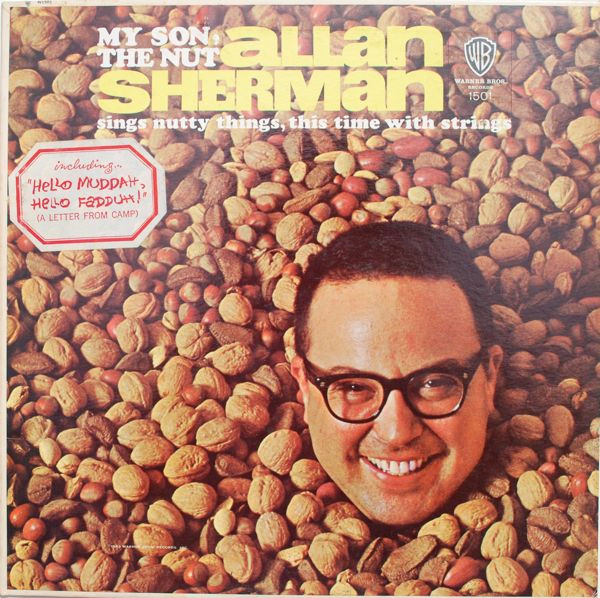
My Son, The Nut
1963

My Son, The Celebrity
1963

Allan In Wonderland
1964
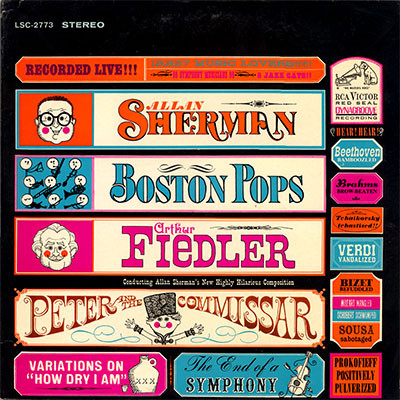
Peter And The Commissar
1964

Hello Mudduh, Hello Fadduh! (A Letter From Camp) / (Rag Mop) Rat Fink
1963

My Son, The Folk Singer
1962

My Son, The Greatest: The Best Of Allan Sherman
1988

A Gift Of Laughter - The Best of Allan Sherman Volume II
1986

The Very Best Of Allan Sherman
1976

Togetherness
1967

My Name Is Allan: Allan Sherman Sings Great Movie Hits & Songs From The Cutting Room Floor
1965

The Best Of Allan Sherman
1965

For Swingin' Livers Only!
1964

My Son, The Nut Vol. 1
1963
Related artists
Frequent collaborators
Around the web
Follow every record they touch.
Start your shelf and Gatefold tracks Allan Sherman's new pressings, tour dates, and the whole discography — automatically.
Start your shelf →Free forever. Works with 10 records or 10,000.