
Album
The Nearer The Fountain, More Pure The Stream Flows
2021 · Rock, Pop
15 collectors on Gatefold own this
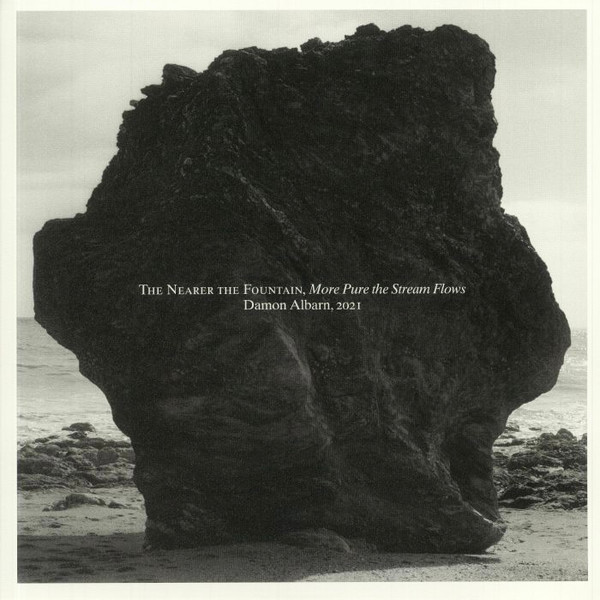
The Nearer The Fountain, More Pure The Stream Flows is a Rock album by Damon Albarn, originally released in 2021. On Gatefold: 10 pressings tracked, owned by 15 collectors.
About
The view from the living room of Damon Albarn’s home near Reykjavik is striking. Beyond the black-sand beaches and North Atlantic water, Esja, a volcanic mountain range, cuts across the skyline. Around it, the Icelandic weather regularly puts on a show. “It’s always extreme there,” Albarn tells Apple Music. “It doesn’t exist in a meteorological platitude.” Toward the end of 2019, Albarn gathered an orchestral ensemble to sit at his window and chart the landscape, wildlife, and climate in music. Three sessions were recorded before the pandemic stalled the project. Relocating to his UK home in Devon, Albarn found he just couldn’t let those musical improvisations lie dormant until lockdown loosened. “They were such a strong thing,” he says. “It’s like a potion—I kept taking the cork top off to sip for a minute, maybe just smell it. At one point, I was like, ‘I’m just going to drink this now and use it to do something.’ So, I did like Asterix, and I made <i>The Nearer the Fountain, More Pure the Stream Flows</i>.” Assisted by longtime collaborators Mike Smith and Simon Tong, Albarn transformed the music into his second solo album—11 unhurried reflections on loss and fragility. “The fragility is the humans’ place within nature,” he says. “And the loss is the transferal of everything. Nothing’s lost. The thing changes, it doesn’t actually disappear—it just has a different state or form.” With its vivid sense of place and transformation, the record recalls two of Albarn’s recent projects: Gorillaz’s <i>Meanwhile</i> EP and The Good, the Bad & the Queen’s <i>Merrie Land</i>. “The older you get, depending on your circumstance, the more acutely you feel these things,” he says. “I’m making music for young people at a rather advanced age for someone making music for young people. People of my own age, it’s kind of, ‘Yeah, well, that’s how I feel as well.’ Whereas for younger people, it’s like, ‘Well, that’s a strong flavor,’ but it’s not a bad thing.” Here, he takes us through the album, track by track. <b>“The Nearer the Fountain, More Pure the Stream Flows”</b> “I’d had that phrase for a while and thought that was a good working title for the Icelandic project. It was only in Devon at the end of [2020] that I realized where it had come from fully—I’d obviously read the poem [John Clare’s ‘Love and Memory,’ adapted here] at some point. And that poem just felt like it worked weirdly with the nature. John Clare was a very natural poet, working-class. [What I was getting from the poem] was ‘the dark journey,’ and you can’t just wipe out the memory of somebody. It’s a very emotional negotiation you go on when someone’s left your life: You’ve lost something, but you retain what you choose to retain, and that can be a beautiful thing as well.” <b>“The Cormorant”</b> “For years, I was scared of swimming out into the bay [in Devon]. I sort of conquered that fear at the beginning of lockdown and started to do it as a daily meditation. Sometimes I got myself in quite a lot of trouble because it was too rough. I did have one point where I thought, ‘I’m going to drown.’ But I love doing it, because although the fear of being devoured by a shark or whatever has diminished, it’s still there a little bit, so it’s quite an edgy thing to do every day. That’s just the first two lines of that song. It’s a deep song, a whole novel in itself really. I was sitting on the beach, and I had my phone. I recorded the whole of the vocal line, music and words, without really anything in my head. It was more of a sung conversation with myself and the cormorant and the water and everything that’s taken place on that beach over 25 years. I love that about the beaches—I’m there on my own, I can just bring everyone who’s ever been there with me and all the thoughts I’ve got. It's important for all of us to have somewhere where you can somehow gather your thoughts.” <b>“Royal Morning Blue”</b> “[When rain turns to snow], suddenly everything goes in slow motion and beautiful geometric patterns start to appear and the world feels reborn in a way. Even the most desolate of landscapes after a big snowfall are perfect. It’s such an ephemeral thing though. It’s the same water but transformed for a moment.” <b>“Combustion”</b> “This is part of a much bigger thing. I think it’ll be developed more when I do it with the orchestra in February [2022] and I’m reunited with my musicians from Iceland. The record will transform again, the space in between the singing will be much greater, to return it more to its meditation on this perspective that musicians and myself were allowed by being there and playing in real time.” <b>“Daft Wader”</b> “[It’s inspired by] Zoroastrian sky burials. And the public mourning of martyrs. It’s a very big part of Shia religion, martyrdom. Problematic. And same with Sunni. It’s problematic, but it just struck me how it was very beautiful seeing communities all sitting together, drinking fruit juice and coffee, and being really peaceful publicly. Because it’s always kind of invested with such drama and violence, their religious festivals—we’re taught to fear them, and not understand it and not be sympathetic. I’m very lucky: I’ve been to Iran, and it has its issues, but it’s a very civilized place.” <b>“Darkness to Light”</b> “Dawn is so much later in the winter [in Iceland]. It’s like half-10, maybe even 11 o’clock. Dawn is in the working day. So, it’s a lot of time making this record in that state, which is something I grew to understand more about when I was doing <i>Dr Dee</i> [a 2011 opera about Elizabethan polymath John Dee] because the time between dusk and night, and night and dawn, was the favored time of the day to commit to magical practice. That’s where all the good spells are cast.” <b>“Esja”</b> “This is the outline of the mountain, and it moves with the contours around a certain harmonic destination. You’ve got to give [the musicians] some sort of harmonic destination. Once you start saying, ‘Play in a certain way,’ you’re missing the point. It’s how they feel once they start to tune in to just staring, and not thinking about what you’re playing. So, listening, being sensitive to each other. It’s like everyone’s got a paintbrush—and how do we keep moving but somehow inhabit our points of view? When I was writing over the top, it made it easier having this harmonic reasoning behind all of this abstract stuff.” <b>“The Tower of Montevideo”</b> “I’ve made it. I’ve swum past the buoy to the uncharted cruise ship [first mentioned in ‘The Cormorant’], and I’ve met fellow musicians, or stowaways or refugees, emotional refugees, and we’ve formed a band and we’re playing these songs to nobody. I’ve had a bit of an obsession about music in empty clubs for a long time. To make music for an audience is a true joy, but be careful, because modern consumption of music is killing us musicians slowly. It’s a long, protracted death, but it’s happening.” <b>“Giraffe Trumpet Sea”</b> “This is a song about flying back to London and looking down—there were a few clouds, a night city—and feeling like I was at the bottom of some ocean, that it was gold treasure. Giraffe trumpets are the cranes. When they’re resting, they look like they’re sort of giraffes. Half-giraffe, half-trumpet, sending out beautiful sounds to the universe. But I left out all the words. I think it was too distracting at that point in the record to go off on another tangent and another story, but I liked the music and I liked the title.” <b>“Polaris”</b> “‘Polaris’ reminds me of that anxiety I felt in the ’80s around Greenham Common [RAF air base housing cruise missiles under Britain’s Polaris nuclear weapons program]. That understanding that we had as kids of that age, that nuclear war was a very real thing, and we were quite scared. ‘Polaris/Watching the embers fall.’ That’s after a nuclear attack. And then the next bit—‘Joining the saline to start the inspection’—is me zoning in on the oystercatchers in Devon when the tide goes out. Seeing them in an <i>Animal Farm</i> kind of way: They’ve become the rulers. They’re black and white, and their red eyes—kind of this uniform. And waiting for the saline to clear so they can eat. And the other birds have to wait in their line before they’re allowed to go and do anything. So, ‘Polaris’ is an ominous word. But it’s the Polar Star as well, which is something that’s been used by anyone who’s gone to sea. It’s saved many people.” <b>“Particles”</b> “[A rabbi Albarn met on a flight] was fleeing certain particles. But she said the particles are looking for you in the universe. They are attracted to you. You cannot stop anything. We moved on to the conversation of Trump, and she said he’s a perfect example of a particle in that you can’t escape it, but it’s benign in a sense because it’s just going to come and cause great disruption and then disappear, and other things will come out of it. And that is true of the universe. Firstly, nothing disappears; it just changes. And secondly, there is no sadness because everything is evolving. And it’s only us who want to find some meaning to it. And that’s why we become sad—because when we can't find meaning to things, we’re sad. And that’s just being a good old-fashioned Homo sapien.”
via Apple Music
The Clerk says
The Clerk knows this whole record — the pressing quirks, the credits, the take.
Tracklist
Side A
- A1The Nearer The Fountain, More Pure The Stream Flows5:00
- A2The Cormorant4:21
- A3Royal Morning Blue3:12
- A4Combustion2:53
- A5Daft Wader3:28
- A6Darkness To Light2:59
Side B
- B7Esja3:41
- B8The Tower Of Montevideo4:19
- B9Giraffe Trumpet Sea1:51
- B10Polaris4:45
- B11Particles3:21
Sound DNA
- Rock
- Art Rock
- sparse
- meditative
- cinematic
Notes from the original pressing. Later editions may differ.
This version was pressed by "Optimal Media GmbH".
Here is the version in which there is no reference to the press shop in the runouts ---> The Nearer The Fountain, More Pure The Stream Flows (2021) (opens in a new tab)
Includes a printed inner sleeve.
Limited copies signed by Damon, were made available via Recordstore.co.uk. These were unsealed.
Limited copies with an art card that Damon signed with his thumb or fingerprints were also available via Music on Vinyl in the UK
Tracks are numbered sequentially across sides on the release.
Mixed [...] at Studio 13 London
Mastered [...] at Metropolis Studios London
Recorded at Studio 13 London, Staðahverfi Reykjavik, Studio 13 Devon
Field Recordings:
A1: Ocean at Hellnar
B7: Ocean at Hellnar
B8: Ocean at Hellnar and Wind Outside House
B10: Birds Close to the Beach
B11: Under the Waterfall
The Nearer The Fountain, More Pure The Stream Flows from Love & Memory by John Clare (1829)
Polaris: Contains a Snapchat from Einar Benediksson
P+C 2021 13
In the runouts, the usual Optimal Media GmbH marks like "1|X" are mirrored.
Credits
The people behind it.
Performers
- Alexina HawkinsVIOLA
- Alexina HawkinsVIOLA
- André de RidderVIOLIN
- Bergrún SnæbjörnsdóttirFRENCH HORN
- Caimin GilmoreDOUBLE BASS
- Carol JarvisBASS TROMBONE
- Damon AlbarnACOUSTIC GUITAR ACOUSTIC GUITAR, PIANO, ELECTRIC PIANO , MONOCHORD, ELECTRIC ORGAN ACOUSTIC GUITAR, PIANO, ORGAN , ELECTRIC PIANO , MONOCHORD
- Einar ÖrnVOCALS , WRITTEN BY
- Josephine StephensonCELLO
- Laura NygrenDOUBLE BASS
- Mike SmithELECTRIC ORGAN ORGAN SAXOPHONE
- Rakel Björn HelgadóttirFRENCH HORN
- Rakel Bjõrn HelgadóttirFRENCH HORN
- Romain BlyFRENCH HORN MARIMBA
- Samuel EgglentonBASS GUITAR DRUM PROGRAMMING
- Shelley SörensenVIOLA
- Sigrún JónsdóttirTROMBONE
- Sigrún Kristbjörg JónsdóttirTROMBONE
15 collectors on Gatefold own this · 10 pressings tracked on Gatefold
Start your shelf.
Track your pressings of The Nearer The Fountain, More Pure The Stream Flows, get the Clerk's take, and see what the record is worth — free.
Start your shelf →Free forever. Works with 10 records or 10,000.