
Album
The Man Who Sold The World
1970 · Rock
88 collectors on Gatefold own this
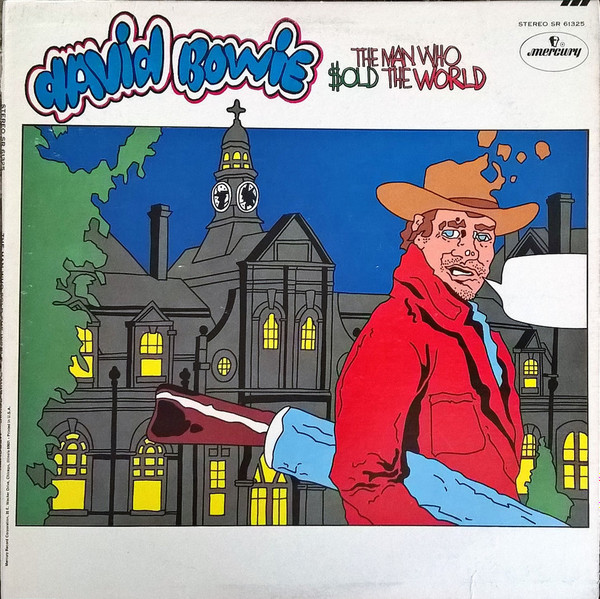
The Man Who Sold The World is a Rock album by David Bowie, originally released in 1970. On Gatefold: 268 pressings tracked, owned by 88 collectors.
About
The first thing that comes to mind when Tony Visconti thinks back to the making of <i>The Man Who Sold the World</i>—his second collaboration with David Bowie—is the band and their partners and wives crammed together in a flat at Haddon Hall, a Victorian mansion in South London. “There were seven of us and only two bedrooms,” the producer, who also played bass on the record, tells Apple Music. “People were sleeping all over the place: on floors or upstairs in this little gallery. We had a rehearsal space in the wine cellar, and that’s where we put the drum kit and the amps.” The result—despite Bowie’s third album being a commercial disappointment upon its release in 1970—has come to be regarded as the start of a classic phase for the king of reinvention. Featuring the first appearances of guitarist Mick Ronson and drummer Woody Woodmansey in his band, <i>The Man Who Sold the World</i> mixed hard-rock grooves with a theatrical swagger—and set a blueprint that Bowie would hone as the decade progressed. “We now know it was the beginning of an idea that David didn’t stop exploring,” says Visconti. “I think this album gave birth to <i>Ziggy Stardust</i>. That was the sound that we were getting on <i>The Man Who Sold the World</i>. We were almost there. The seed was planted in all of our minds to go in that direction.” To commemorate its 50th anniversary, Bowie’s third album is here reissued under its original intended title, <i>Metrobolist</i>, with a new mix by Visconti. Revisiting the album’s nine tracks gave the producer the opportunity to push sonic boundaries further than the group’s finances allowed in 1970. “The whole object of remixing an album that old is to use new technology and make it sound fantastic, with tools that we didn’t have in the old days,” he says. “But I can’t forget the ethics we had in the old days around how things should sound.” The only song that remains untouched on the new mix is the atmospheric ballad “After All,” both because Visconti believed it couldn’t be improved and because he couldn’t locate the original tapes. “David has a vault somewhere and nobody can find it,” he teases. “He must have hundreds and hundreds of multi-tracks." Here, Visconti talks us through reworking <i>The Man Who Sold the World</i>, one song at a time. <b>The Width of a Circle</b> “This was probably the only song in our repertoire that we had experienced playing in front of an audience. It felt like an opener. There are three distinct parts of this song. We were playing the front part live, then the middle part where it has that interlude was part of a jam. We were never satisfied with the way this song originally ended, so I remember we said, ‘Let's do a part two.’ Which is that little ethereal part in the middle, and then it goes into that boogie thing for the whole third part. That was invented on the spot. We jammed that for about an hour or two, and when we finished, we said, ‘Oh my god, this is the way it's supposed to be. This is the way we should have played it on stage.’” <b>All the Madmen</b> “I'd say half the album was rehearsed and the other half was created on the spot. ‘All the Madmen’ was created on the spot in the studio. After David put down the 12-string guitar and a rudimentary vocal, Woody, Mick, and I overdubbed our parts. That's the way The Beatles were doing it at the time. It turned out to be really, really successful. It’s got a lot of texture in it—more than in ‘The Width of a Circle’—and it really sounds like a grand production. As a band, we were all on the same level and there was certainly a musical chemistry.” <b>Black Country Rock</b> “‘Black Country Rock’ was a jam. We didn't have enough material to record and we had to go in and make an album. We started jamming on those chords, and then I played some funky stuff on the bass and Woody got funky. We put the whole track down and David and the four of us looked at each other: 'What is it? What did we just create?' And because it was funky, somebody said, ‘It’s kind of Black.’ And they said, ‘Yeah, but it's country.’ Then ‘But it's rock.’ And David got out his notepad and I swear he wrote the lyrics on the spot.” <b>After All</b> “This was another song that was done à la carte. Again, David did his acoustic guitar and vocal and then we just had to figure out what was going to go on it afterwards. It took a bit of time. It was recorded in a whole day, which was a luxury for one song, because in those days you usually did two or three songs in a session. It was piecemeal. There were recorders on it and I played three basses. Slowly, the song built up, and we loved it in the end. And again, David struggled to write the lyrics. He had a ‘la, la, la’ lyric for about a day or two before he finally went in and did the proper lyrics.” <b>Running Gun Blues</b> “David wrote this on his 12-string and we recorded it live as a band. And it was a good idea of his: a war protest song about Vietnam, I think. I could be totally wrong, but that's what I got from it. It was recorded very, very swiftly. We were good musicians, and I think we got that whole thing down within a few hours: vocals, all the overdubs and the Moog synthesizer. It was probably one of the ones we’d rehearsed in the wine cellar at Beckenham, so we knew the song.” <b>Saviour Machine</b> “This started out as an earlier song called ‘Ching-a-Ling’ when David was in a group with his former girlfriend Hermione Farthingale. They had this folky song and the middle part of that is the basis of 'Saviour Machine.' It’s a far cry from ‘Ching-a-Ling' to 'Saviour Machine,' which is a very, very heavy subject matter. The nice thing about this song is that I was a young jazz musician from New York and I introduced a jazz bolero beat in there. Woody and Mick looked at each other, having only heard of Ravel's ‘Boléro.’ But I said, ‘No, there's a funky way of playing a bolero in all that.’ And we jammed on that. Woody and Mick were so fast to pick it up. I'm really proud of how this song evolved. I consider it a masterpiece. It's a really great track.” <b>She Shook Me Cold</b> “Mick said, ‘If I’m going to be in a band with you, you’ve got to play like Jack Bruce.’ So he sat me down and he gave me an education in Jack Bruce's style. I was like any other bass player in those days—I could play funky, I could play rock and all that, but what Jack Bruce did was play lead bass. He played the bass like it was a cello with fingers flying all over the place. So I said, ‘Okay, I got it.’ Besides the heavy chords on the beginning and the end, ‘She Shook Me Cold’ was just a crazy jam. I’ll tell you now, we didn't do that live. We had to do that part separately. But god, it was fun to do and to be so free and liberal. Nowadays, you have to play very simply and carefully, but we could play with wild abandon back in those days. And that's an example of how far out we got permission to be in those days.” <b>The Man Who Sold the World</b> “David wrote this at home and it was a very haunting track. We were very impressed by it and we all had a good, deep feeling about it. We weren't quite sure what he was talking about in the beginning, and he explained it to us. I thought it was an intriguing title. It was another one that didn't take very long, because, again, we’d rehearsed it and learned it back in Beckenham. The ending was David and Mick and I doing that whole choir with the three of us. I was the low voice and Mick is somewhere in the middle and David's doing the very high stuff. That took a bit of a long time, but it was just so much fun. Mick played a lot of subtle guitar work, and I made sure it was heard on the new mix.” <b>The Supermen</b> “I remember the image for this. David said, ‘Think of a cyclops and he’s stomping with his big feet and shaking the ground and he's coming at you with his horn and his one eye in the middle.’ David often had images for the way the sound should be. He would give us visual images. We were channeling classical, like Wagner or Mahler. We wanted a big symphonic sound. It’s really quite impressive.”
via Apple Music
The Clerk says
The Clerk knows this whole record — the pressing quirks, the credits, the take.
Tracklist
Side A
- A1The Width Of A Circle8:07
- A2All The Madmen5:38
- A3Black Country Rock3:33
- A4After All3:52
Side B
- B1Running Gun Blues3:12
- B2Saviour Machine4:27
- B3She Shook Me Cold4:13
- B4The Man Who Sold The World3:58
- B5The Supermen3:39
Sound DNA
- Rock
- Hard Rock
- gritty
- brooding
- nocturnal
The Man Who Sold the World is the third from 26 studio albums (1967-2016) by the British rock musician David Bowie. Recording 17 April – 22 May 1970 at Trident Studios in London. Originally released November 1970 on Mercury in the United States, this album had a variety of different covers, although the official cover is now believed to be the April 1971 UK cover.
The German Mercury edition contains some extra music at the conclusion of the album - as the last track fades out a short section of an earlier track "Saviour Machine" is heard. Evidence of this being the original intention can be deduced by it also appearing very faintly and much briefer on the RCA editions.
Credits
The people behind it.
Performers
- David BowieGUITAR GUITAR, VOCALS GUITAR, WRITTEN-BY, VOCALS, LINER NOTES
- Mick RonsonGUITAR GUITAR, VOCALS GUITAR, VOCALS, SYNTHESIZER , RECORDER
- Mick WoodmanseyDRUMS DRUMS, PERCUSSION OTHER , DRUMS
- Ralph MaceSYNTHESIZER
- Tony ViscontiBASS BASS , PIANO BASS , PIANO, GUITAR
- Freddi BurettiOTHER , VOCALS VOCALS
- Herbie FlowersBASS OTHER , BASS
- John CambridgeDRUMS OTHER , DRUMS
- Mark Carr-PritchardGUITAR OTHER , GUITAR
- Tim RenwickGUITAR OTHER , GUITAR
- Trevor BolderBASS OTHER , BASS
88 collectors on Gatefold own this · 268 pressings tracked on Gatefold
Start your shelf.
Track your pressings of The Man Who Sold The World, get the Clerk's take, and see what the record is worth — free.
Start your shelf →Free forever. Works with 10 records or 10,000.