
Album
The Chess Box
1989 · Blues
4 collectors on Gatefold own this
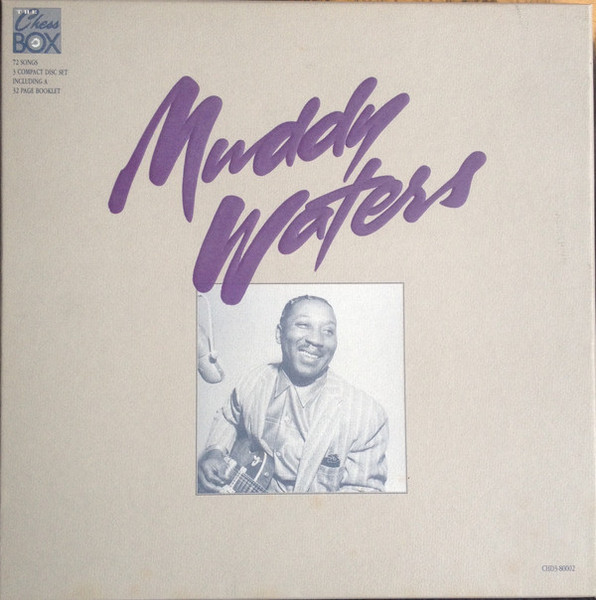
The Chess Box is a Blues album by Muddy Waters, originally released in 1989. On Gatefold: 8 pressings tracked, owned by 4 collectors.
About
When he died in 1983 at the age of sixty-eight, McKinley Morganfield was possibly the best-known bluesman in the world. Yet the notoriety of the onetime Mississippi plantation hand known as Muddy Waters is due largely to his overwhelming influence on a pivotal generation of rockers – Sixties wild boys like the Rolling Stones, Led Zeppelin, Eric Clapton, Jimi Hendrix and Johnny Winter – who covered his tunes, hot-wired his sound and assumed, to varying degrees, his inimitable style of barnyard machismo. Meanwhile, Waters's own landmark recordings for the Chess label, the greatest single oeuvre in modern blues, languished on haphazard compilations and pricey imports until MCA initiated its current Chess reissue series. Muddy Waters: The Chess Box, a feast (six LPs, three cassettes or three CDs) of stone classics, vintage rarities and edifying curiosities, is the first comprehensive domestic Waters collection ever. That it's finally here is a gas. That no one bothered to do the job during Waters's lifetime... well, that's why they call it the blues. Hard-core blues nuts with deep pockets may grouse that The Chess Box is merely lip service compared with Muddy Waters (The Chess Box), the eleven-LP monster issued by P-Vine in Japan a few years back. But the seventy-two astutely chosen performances are more than ample testimony to the breadth of Waters's art. They vividly document not only the revolutionary qualities of Waters's electric blues inventions but the evolutionary odyssey of the blues itself as the music traveled upriver from Robert Johnson's Delta crossroads to Chicago, where émigrés like Waters married the desperate energies of the urban struggle to the timeless sound of black experience. To that combustible equation Waters added force of personality: a potent compound of leonine pride, feral sexuality and sly wit graphically captured in the immortal 1954 hit "Hoochie Coochie Man," written by resident Chess tunesmith Willie Dixon and rendered by Waters with stunning autobiographical gusto. Waters first made blues history with his early-Forties recordings for the Library of Congress, so his consummate brand of blues power was already at an advanced stage when he cut his initial drummerless, small-group sides for Leonard and Phil Chess. Indeed, the first third of The Chess Box, covering 1947 to early 1954 and featuring early vinyl triumphs like "I Can't Be Satisfied," "Rollin' and Tumblin', Part I" and "Long Distance Call," is worth the cost of the entire set. Particularly illuminating is the juxtaposition of Waters's own "Rolling Stone" (a major inspiration for a certain English band and a Bob Dylan hit – not to mention this magazine) with his dynamic reading of Robert Johnson's "Walkin' Blues." Both songs, first issued together as a 1950 single, bear the vital imprint of Waters's Delta roots. But Waters also displays a striking streetwise ferocity in his vocal delivery, heightened by the serrated shiver of his distorted electric slide guitar. The result is a compelling portent of the pioneering transformation of blues expression that would soon come with the sonic assault of Waters and his working band on the ragged but righteous "Standing Around Crying" (1952) and the superb single "Blow Wind Blow" (1953). The extraordinary power of Waters's music, as it reached full maturity in the mid- and late Fifties, accrued from a remarkable collision of songwriting moxie, powerful contributions from Waters's accompanists and the production savvy of the Chess brothers – in particular Leonard, the hands-on studio half of the team. And although Waters wrote his share of classic tunes during that period ("Got My Mojo Working," "Trouble No More" and "Mannish Boy," his fearsome retooling of Bo Diddley's "I'm a Man"), he also benefited from the genius of Willie Dixon, who captured in words and music Waters's mesmeric braggadocio and frisky virility. Waters, in turn, didn't just sing Dixon diamonds like "I'm Ready," "I Just Want to Make Love to You" and "Don't Go No Farther." He inhabited them, delivering lines like "You need grits/Go to the grocer's/You need fish/Go to the sea/You need love/Look for me baby" with an immediacy that most of his white spiritual descendants never mustered. Steamrolling sidemen like pianist Otis Spann, harpmen Little Walter and James Cotton, guitarist Jimmy Rogers and drummer Francis Clay ensured that Waters's declarations of love were not mistaken for idle boasts. Alas, just as Waters's music was setting off a blues revolution overseas, his commercial fortunes dipped at home. When the Rolling Stones first met Waters at the Chess studios in 1964, he wasn't cutting tracks; Leonard Chess had put him to work painting the ceiling. Yet the Sixties and early-Seventies tracks on The Chess Box, many of them rare or previously unissued, confirm Waters's enduring strengths despite ill-considered attempts to dress him up for the times, like 1966's dreary Muddy, Brass and the Blues. Dig the lean, mean remix of "Black Night" from that LP, minus the dull overdubbed horns. Other new-found delights include two smokin' alternate takes from the '69 Fathers and Sons sessions with Paul Butterfield and Mike Bloomfield and live versions of "Country Boy" and "Going Down Slow," from 1968 and '71 respectively, which show Waters entering his twilight years with undiminished fire. That fire crackles loud and clear all through this set. Reissue producer Andy McKaie (together with associate producer Mary Katherine Aldin) applied the same diligence and care to Waters's Chess Box that went into the earlier volumes devoted to Chuck Berry and Willie Dixon, and Robert Palmer's essay in the accompanying booklet is required reading. But although it deserves both, this music really transcends packaging and scholarship. Muddy Waters: The Chess Box is simply mojo magnifico.
via Last.fm
The Clerk says
The Clerk knows this whole record — the pressing quirks, the credits, the take.
Tracklist
Side A
- A1Gypsy Woman2:33
- A2Good Looking Woman2:41
- A3Mean Disposition2:33
- A4I Can't Be Satisfied3:41
- A5I Feel Like Going Home3:08
- A6Train Fare Home Blues2:46
Side B
- B1Mean Red Spider2:16
- B2Streamline Woman3:16
- B3Little Geneva2:46
- B4Rollin' And Tumblin', Part 12:58
- B5Rolling Stone3:08
- B6Walkin' Blues2:55
Side C
- C1Louisiana Blues2:52
- C2Evans Shuffle2:10
- C3Long Distance Call2:39
- C4Honey Bee3:20
- C5She Moves Me2:56
- C6Still A Fool3:17
Side D
- D1Stuff You Gotta Watch2:48
- D2Standing Around Crying3:20
- D3Flood2:36
- D4Baby Please Don't Go3:15
- D5Blow Wind Blow3:08
- D6Hoochie Coochie Man2:46
Side E
- E1I Just Want To Make Love To You2:50
- E2I'm Ready3:02
- E3Smokestack Lightnin'3:06
- E4Young Fashioned Ways2:59
- E5Mannish Boy2:55
- E6Trouble No More2:39
Side F
- F1Forty Days And Forty Nights2:50
- F2Just To Be With You3:13
- F3Don't Go No Farther2:54
- F4Diamonds At Your Feet2:24
- F5I Love The Life I Live, I Live The Life I Love2:48
- F6Rock Me3:10
Side G
- G1Look What You Done2:21
- G2Got My Mojo Working2:50
- G3Good News2:47
- G4Evil2:17
- G5She's Nineteen Years Old3:16
- G6Close To You3:04
- G7Walkin' Thru The Park2:44
Side H
- H1Blues Before Sunrise (With Dialogue & False Starts)3:51
- H2Lonesome Road Blues3:02
- H3Take The Bitter With The Sweet (False Start, Dialogue & Alternate Take)3:50
- H4She's Into Something2:44
- H5Southbound Train2:53
- H6Double Trouble2:45
Side I
- I1I Feel So Good2:56
- I2You Shook Me2:46
- I3You Need Love2:41
- I4Twenty Four Hours2:30
- I5Elevate Me Mama (Alternate Take)3:03
- I6So Glad I'm Living2:52
Side J
- J1My Love Strikes Like Lightning2:43
- J2You Don't Have To Go (Alternate Take)2:49
- J3Things That I Used To Do3:12
- J4My Home Is In The Delta3:58
- J5Good Morning Little Schoolgirl3:12
- J6The Same Thing2:43
Side K
- K1You Can't Lose What You Ain't Never Had2:55
- K2Short Dress Woman2:46
- K3Making Friends2:36
- K4Black Night (Alternate Mix)3:17
- K5Bird Nest On The Ground2:53
- K6Country Boy4:38
Side L
- L1Sugar Sweet ("Fathers And Sons" Alternate Take)2:16
- L2All Aboard ("Fathers And Sons" Alternate Take)2:38
- L3Going Down Slow4:07
- L4Who's Gonna Be Your Sweet Man When I'm Gone (Original British Mix)5:05
- L5Can't Get No Grindin' (What's The Matter With The Meal)2:46
Sound DNA
- Blues
- Chicago & Electric Blues
- warm
- soulful
- bluesy
Notes from the original pressing. Later editions may differ.
LP size cardboard box with 32-page booklet (11" x 11").
All tracks recorded in Chicago except where noted:
A1: Recorded 1947, originally Aristocrat single 1302
A2: Recorded April 1948, previously unreleased
A3: Recorded April 1948, originally released on Chess LP 9180, "Rare And Unissued"
A4: Recorded April 1948, originally Aristocrat single 1305
A5: Recorded April 1948, originally Aristocrat single 1305
A6: Recorded November 1948, originally Aristocrat single 1306
B1: Recorded November 30, 1948, originally Aristocrat single 1307, previously unreleased on U.S. album
B2: Recorded November 30, 1948, originally Aristocrat single 1310
B3: Recorded July 1949, originally Aristocrat single 1311
B4: Recorded February 1950, originally Aristocrat single 412
B5: Recorded February 1950, originally Chess single 1426
B6: Recorded February 1950, originally Chess single 1426
C1: Recorded October 23, 1950, originally Chess single 1441
C2: Recorded October 23, 1950, originally Chess single 1441
C3: Recorded January 23, 1951, originally Chess single 1452
C4: Recorded January 23, 1951, originally Chess single 1468
C5: Recorded July 11, 1951, originally Chess single 1490
C6: Recorded July 11, 1951, originally Chess single 1480
D1: Recorded December 29, 1951, originally released on Chess LP 9180, "Rare And Unissued"
D2: Recorded September 17, 1952, originally Chess single 1526
D3: Recorded December, 1952, previously unreleased in U.S.
D4: Recorded May 4, 1953, originally Chess single 1542
D5: Recorded September 24, 1953, originally Chess single 1550, previously unreleased on U.S. album
D6: Recorded January 7, 1954, originally Chess single 1560
E1: Recorded April 13, 1954, originally Chess single 1571
E2: Recorded September 1, 1954, originally Chess single 1579
E3: Recorded September 1, 1954, originally released on Chess LP 9180, "Rare And Unissued"
E4: Recorded February 3, 1955, originally Chess single 1602
E5: Recorded 1955, originally Chess single 1602
E6: Recorded 1955, originally Chess single 1612
F1: Recorded 1956, originally Chess single 1620
F2: Recorded 1956, originally Chess single 1644
F3: Recorded 1956, originally Chess single 1630
F4: Recorded 1956, previously unreleased on U.S. album
F5: Recorded December 1, 1956, originally Chess single 1680
F6: Recorded December 1, 1956, originally Chess single 1652
G1: Recorded December 1, 1956, originally Chess single 1758, previously unreleased on U.S. album
G2: Recorded December 1, 1956, originally Chess single 1652
G3: Recorded May/June 1957, originally Chess single 1667, previously unreleased on U.S. album
G4: Recorded May/June 1957, originally Chess single 1680, previously unreleased on U.S. album
G5: Recorded November 1958, originally Chess single 1704
G6: Recorded November 1958, originally Chess single 1704
G7: Recorded Fall 1958, originally Chess single 1718
H1: Recorded early 1959, previously unreleased in U.S.
H2: Recorded July 1959, originally released on Chess LP 1444 "Muddy Waters Sings Big Bill Broonzy"
H3: Recorded July 1959, previously unreleased
H4: Recorded July 1959, originally Chess single 1733
H5: Recorded July 1959, originally released on Chess LP 1444 "Muddy Waters Sings Big Bill Broonzy"
H6: Recorded August, 1959, originally released on Chess LP 1444 "Muddy Waters Sings Big Bill Broonzy"
I1: Recorded live at Newport Jazz Festival, Newport, R.I., July 3, 1960, originally released on Chess LP 1449 "Muddy Waters At Newport"
I2: Recorded June 1962, originally Chess single 1827
I3: Recorded October 12, 1962, originally Chess single 1839
I4: Recorded May 2, 1963, originally Chess single 1862, previously unreleased on U.S. album
I5: Recorded June 6, 1963, previously unreleased
I6: Recorded June 6, 1963, previously unreleased in U.S.
J1: Recorded June 6, 1963, previously unreleased in U.S.
J2: Recorded June 6, 1963, previously unreleased
J3: Recorded June 6, 1963, previously unreleased in U.S.
J4: Recorded September 1963, originally released on Chess LP 1483 "Folk Singer"
J5: Recorded September 1963, originally released on Chess LP 1483 "Folk Singer"
J6: Recorded April, 1964, originally Chess single 1895
K1: Recorded April, 1964, originally Chess single 1895
K2: Recorded October, 1964, originally Chess single 1914, previously unreleased on U.S. album
K3: Recorded June 22, 1966, originally Chess single 2107
K4: Recorded June 22, 1966, original session produced for Chess LP 1507 "Muddy, Brass & The Blues", previously unreleased; remixed without horns at Penguin Recording, Eagle Rock, California, June, 1989
K5: Recorded 1967, originally Chess 2018
K6: Recorded live at Montreux Jazz Festival, Switzerland, 1968, previously unreleased
L1: Recorded April 22, 1969, previously unreleased
L2: Recorded April 22, 1969, previously unreleased
L3: Recorded live, Mister Kelly's, June 1971, previously unreleased
L4: Recorded in London, December 7, 1971, previously unreleased
L5: Recorded March 1972, originally released on Chess album 50023, "Can't Get No Grindin'"
Keyboard credits track L4: Georgie Fortune (Georgie Fame).
All recording dates and personnel culled from the Chess files; "The Chess Labels—A Discography," Vols. One and Two by Michel Ruppli (Greenwood Press); "Blues Records," Volume Two (pre-release copy) by Mike Leadbitter & Neil Slaven; "Muddy Waters Discography" by Tommy Holmstrom & Tommy Lofgren (Jefferson Magazine, Sweden ). Album release dates from the Chess files.
Digitally transferred from original mono and stereo Chess masters except for those marked with an asterisk (B5, D5, F3, G2, G4) which are digitally transferred from original Chess 78 r.p.m. recordings. Digitally assembled from original Chess masters and disc transfers by Doug Schwartz, MCA Studios, No. Hollywood. Digital transfers from 78 r.p.m.s by Steven Lasker with Paul Elmore, MCA Studios, No. Hollywood, except for "Blow Wind Blow" and "Good News" courtesy of Warner Pioneer Japan.
Photo Credits: (1, 4, 5, 8, 15, 29) Chess files, (2, 16) Mary Katherine Aldin, (3) Jacques Demetre/Courtesy Blues and Rhythm Archives, (6, 38, 39) Courtesy of The Cameron Organisation, Inc., (7) Courtesy of Frank Driggs, (9, 11) Paul Natkin/Photo Reserve, (10, 21) The Estate of McKinley Morganfield, (12) David Gahr, (13) Courtesy of Brian Smith, (14, 22, 28) Showtime (Toronto) Archive/Escott, (17, 18, 19, 20) George Adins, Courtesy of The Estate of McKinley Morganfield, (23) James Bland, (24 ) Courtesy of Mary Katherine Aldin, (25, 26, 27) Courtesy of Jim O'Neal, (30, 31, 32) Brian Smith, (33, 34 ) Tom Copl, (35) Ray Flerlage, (36) CBC/TV photo, courtesy of Manny Greenhill, (37) Valerie Wilmer
Special Thanks To Phil Chess, Scott Cameron and Nancy Meyer
Thanks to those members of the worldwide blues community who freely and generously assisted the producers of this compilation, and especially: Bruce Bastin; Keith Briggs; Tony Burke (Blues And Rhythm: The Gospel Truth); Robert Cray; Dr. Demento; Willie and Marie Dixon; Bill Ferris (U. of Mississippi's Center For The Study Of Southern Culture); Manny and Mitch Greenhill; Paul Harris; Richard James Hite; John Lee Hooker; Aki Inagaki; Mike Kappus; Dan Kochakian; Steven Lasker; Peter Lee (Living Blues Magazine); Denis Lewis; Luke "Long Gone" Miles; Jim O'Neal; Bonnie Raitt; John G. Rockwood; Jim Rooney; Frank Scott; Dick Shurman; Neil Slaven; Suzanne Steel (The Blues Archive, U. of Mississippi); Dick Waterman.
Credits
The people behind it.
Performers
- Muddy WatersVOCALS GUITAR VOCALS, GUITAR
- A.C. ReedTENOR SAXOPHONE
- Alex AtkinsALTO SAXOPHONE
- Andrew StephensonBASS
- Buddy GuyGUITAR
- Calvin JonesBASS
- Carey Bell HarringtonHARMONICA
- Casey JonesDRUMS
- Clifton JamesDRUMS
- Donald "Duck" DunnBASS
- Earl HookerGUITAR
- Elgin EvansDRUMS
- Ernest "Big" CrawfordBASS
- Ernest CottonTENOR SAXOPHONE
- Francis ClayDRUMS
- Fred BelowDRUMS
- Georgie FameKEYBOARDS
- Georgie FortuneKEYBOARDS
4 collectors on Gatefold own this · 8 pressings tracked on Gatefold
Start your shelf.
Track your pressings of The Chess Box, get the Clerk's take, and see what the record is worth — free.
Start your shelf →Free forever. Works with 10 records or 10,000.