
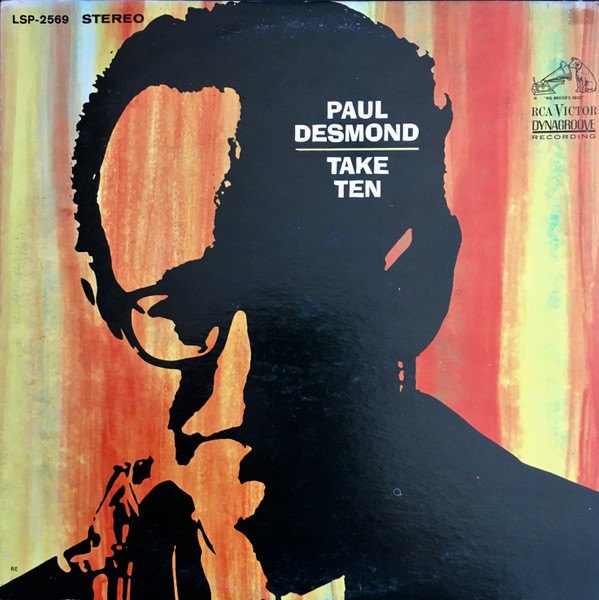
Take Ten is a Jazz album by Paul Desmond, originally released in 1963. On Gatefold: 79 pressings tracked, owned by 7 collectors.
About
Take Ten was Desmond's follow-up composition to Take Five, for the Brubeck Quartet a hit record and for Paul a dependable annuity that is still producing considerable income for his estate. The bassist for the title tune of Desmond's second RCA album is Eugene Wright, fellow Brubeckian and shaman of 5/4 time who, in the early sixties when 5/4 was Sanskrit to most jazz musicians, would hold little counting seminars backstage: "1,2,3/1,2," he would instruct the locals, "that's the only way you can keep track of it until it becomes natural." In Take Ten, it is obviously natural to Gene. Desmond is misterioso, Near-Eastern and bluesy. Jim Hall was one of the first American musicians to return from Brazil with news of bossa nova, that felicitous melding of samba and harmonies from the French impressionists and jazz. Desmond saw deeply into its beautiful possibilities. His El Prince is heard in two versions, with drummer Connie Kay in a complex samba pattern. The second take (which languished in a tape box for two decades) is a tad slower and has forceful Desmond, a buoyant solo by Hall and intriguing bass lines by Gene Cherico. At least one hearing of Alone Together can profitably be spent concentrating on Connie's snare accents and cymbal work, little kicks of encouragement. Paul, at a fairly good clip, marries relaxation and irresistible swing, especially in his second solo. Jim quotes Dizzy Gillespie's Anthropology and in the bridge of his second solo chorus has the kind of chord fiesta that makes grown men weep, if they are guitarists. The structure of this song is a normal AABA, but the first two A sections are 14 bars instead of the usual eight. The composition hangs together so well, the eccentricity is not obvious. The originally issued take of Embarcadero has nifty counterpoint in the first 16 bars following the guitar solo. One of several original Desmond bossa novas, the tune could be named after the Embarcadero in his native San Francisco or the one in Rio, or both. Luiz Bonfa's gorgeous theme from the film Black Orpheus brings us to Kay laying down the basic bossa nova pattern, Hall and Cherico in rhythmic cahoots and Paul soaring. The tag is played as written, then the piece is taken out on a vamp ending. Nancy sounds as if Paul, like Lester Young, thought of a ballad's lyrics as he played it. Hall's introduction is among his finest. Samba de Orfeu is one of the most famous pieces introduced by Antonio Carlos Jobim. Desmond regretted the hype and hoopla surrounding the bossa nova phenomenon, but this marvelous music insinuated itself quickly into American jazz. As he hoped, it has become a permanent element. The One I Love gets a fluid performance with no quotes and no cliches. In his solo, Hall alternates legato and punchy passages to great effect. Out of Nowhere has interesting Desmond modulations in the opening chorus. Hall's comping is exemplary, and Kay negotiates a classic bop ride cymbal pattern throughout. Following Jim's two-chorus solo, he and Desmond trade twos, then Paul and the rhythm section do a chorus of stop-time. – DOUG RAMSEY.
via Last.fm
The Clerk says
The Clerk knows this whole record — the pressing quirks, the credits, the take.
Tracklist
Side A
- A1Take Ten2:59
- A2El Prince3:20
- A3Alone Together6:46
- A4Embarcadero3:56
Side B
- B1Theme From "Black Orpheus"4:07
- B2Nancy5:58
- B3Samba De Orfeu4:14
- B4The One I Love (Belongs To Somebody Else)5:31
Sound DNA
- Jazz
- Cool Jazz
- warm
- uplifting
- cinematic
Cover artwork was created by Andy Warhol, who was paid $206 in 1962 for his work.
Credits
The people behind it.
Performers
- Connie KayDRUMS
- Eugene WrightBASS
- Gene ChericoBASS
- George DuvivierBASS
- Jim HallGUITAR GUITAR, FEATURING
- Paul DesmondALTO SAXOPHONE ALTO SAXOPHONE, LINER NOTES LINER NOTES, ALTO SAXOPHONE
- Al RichmondFRENCH HORN
- Bob PrinceCONDUCTOR
- Bobby ThomasPERCUSSION
- Gloria AgostiniHARP
- Milt HintonBASS
7 collectors on Gatefold own this · 79 pressings tracked on Gatefold
Start your shelf.
Track your pressings of Take Ten, get the Clerk's take, and see what the record is worth — free.
Start your shelf →Free forever. Works with 10 records or 10,000.