
Album
Soul Mining
1983 · Rock, Pop
35 collectors on Gatefold own this
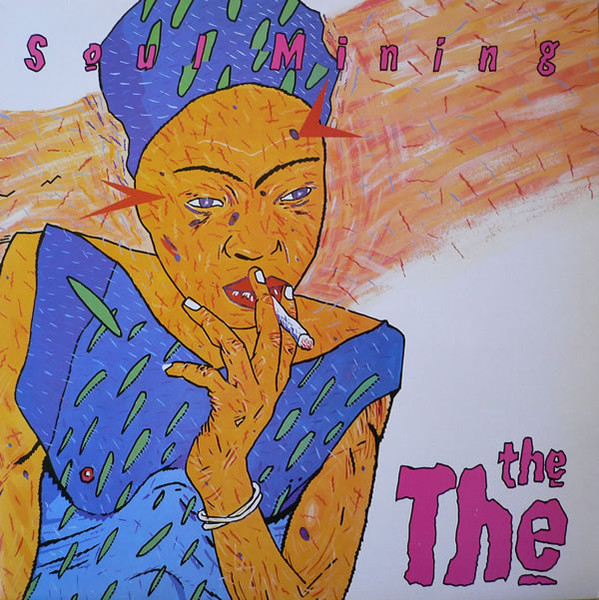
Soul Mining is an Electronic album by The The, originally released in 1983. On Gatefold: 98 pressings tracked, owned by 35 collectors.
About
In the late ’70s, a teenage Matt Johnson found himself working at a London recording studio at the height of post-punk’s explosive energy. “It was so vibrant and alive,” Johnson tells Apple Music. “Punk wasn't something I was particularly a fan of, but the post-punk scene in London and the UK was incredibly exciting.” His band, The The, which he formed in 1979 as a duo but soon became Johnson alone, was a product of that highly creative and experimental time; the era's lo-fi DIY fingerprints are all over Johnson's solo album, 1981’s <i>Burning Blue Soul</i> (which was later credited to The The). But it was with 1983’s <i>Soul Mining</i> that Johnson’s vision as a singer-songwriter-multi-instrumentalist auteur would be fully realized. It would also become a defining document of when post-punk gave way to synth-pop—and along with it ushered in one of alternative music’s most singular voices. After multiple trips to record in New York at his manager’s behest—hotel rooms were trashed, record label money was blown on drugs, and producers parted ways—Johnson ended up back in London with some demos (provisionally titled <i>The Pornography of Despair</i>), a new deal with CBS Records, and Wire engineer Paul Hardiman as co-producer. “We wanted to go for a simple, rich, fat sound,” Johnson says, “but also, because there was not a traditional band with bass, drums, guitar, keyboard, it meant that I could experiment. I thought, ‘Why can't I have fiddle and accordion on one track and cellos and synthesizer on another?’ There was no fixed lineup. There was fluidity. So I could bring in my friends such as [Foetus’] Jim Thirlwell, [Orange Juice’s] Zeke Manyika, Thomas Leer on the one hand, and brilliant session players like [Squeeze’s] Jools Holland on the other.” That freedom—along with Johnson’s admittedly liberal use of MDMA at the time—would fuel one of the 1980s’ most distinctive and personal pop records, mixing together folk melodies on the hopeful, anthemic single “This Is the Day”; Holland’s boogie-woogie piano on the moody “Uncertain Smile”; Manyika’s tribal-inspired, trance-inducing drumming on the Balearic classic “Giant”; and elements of industrial and funk scattered throughout. But at its core, <i>Soul Mining</i> is the expression of a young man in his early twenties in existential crisis, navigating his relationships with others and himself, and struggling to find deeper meaning in an increasingly inhospitable world. “It's very autobiographical,” Johnson says. “Life was really starting to change for me.” To commemorate its 40th anniversary, Johnson walks us through <i>Soul Mining</i> track by track. <b>“I've Been Waitin' for Tomorrow (All of My Life)”</b> “I wanted to wrong-foot people by opening with the most aggressive track—a bit of punk ethos, as in aggressive and fairly political: ‘I've been filled with useless information/Spewed out by papers and radio stations.’ There were no real verses or choruses, at least during the recording of the music. We sort of created a chorus. We had an extra bassline that suggested a chorus. The drums were provided by Zeke Manyika, and he copied what would've been a drum machine pattern that I would've put down. I often think of ‘Waitin’ for Tomorrow’ in the same category as ‘Giant’ because I created them in a similar fashion, on the Portastudio—quite a linear fashion and no real structure. The structure came from the overdubbing and muting and bringing in different instruments.” <b>“This Is the Day”</b> “I saw it as bittersweet, but ultimately positive. I wanted to it to have a positive feeling because my life was changing dramatically. I went from being on the dole to suddenly having a major-label deal. And then shortly after that, I was able to buy my first flat. I had my first proper relationship, and my family were very close. But being quite a sensitive person with a melancholic streak, I couldn't feel properly happy inside myself. If I saw other people unhappy, their sadness would affect me. There was a video made for the song, which I didn't like at the time. But recently I watched it again, and it was very emotional for me because all of my family were in that film and my girlfriend Fiona, and now four of the people have died. It talks about friends and family and memories, and now looking back at that, the song has taken on new meaning.” <b>“The Sinking Feeling”</b> “‘Sinking Feeling’ is the most political song on the album. We were at the height of Thatcherism in the UK; unemployment was rising. There was a real attack on working people. There was a minor strike. The privatization frenzy was growing. It was a very, very divisive time. And so the chorus particularly—'I'm just a symptom of the moral decay that's gnawing at the heart of the country'—became a bit of a soundtrack for its times. That song, I suppose, pointed towards [1986’s] <i>Infected</i>. They were horrible times. But the weird thing is, I look back at them with some sense of nostalgia, because the world has gone even more insane. From a young age, I was quite aware of the class politics in the UK, and that's something that had quite an effect on me.” <b>“Uncertain Smile”</b> “The original version had a completely different ending and was called 'Cold Spell Ahead.’ Then I did another version of it where I removed the tempo change, removed the ending, and I probably wrote another verse, and I retitled it ‘Uncertain Smile.’ Paul wanted to do another version, which was tougher-sounding, and we left this long outro. The Garden [studio] had a beautiful piano, a little Yamaha baby grand C3. And the story is, it was a hot summer day. Jools showed up, dressed all in leather on his motorbike, and came in very affable. He was a very fast worker. He sat at the piano and said, ‘Can you just give me a few bars?' And we played it to him. He went, ‘I'm ready for a take.’ As he's playing, me and Paul looked at each other and just shook our heads and laughed, and were like, ‘We've got it!’” <b>“Twilight Hour”</b> “I was just newly into the relationship with Fiona. We weren't living together at that point. And there's that uncertainty, that insecurity… You've had maybe a wonderful night, and then you haven't heard back. And so your imagination—or certainly my imagination—would run. One of my favorite lines is 'You are relying on her for your independence.’ You feel there's this new confident life opening up, and then the possibility of it suddenly being snatched away causes this sort of terror. That's probably the most cinematic track. It sort of falls between the cracks, but it helps create the dynamic between the different types of tracks. I love Thomas Leer's contribution on the synthesizer. It sounds like some sort of Eastern instrument, the way that he bends the notes—it's so beautiful.” <b>“Soul Mining”</b> “I was very fond of ‘Soul Mining.’ It bore close relation to ‘Twilight Hour’—something goes wrong when things are going right. Things are given and taken away all the time in life. So it's a bit of a melancholy song. I like the atmosphere that's quite cinematic in its own way. It was quite haunting, a moody song, and I like the simple guitar work that I played on that, and the marimbas. Another one of the songs that slips through the cracks, I suppose, but they make up side two, and they lower the intensity.” <b>“Giant”</b> “It starts with some cinematic description—‘Sun is high and I'm surrounded by sand/I'm strapped into a rocking chair.’ I wanted to create this gigantic desert scene with an individual wrestling with himself under the influence of ayahuasca or peyote or magic mushrooms. He could be going into a very introspective state, slightly hallucinogenic, and coming face-to-face with one's own conscience and one's own morality and sense of self and reality. 'How can anybody know me when I don't even know myself?' That revealing—it's like peeling the layers of an onion. But with the whole of the album, I wanted to make sure, whenever the lyrics were dark, that the music would be euphoric. I wanted to have that balance. One of the defining moments on 'Giant' is the wonderful chanting. There was Zeke, myself, and Paul, and we all joined in. Zeke then suggested, 'How about if we do a response to the other chant?' It was an amazing suggestion, and we overdubbed and overdubbed and overdubbed. So you had this gigantic sense of space and scale.” <b>“Perfect”</b> “'Giant' was always intended to be the album closer. But in America, they stuck on another track ['Perfect']. I got to New York, and I saw a copy of the album. I'm like, ‘What the hell is this?’ And the A&R man went, ‘Oh, I put it on. I thought it'd be good!’ I hit the roof, but what can I do? Many years later, I got it removed. The analogy I drew is like, you've written a book and there's a final chapter, and there was a discarded chapter earlier on that was chopped out, and the publisher found that discarded chapter and stuck it on the end of the book. Ridiculous. But that's what happened. My favorite version of ‘Perfect’ was the one that I remixed with Paul Hardiman, the 7-inch single with David Johansen on harmonica. I really liked that one. Paul and I redid it, and we shouldn't have done, really. We changed the beat. The new one had this swing to it, and we had trumpet replace the harmonica, and I was never happy with it. I thought, it's lost something. It's just lost its toughness, its edginess. And the original was really good, so therefore I didn't put it on the album. I said, 'It can be a B-side.'”
via Apple Music
The Clerk says
The Clerk knows this whole record — the pressing quirks, the credits, the take.
Tracklist
Side A
- A1I've Been Waitin' For Tomorrow (All Of My Life)
- A2This Is The Day
- A3The Sinking Feeling
- A4Uncertain Smile
Side B
- B1The Twilight Hour
- B2Soul Mining
- B3Giant
Sound DNA
- Electronic
- Synth-Pop / New Wave
- dense
- brooding
- urban
The song 'Perfect' was originally added to many CD & cassette versions in the UK and in other countries prior to the 2002 reissue.
Credits
The people behind it.
Performers
- Matt JohnsonLEAD VOCALS MUSIC BY, LYRICS BY, VOCALS PERCUSSION
- Paul HardimanVOCALS
- Zeke ManyikaVOCALS DRUMS
- Andy DuncanDRUMS FIDDLE
- Anne StephensonVIOLIN
- Camelle HindsBASS BASS GUITAR
- David JohansenHARMONICA
- Frank WantPERCUSSION
- Harry BeckettTRUMPET
- J.G. ThirlwellPERCUSSION
- Jeremy MeekBASS BASS GUITAR
- Jools HollandPIANO
- Martin McCarrickCELLO
- Paul BoyleFIDDLE
- Paul WickensACCORDION
- Steve SherlockFLUTE, SAXOPHONE
- Thomas LeerSOLOIST, SYNTH SOLOIST, SYNTHESIZER SYNTH
- WicksACCORDION
35 collectors on Gatefold own this · 98 pressings tracked on Gatefold
Start your shelf.
Track your pressings of Soul Mining, get the Clerk's take, and see what the record is worth — free.
Start your shelf →Free forever. Works with 10 records or 10,000.