
Album
Saturation
1993 · Rock
10 collectors on Gatefold own this
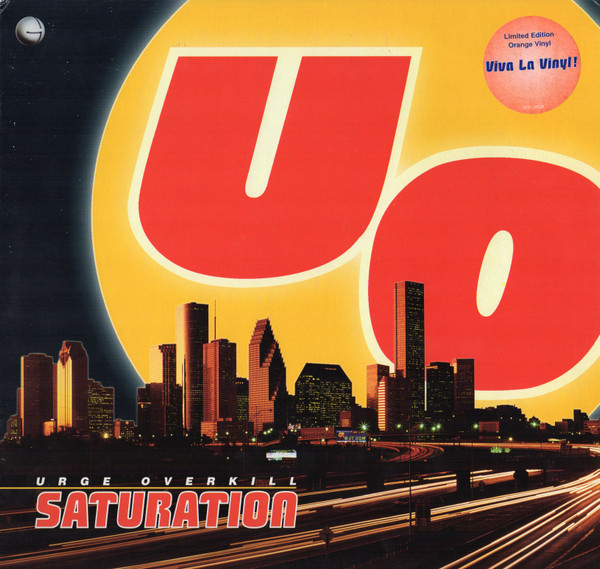
Saturation is an Alt/Indie album by Urge Overkill, originally released in 1993. On Gatefold: 31 pressings tracked, owned by 10 collectors.
About
Urge Overkill’s major-label debut posited these three ragtag playboys from Chicago as a '90s iteration of Cheap Trick or The Cars. “Sister Havana,” “Tequila Sundae,” and “Positive Bleeding” are fizzy, compact rock tunes—the kind of songs you imagine small-town teenagers swilling beer to as they cruise the main drag in cars borrowed from their parents. Urge Overkill were woozier and more eccentric than Weezer—who really were The Cars of the '90s—but such was Urge Overkill's advantage. Like the Stones before them, they squeezed soulfulness from sloppiness in songs like “Bottle of Fur.”
via Apple Music
The Clerk says
The Clerk knows this whole record — the pressing quirks, the credits, the take.
Tracklist
Side A
- A1Sister Havana3:49
- A2Tequila Sundae4:19
- A3Positive Bleeding3:41
- A4Back On Me3:10
- A5Woman 2 Woman2:40
- A6Bottle Of Fur4:13
Side B
- B1Crackbabies4:02
- B2The Stalker2:52
- B3Dropout4:55
- B4Erica Kane3:08
- B5Nite And Grey4:20
- B6Heaven 902103:49
Sound DNA
- Alt/Indie
- Alternative Rock
- polished
- swaggering
- witty
After seeing the immediate aftermath of Nirvana's near-instant success with the single "Smells Like Teen Spirit" halfway through the two groups' 1991 tour together, Urge Overkill decided their first major label studio album needed to be more concise, high energy, and less eclectic than their previous albums.
"Saturation" was recorded half in Chicago at The Bank (the group's studio in the basement of an old bank building) and half in Philadelphia the The Butcher Brothers' basement studio in urban Philly. Most of the album hadn't been demoed, it was largely constructed in studio on the strength of Geffen's belief in the band and the deal the group had signed allowing them almost total artistic control over the process. Roeser has said in interview that if they hadn't been on Geffen, they'd likely never have worked with someone as willing to experiment as the Butcher Brothers were and the album wouldn't be at all the same. He also said that the producers were thrilled to get to work with a rock group that wanted to sound "produced" rather than one that simply wanted to replicate a live sound, so they went over and above in coming up with ideas and additional segue tracks for the album.
"The Stalker" was recorded almost entirely at The Bank by Blackie Onassis and Eddie "King" Roeser (after the Butcher Brothers came out to help them set up the group's Chicago studio), with noises and a few vocal tracks added during later overdubs in Philadelphia. "Heaven 90210" was written largely in a van the group drove to Philadelphia for the first weekend recording sessions with The Butchers and constructed in the studio, never having been demoed previously. "Sister Havana" was born out of the 1991 tour with Nirvana: Nash Kato and Dave Grohl were jamming onstage during a soundcheck. Nash played the riff, which was apparently a "reversed Boston riff" and Grohl said "that's your hit single right there." "Dropout" was one of the final songs to be recorded during the sessions. The Butcher Brothers had had a looped hip hop / electronic beat they kept playing with during the sessions, and Blackie O eventually wrote words and a guitar part for it after hours when Nash and Eddie had left. He presented it to Nash and Eddie the following morning and they decided it would definitely be on the album. Blackie wrote in 1994: "'Dropout' was just a song that was sort of around in the studio during the recording of 'Saturation'. We'd play the loop over and over mainly to amuse ourselves. On the last day of mixing, I went in and put some vocals and acoustic guitar on it and that was sorta that. Nash said it sounded like 'space folk'."
The lead vocals on this album are mostly performed by Kato, whereas most on the previous recordings were done by Roeser. Roeser has said in interview that this change is largely because he was dealing with medical issues with his vocal cords at the time of recording due to overextending his voice live, drinking, and smoking.
The album features short, untitled "interstitial" tracks after "Positive Bleeding", "Crackbabies", "Erica Kane", and "Nite And Grey". They're a mix of studio dialogue / crosstalk and in-jokes, and the latter two feature samples from popular television shows of the 60s and 70s ("Mary Tyler Moore" and "Hawaii Five-O", respectively.) These were constructed largely by The Butcher Brothers on an MPC to amuse the band. The compact disc versions of the album feature a hidden bonus track (called "Operation: Kissinger" that samples a vocal scream from the Prince song "Gett Off"; it also appears as B-side to "Sister Havana") after twenty minutes and twenty seconds of silence. The track was originally recorded and presented to the band's A&R representative with Geffen (this was likely Mio Vukovic) as a joke (in a 30th anniversary interview, Roeser calls the song "terrible"). The band told him they were excited to move in a new direction, then played it as he sweated in worry. Afterward, the band told him it was recorded solely to mess with him.
Allegedly (according to Roeser) there are a few other tracks recorded during these sessions that didn't make it onto the album as they weren't considered good enough at the time.
Singles taken from the album: "Sister Havana" (worldwide), "Positive Bleeding" (worldwide), "Bottle Of Fur" (Australia and the U.S.), and "Dropout" (Europe and Australia only). (It's possible that "Crackbabies" was also technically considered a single by Geffen in the U.S., as there's a label-produced live video for it from the year of the album release, but it was not promoted with any physically released single formats.)
Andy Kravitz (one third of of the Butcher Brothers production team) purportedly drummed, played added percussion throughout much of the album (all uncredited), and assisted with some songwriting (also uncredited).
The group used a touring bass player for the subsequent tour since Nash and Eddie often couldn't play each other's guitar parts, and most new songs required two guitars to do them justice. Friend of the group, multi-instrumentalist Chuck Treece joined on bass for the live shows that year.
Credits
The people behind it.
Performers
- Blackie OnassisDRUMS VOCALS, DRUMS ACOUSTIC GUITAR , LEAD VOCALS
- Eddie "King" RoeserVOCALS, BASS VOCALS, GUITAR, BASS LEAD VOCALS
- Nash KatoVOCALS, GUITAR VOCALS, GUITAR, KEYBOARDS LEAD VOCALS
- Urge OverkillARRANGED BY, COMPOSED BY, PERFORMER COMPOSED BY, ARRANGED BY, PERFORMER
- PrinceVOCALS
- Sonny CurtisVOCALS
10 collectors on Gatefold own this · 31 pressings tracked on Gatefold
Start your shelf.
Track your pressings of Saturation, get the Clerk's take, and see what the record is worth — free.
Start your shelf →Free forever. Works with 10 records or 10,000.