
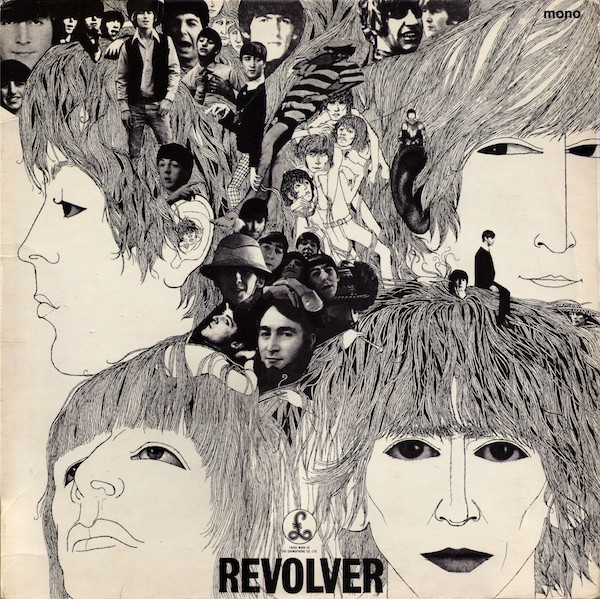
Revolver is a Rock album by The Beatles, originally released in 1966. On Gatefold: 938 pressings tracked, owned by 335 collectors.
About
One of the great, possibly true stories about 1966’s <i>Revolver</i> concerns an exchange between Paul McCartney and Bob Dylan at London’s Mayfair Hotel about what they were currently working on. (In Dylan’s case, it was <i>Blonde on Blonde</i>.) On hearing the tape loops and death poetry of “Tomorrow Never Knows,” Dylan allegedly said to McCartney, “Oh, I get it. You don’t want to be cute anymore.” It’s not entirely true. Part of what makes <i>Revolver</i> appealing is that it’s as much “Yellow Submarine” and the domestic sweetness of “Here, There and Everywhere” as it is “She Said She Said” and “Tomorrow Never Knows.” But Dylan’s point was well-taken: For a band that put out “I Want to Hold Your Hand” less than three years earlier, the relative complexity of <i>Revolver</i>—in both sound and subject matter—not only challenged The Beatles’ image as the pop band the whole family could agree on (as opposed to, say, The Rolling Stones), but it also put pop on a course toward unfamiliar horizons. Not only were The Beatles able to bridge their interest in the relatively uncommercial worlds of psychedelia, experimental, and Indian classical music with Motown (“Got to Get You Into My Life”) and what we now think of as classically Beatlesque pop (“Good Day Sunshine”), but they also gave us a template for the pop album as the kaleidoscopically varied studio construction we think of it as today. Cute, but more. On the occasion of the album’s 2022 Super Deluxe reissue—which, in addition to a new mix in Spatial Audio by Giles Martin and Sam Okell, features some extraordinary rehearsals, outtakes, and demos—we’re taking a look back at what shaped <i>Revolver</i> and what <i>Revolver</i> shaped in turn. <b>Before: The R&B Backbeat</b> <i>Revolver</i> is the last Beatles album where you can really hear the influence of American soul and R&B. “Taxman” is obvious, as is “Got to Get You Into My Life,” which John called “our Tamla-Motown bit.” But you can also hear it in “And Your Bird Can Sing” and “Love You To,” whose Indian influence is anchored by a beat heavy enough to drive a dance floor regardless of the continent it’s on. And where the beat of “Tomorrow Never Knows” is rightly cited as a precursor to techno and drum ’n’ bass, it’s also a take on the syncopations of James Brown drummer Clyde Stubblefield, who said he got his style, in part, from listening to washing machines and trains—the funk of daily life. Their growing conceptual interests didn’t get in the way of their roots as a bar-and-dance band, and their ability to bridge the two—or, more importantly, to dissolve the distinction between them—is part of what makes <i>Revolver</i> <i>Revolver</i>. Four people, one room. <b>Before: British Humor and the Surrealism of Daily Life</b> For however mystical <i>Revolver</i> can seem, squint and you hear an album mostly about ordinary life. “Eleanor Rigby,” “Doctor Robert,” the “Taxman,” the lovebirds of “Here, There and Everywhere,” and the eccentric of “I’m Only Sleeping”: these are the people in your neighborhood, and if they’re stranger than you remember, it might be because you never really looked. The Kinks were experts in this field. And John, in particular, was a fan of the Scottish singer Ivor Cutler, whose novelty songs masked a sense of surrealism that pointed toward more cosmic realms. The point isn’t just that <i>Revolver</i> was strange, but that it located its strangeness in places easily dismissed as familiar. So, while John borrowed the first line of “Tomorrow Never Knows” from a book connecting LSD with <i>The Tibetan Book of the Dead</i>, its title came from a more historically modest source: Ringo Starr. <b>Before: Power of the Experiment</b> Given their cultural stature, it’s easy to forget that The Beatles didn’t really know what they were doing at the time. So, while <i>Revolver</i>’s experimental qualities—the tape loops of “Tomorrow Never Knows,” the dislocated horn sections of “Got to Get You Into My Life”—could seem pretentious or alienating, they’re better understood as an embrace of the same unknowns that led to “Yesterday” or “Norwegian Wood (This Bird Has Flown).” Namely, can this be done? Though the band’s interest in avant-garde composers like John Cage or Luciano Berio wasn’t always obvious in their sound, it spoke to a sense of experimentation and open-mindedness that spurred them on when they could’ve easily and comfortably stayed in the same place. <b>Before: Pop as Art</b> Part of The Beatles’ story is that of pop’s transformation into something like art. Not that <i>Revolver</i> was without precedent. Frank Sinatra’s serial-like string of albums in the ’50s (<i>In the Wee Small Hours</i>, <i>Only the Lonely</i>, <i>No One Cares</i>), Ray Charles’ <i>Modern Sounds in Country and Western Music</i>, the sound sculptures of producers like Phil Spector and Joe Meek, the arrangements of The Beach Boys’ <i>Pet Sounds</i>—all undoubtedly pop music. But they’re also examples of artists stretching pop to accommodate a sense of depth and conceptual ambition that hadn’t been there before. As George said around the time of <i>Revolver</i>’s release, selling a lot of records was nice. Now the point was to make them better. <b>After: Psychedelia for the Mainstream</b> The real psychedelic quality of <i>Revolver</i> wasn’t its sound but its subject. Time, memory, the inevitability of death: With the exception of Bob Dylan and The Byrds, no mid-’60s pop artists were wading as deeply into inner space as The Beatles. And because, in George’s words, they’d “had a few hits,” their ideas landed on audiences that probably wouldn’t have encountered them otherwise, or at least ones that might’ve been more hesitant to hear them out. The effect was to expand our sense of the terrain that pop music could cover and introduce a sense of headiness and ambiguity that gave way to everything from Jimi Hendrix and Prince to the inward-facing stance of alternative rock. <i>Revolver</i> tried to touch what can’t be touched. <b>After: The Studio as Instrument</b> Before <i>Revolver</i>, the studio was, by and large, a place where bands went to record music they’d already worked out. After <i>Revolver</i>, it became a kind of instrument of its own. It wasn’t just the unprecedented amount of time The Beatles spent making it (220 hours to <i>Rubber Soul</i>’s 80) or their experiments with new technology; it was the way they opened their process to the concept of music being less a set of notes than a sequence of sounds—an attitude that evolved into everything from dub to shoegaze to hip-hop. Paul remembers meeting with producer George Martin before they went into the studio to play him what they’d been writing. When they got to “Tomorrow Never Knows,” Martin was curious but puzzled: there were no chord changes, no verses, no chorus. In other words, it wasn’t a song. The blueprint was in the band’s collective head, but you couldn’t make sense of it until the work was done. <b>After: Pop as Playground</b> <i>Revolver</i> helped define the pop album as a loose, collagelike space where you could get any number of sounds and moods thrown at you. Paul’s sweetness, John’s cynicism, the experimental and the straightforward, Western R&B and Eastern classical—and each of them somehow as much a part of the band’s identity as the others. Not only was the shift an important step toward understanding artists as people who curate and arrange the world rather than creating it out of thin air, but it also gave us a template you can still hear in everything from <i>Thriller</i> to <i>Purple Rain</i>, M.I.A.’s <i>Kala</i>, and Frank Ocean’s <i>Blonde</i>. <i>Revolver</i> wasn’t just a marketing tool; it was an experience. And the band’s eclecticism wasn’t a lack of commitment—it was liberation.
via Apple Music
The Clerk says
The Clerk knows this whole record — the pressing quirks, the credits, the take.
Tracklist
Side A
- A1Taxman
- A2Eleanor Rigby
- A3I'm Only Sleeping
- A4Love You To
- A5Here, There And Everywhere
- A6Yellow Submarine
- A7She Said She Said
Side B
- B1Good Day Sunshine
- B2And Your Bird Can Sing
- B3For No One
- B4Dr. Robert
- B5I Want To Tell You
- B6Got To Get You Into My Life
- B7Tomorrow Never Knows
Sound DNA
- Rock
- Psych Rock
- layered
- playful
- psychedelic
Revolver is the seventh studio album by the English rock band The Beatles. Released on 5 August 1966, it was the Beatles' final recording project before their retirement as live performers, and marked a progression on their 1965 release Rubber Soul in terms of the group's readiness to experiment in the recording studio. The album's diverse sounds include tape loops and backwards recordings on the psychedelic "Tomorrow Never Knows", a classical string octet on "Eleanor Rigby", and Indian-music backing on "Love You To". The album was reduced to eleven songs by Capitol Records in North America, where three of its tracks instead appeared on the June 1966 release Yesterday and Today.
The Beatles recorded the album following a three-month break from professional commitments at the start of 1966, and during a period when London was feted as the era's cultural capital. The songs reflect the influence of psychedelic drugs such as LSD and the increasing sophistication of the Beatles' lyrics to address themes including death and transcendence from material concerns. With no thoughts of reproducing their new material in concert, the band made liberal use of studio techniques such as varispeeding, reversed tapes, close audio miking and automatic double tracking (ADT), in addition to employing musical instrumentation outside of their standard live set-up. Some of the changes in studio practice introduced by Revolver, particularly ADT, were soon adopted throughout the recording industry. The sessions also produced a non-album single, "Paperback Writer" backed with "Rain", for which the Beatles filmed their first on-location promotional films.
In the UK, Revolver's fourteen tracks were released to radio stations throughout July 1966, with the music signifying what author Ian MacDonald later described as "a second pop revolution – one which while galvanising their existing rivals and inspiring many new ones, left all of them far behind". In the US, it was the last Beatles album to be subjected to Capitol's policy of altering the band's intended running order and content. The release there coincided with the Beatles' final concert tour, which was marred by the controversy surrounding John Lennon's remark that the band had become "more popular than Jesus". The record topped the UK Albums Chart for seven weeks and America's Billboard Top LPs list for six weeks. Together with the children's novelty song "Yellow Submarine", "Eleanor Rigby" became an international hit when issued as a double A-side single.
Revolver's cover artwork, designed by Klaus Voormann, won the 1967 Grammy Award for Best Album Cover, Graphic Arts. The album was influential in advancing principles espoused by the 1960s counterculture and in inspiring the development of pop music into subgenres such as psychedelic rock, electronica, progressive rock and world music. With the restoration of the three omitted tracks for its international CD release in 1987, many music critics recognise Revolver as the Beatles' best album, surpassing Sgt. Pepper's Lonely Hearts Club Band. The album was ranked first in Colin Larkin's book All-Time Top 1000 Albums and third in Rolling Stone magazine's list of the 500 greatest albums of all time. In 2013, after the British Phonographic Industry had changed its sales award rules, Revolver was certified platinum in the UK. The album has been certified 5× platinum by the Recording Industry Association of America.
Credits
The people behind it.
Performers
- Alan CivilHORN FRENCH HORN HORNS
- Anil BhagwatTABLA
- George HarrisonGUITAR GUITAR, VOCALS LEAD VOCALS
- John LennonGUITAR GUITAR, VOCALS LEAD VOCALS
- Paul McCartneyBASS BASS, VOCALS LEAD VOCALS
- Ringo StarrDRUMS, VOCALS LEAD VOCALS VOCALS
- The Beatles
- George MartinARRANGED BY
- John McCarthyVOCALS
- Paul MacCartneyLEAD VOCALS
- Peter CoeTENOR SAXOPHONE
335 collectors on Gatefold own this · 938 pressings tracked on Gatefold
Start your shelf.
Track your pressings of Revolver, get the Clerk's take, and see what the record is worth — free.
Start your shelf →Free forever. Works with 10 records or 10,000.