
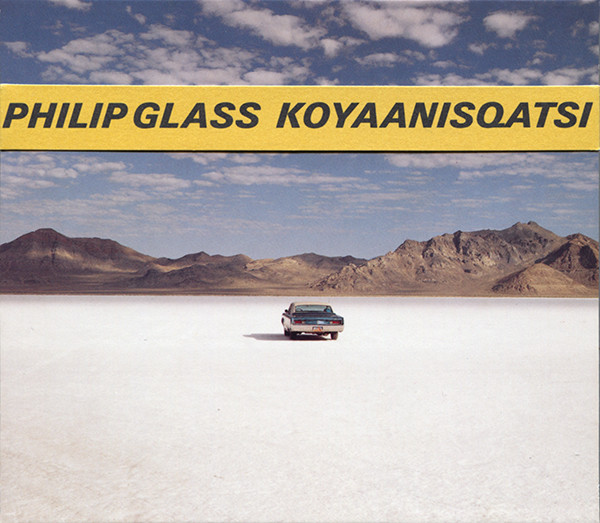
Koyaanisqatsi is a Soundtrack & Scores album by Philip Glass, originally released in 1998. On Gatefold: 9 pressings tracked.
About
Glass's earlier works - from Music In Similar Motion (1969) through the operas Einstein on the Beach (1976), Satyagraha (1980) and Akhnaten (1983) - had won him respect and influence within the musical world. But it was Koyaanisqatsi, which was finally issued in 1983 after several years in the making, that marked the composer's first great popular success. Indeed, it could be argued that Koyaanisqatsi, a collaboration with the filmmaker Godfrey Reggio, has proved the most influential mating of cinema and music after Fantasia in 1940. Everybody in the music or entertainment business seems to have borrowed from it at some point or another, and not always for the good. Still, the original Koyaanisqatsi remains inviolate. Although the 87-minute film is completely non-narrative, without a single identifiable character or a word of dialogue, it is as thrilling as any mystery, as sumptuous as any Hollywood spectacular. A cavalcade of potent visions - clouds chasing clouds across a New Mexican desert, the mass dynamiting of a failed housing project in St. Louis, hives of people swarming in and out of Grand Central Station, hectic traffic swapping lanes on the Los Angeles freeways - Koyaanisqatsi finally evolves into a vast cinematic ballet, music and motion forever interweaving and intertwined. The original recording of Koyaanisqatsi was issued at what was a distinctly uneasy time — for the record companies at least. The LP era was coming to an end and the compact disc was only beginning to enter its primacy. Because the LP, which wasthen the more popular medium by far, could rarely hold more than 25 minutes per side, it was decreed that the score for the Glass/Reggio film should be radically abridged for its initial release. Fifteen years later, it is a pleasure to have virtually all of the music from Koyaanisqatsi on disc, including about a halt hour of material that has hitherto been available only with the film. (A few connective passages - and a lot of long silences - are still omitted.) At last, we are finally able to listen to the score as a unified whole, instead of a succession of disparate sections. Koyaanisqatsi is in fact a deeply formal composition. It grows slowly from its "ahistorical opening through episodes of idyllic a capella lyricism (Vessels) through the agitated turmoil of Pruit Igoe on through the haunting, chanted Prophecies, before suddenly veering back into the same gloomy meditation that startedthe whole thing off some 65 minutes earlier. The longest and perhaps the grandest section is called The Grid, for full chorus and ensemble; not surprisingly, it corresponds to the wildest and most apocalyptic moments of the film. The Grid was condensed by more than a third for the 1983 disc, with the result that much of its cumulative power was lost. This, then, is the first recording to capture the music in all of its insistent majesty. It begins simply enough, in a rather old-fashioned manner, the brass puttering along with near-Elgarian pomp. A few minutes on, however, one of Glass's trademark bright, rapid arpeggiated passages for keyboard and woodwinds cuts fiercely into the action, and the music is transformed. For the rest of its twenty-one minutes and twenty-three seconds, The Grid might as well have been titled The Dervish, as it whirls, furiously and exhaustively, through hundreds of reiterations, all varied just enough to sustain the listener's interest. Try playing this movement on a long drive someday and you will soon discover the true meaning of "highway hypnosis." Another reason for a new recording of Koyaanisqatsi is the infinitely greater surety and dexterity with which the Philip Glass Ensemble now plays the composer's music. As Glass himself put it a few years ago, while he was preparing to re-record the epochal Music in 12 Parts, in the 1970s and early 1980s the ensemble was in the process of creating a musical language. "Now we know the language," he added, with a grin. "And we're fluent in it." (Tim Page).
via Last.fm
The Clerk says
The Clerk knows this whole record — the pressing quirks, the credits, the take.
Tracklist
- 1Koyaanisqatsi3:27
- 2Organic4:57
- 3Clouds4:37
- 4Resource6:36
- 5Vessels8:12
- 6Pruitt Igoe7:50
- 7Pruitt Igoe Coda1:17
- 8Slo Mo People3:19
- 9The Grid (Introduction)3:24
- 10The Grid18:05
- 11Microchip1:47
- 12Prophecies10:34
- 13Translations & Credits2:11
Sound DNA
- Soundtrack & Scores
- Orchestral Score
- dense
- hypnotic
- cinematic
This is the re-recorded Koyaanisqatsi soundtrack which include the complete score. The original 1983 release include only shortened movements to fit on one LP.
As with the earlier release, the piece called "Pruit Igoe," is named after the the St. Louis housing project demolished from 1972-1976. Reggio filmed one of the 1975 implosions. It was generally known as Pruitt-Igoe.
Credits
The people behind it.
Performers
- Al RichmondFRENCH HORN
- Alan RaphBASS TROMBONE
- Albert De RuiterBASS VOCALS
- Allan DeanTRUMPET
- Andrew StermanFLUTE , PICCOLO FLUTE , BASS CLARINET FLUTE, PICCOLO FLUTE, BASS CLARINET MUSICIAN , FLUTE, PICCOLO FLUTE , BASS CLARINET
- Beverly LauridsenCELLO
- Bob CarlisleFRENCH HORN
- Bob MintzerSAXOPHONE, CLARINET
- Bob SmithTROMBONE
- Brooks TillotsonFRENCH HORN
- Charles LewisTRUMPET
- Dennis ElliotTROMBONE
- Ellen HassmanCELLO
- Elliot Z. LevineBARITONE VOCALS VOCALS
- Fred ZlotkinCELLO
- Garfield MooreCELLO
- George FlynnBASS TROMBONE
- Jack KriplSAXOPHONE, FLUTE, CLARINET
9 pressings tracked on Gatefold
Start your shelf.
Track your pressings of Koyaanisqatsi, get the Clerk's take, and see what the record is worth — free.
Start your shelf →Free forever. Works with 10 records or 10,000.