
Album
In The End It Always Does
2023 · Pop
5 collectors on Gatefold own this
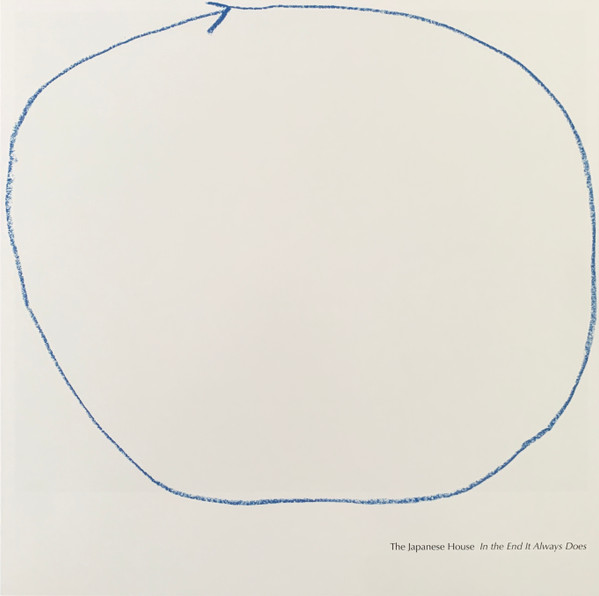
In The End It Always Does is an Alt/Indie album by The Japanese House, originally released in 2023. On Gatefold: 9 pressings tracked, owned by 5 collectors.
About
Amber Bain—the East London-based singer-songwriter who goes by The Japanese House—took her time with her second album (four years, to be precise, passed between her 2019 debut <i>Good at Falling</i> and the arrival of <i>In the End It Always Does</i>). “It was this weird, really expansive time where I was like, ‘I can’t think of anything to say,’” Bain tells Apple Music. “I’d write the odd song here and there, but I’d moved out of London, gone to [English coastal town] Margate and was living this slowed-down version of life, both because of lockdown and because I was out of the city.” Then, Bain broke up with her girlfriend and moved back to the capital—events which finally provided the catalyst for her second record. “It felt like my life was kind of restarting simultaneously with the ending [of the relationship],” she says. “It’s a very inspiring place to be, when you’re on the edge. It’s really easy to engage with ideas and your core emotions and wants when you’re not in a very stable place.” <i>In the End It Always Does</i> is an album—as its cover art suggests—about circularity (it’s not lost on Bain that its predecessor was also about a breakup), how distance can grow to become an uncrossable void in a relationship, and endings, whether that’s a split or the gradual fade of the pain you feel after one, something Bain found herself just as devastated by. All of which is set against “classic sounds: really nice guitars, really nice strings, really nice pianos” and, often, an embrace of Bain’s poppier side. Stepping away from her computer, she says, was creatively liberating. As was the cast of people she surrounded herself with, including long-term friend and collaborator George Daniel of The 1975, and producer Chloe Kraemer (who’s worked with Rina Sawayama, LAVA LA RUE, and more). “Working with a queer woman really opened up the emotion,” says Bain of working with Kraemer. “The conversations Chloe and I had during this record I wouldn’t have had with anyone else, because no one really gets it the same as she does. I just do think that communication between two women is different. And queer people—there’s a level of understanding there that you can't get really otherwise.” Below, Bain takes us inside her raw, honest, and beautiful second album, one track at a time. <b>“Spot Dog”</b> “As soon as I wrote the piano introduction to this, I knew it would start the album. My ex and I loved the film <i>One Hundred and One Dalmatians</i> and it’s a direct ode to a song called ‘A Beautiful Spring Day’ by George Bruns from the [1961] film’s soundtrack. I was using the song as an experiment: What do I want to be in my record? Do I want pianos and strings? Do I want synths? Do I want guitar-y bits? And this covers all bases on the album. I was really using the song as a palette to throw everything at in the beginning and see where I landed.” <b>“Touching Yourself”</b> “I’ll often write half a song when I’m in one place and then, when I try and finish it, I’ll be in a completely different place. So it ends up taking on a whole new meaning. For the first half of this, I was in the throes of romance and thought it was fun to write a song about sexting. It ended up being about someone being far away from you. Obviously, at the beginning I was far away from this person a lot—I was always touring. And then suddenly I was close to them all the time because it was lockdown, yet felt so far away from them. I feel like I’m really embracing a more poppy side of myself—often I hold myself back on that front. Originally, I was trying to write a chorus around this weird time signature, and in the end I gave up and was like, ‘I’m just going to write a really fun, simple pop chorus.’ It was a good lesson—the most simple songs are often my favorites.” <b>“Sad to Breathe”</b> “I wrote this when Marika [Hackman, Bain’s ex, who <i>Good at Falling</i> is about] and I broke up. We’re really good friends now and have sorted everything out—we’re very close. When I think about how completely depressed and destroyed I was from that breakup, I almost find it cute and funny. I think that’s why I decided to make the rest of that song euphoric and in double time. I guess in some ways it’s me looking back positively on this really sad time, and telling my former self that it’s going to be OK.” <b>“Over There”</b> “This is about when I was living in a throuple and one of them left. Then, in lockdown, she’d found another partner and ended up going to live with them. I felt really sad about that. The song is talking about how something beautiful so nearly happened, and how that feels such a loss when it doesn’t. My favorite line in it is, ‘She keeps her coat on/There’s not a lot to go on/She used to dote on me.’ It’s that feeling that you used to be so close to someone and now they don’t even take their coat off when they come round because they know they’re about to leave. That feeling—it’s like someone’s punching your chest. Musically, I was in a bit of a rut and [US producer] BJ Burton sent me something that he and [Bon Iver’s] Justin Vernon had been working on. I started writing over the little loop he sent me—luckily they said I could keep using the chords, because that would have really thrown a spanner in the works!” <b>“Morning Pages”</b> “There’s this book called <i>The Artist’s Way</i> where you write every morning. It’s meant to be a way of opening your brain and you’re supposed to throw away [what you’ve written] and not read it afterwards. I only ever did it once and it became the lyrics to this song. I sent Katie [Gavin of MUNA] the song and she wrote a verse on it. I fell in love with what she wrote—she’s great at completely understanding what a song is about. We’ve been friends with MUNA for so long and I really like the way our voices sound together. I think we’re drawn to this style of song, where the theme is sad and gay. I think it’s perfect.” <b>“Boyhood”</b> “I wasn’t in a particularly good place when I wrote the early version of this song. I was thinking about trauma and things that happen to you in your life—how you become the summation of those things and how that feels unfair in a way. I was also thinking about gender in terms of me not having had a boyhood. The word ‘girlhood’ doesn’t really even exist. I was thinking about how different it would be had I had a boyhood because a lot of the time I felt like I was a boy and would dress as a boy, asked to be called a boy’s name. It’s taken me a long time to accept certain aspects of my gender. In some ways, it’s about embracing the things that have happened to you and about letting go of others in order to become someone that you feel you are intrinsically. The demo was really electronic, then we experimented with stripping everything back and it becoming a completely acoustic organic song. We watched this video of a gay dance group dancing in cowboy hats and boots in front of the White House—I think it’s in the early noughties at Pride—and it’s exactly the same BPM as ‘Boyhood.’ We wanted to encapsulate a definite cowboy twang but also [have] a campness to it. It’s a dance song in a weird way—just a stripped-back, acoustic dance song.” <b>“Indexical reminder of a morning well spent”</b> “In lockdown, my then girlfriend and I were reading outside and having a really lovely morning. We were eating croissants or jam on toast and I accidentally got something on one of her books—a little fingerprint of jam or something. I was like, ‘I’m so sorry.’ She said, ‘It’s OK, it’s an indexical reminder of a morning well spent.’ She just made that up! And I wrote it down immediately. The song is about giving in to love and solitude and repetitive life. It’s a little map of things that were going on over the period of lockdown.” <b>“Friends”</b> “I had a much slower version of this originally. George and I were both pretty depressed at this point and I think we sped it up just to make a dance tune to cheer us up. I think we were a bit sick of listening to all these sad songs. George is an amazing sound designer when it comes to writing drum parts and creating rhythms. And I’m good at making basslines. We were collaborating in this new way, and it was really fun to explore that. Later, we ended up adding these Paul Simon-y guitars and making it slightly less electronic. I don’t even know what genre this is, but it’s fun to have a sexy song about threesomes.” <b>“Sunshine Baby”</b> “I would call my ex and my dog my ‘sunshine babies.’ My dog is obsessed with the sun, and me and my ex are the same—probably some of the best moments of our relationship were just lying on the beach in Margate. The song started as an attempt to find a way to stop fighting, but at the end it became sort of a resignation about the relationship ending. That speaks to what the whole album is about. Do you resign to being in something that you’re not completely happy with, or do you resign to it ending? And which one’s worse? There’s relief in giving up. And you can hear that in the music—there’s catharsis in the outro, the sax, and lying back on a beach in the sand looking up at the sun like, ‘OK, fine.’” <b>“Baby goes again”</b> “This is inspired by Fleetwood Mac’s ‘Honey Hi’ or ‘Tusk.’ I think it’s about the feeling like you’re always on the cusp of fixing everything. Then I’d often feel like I’d just go and fuck everything up, or one of us would. Just when you’re starting to feel great again, someone’s done something stupid. There’s the lyric in there, ‘I keep circling/You can’t stop a circle, but I keep coming back around, at least I can’t keep coming back around.’ That again links to the title and the album art so clearly. It was: ‘I’m aware that I keep repeating myself and making the same mistakes, but at least I keep coming back around.’ I was wondering if that can be enough. And it wasn’t. But I think the song was the last glimpse of hope for my relationship in a lot of ways.” <b>“You always get what you want”</b> “I wrote this song when I was 17 or 18. It’s the oldest song on the record, and I really liked it. It was about when my girlfriend left me for a boy, and I was bitter. I was just like, you always get everything you want. Now, that person is one of my best friends because we were so young when we were together. But she makes a joke that I’ve cursed her and that, ever since I wrote that, things keep going wrong for her. The original version of the song was so embarrassing, but I really like the bass of it. We did all the production for it in one day.” <b>“One for sorrow, two for Joni Jones”</b> “I had this instrumental thing written with the piano and strings, and I had this idea that we’d have some sort of lyrical rambling over the top of it, kind of like an ode to Joni Mitchell. Obviously I love her so much and I named my dog after her. I went into the studio and said I’d written this weird thing—a poem I’d written hungover that morning after seeing a Charli XCX show—and that maybe it could be the lyrical rambling. Katie Gavin came in and sung pretty much the exact melody we have for it now. It was just so magical watching her do that—she was kind of laughing and crying and me and Chloe were both sobbing. It’s just one of the most honest and pure things I’ve ever written. It’s on the cusp of being embarrassing because it’s radical honesty. But I think it pulls back at the right moments. It’s talking about how it’s so sad that you think your life’s going to end [after a breakup], but actually day to day, you’re just going to be walking in the park with your little dog and everything’s going to be pretty much the same. This is definitely the most raw and real thing I’ve ever released.”
via Apple Music
The Clerk says
The Clerk knows this whole record — the pressing quirks, the credits, the take.
Tracklist
Side A
- A1Spot Dog
- A2Touching Yourself
- A3Sad To Breathe
- A4Over There
- A5Morning Pages
- A6Boyhood
Side B
- B1Indexical Reminder Of A Morning Well Spent
- B2Friends
- B3Sunshine Baby
- B4Baby Goes Again
- B5You Always Get What You Want
- B6One For Sorrow, Two For Joni Jones
Sound DNA
- Alt/Indie
- Indie Rock
- shimmering
- bittersweet
- confessional
Credits
The people behind it.
Performers
- Amber BainBASS DRUM PROGRAMMING, PROGRAMMED BY GUITAR
- Chloe KraemerDRUM PROGRAMMING, PROGRAMMED BY STRINGS, PROGRAMMED BY, DRUM PROGRAMMING, SYNTH STRINGS, SYNTH
- Cicely CottonSAXOPHONE SAXOPHONE, VOCALS VOCALS
- Freddy SheedDRUMS
- George DanielDRUM PROGRAMMING, PROGRAMMED BY DRUMS, DRUM PROGRAMMING, PROGRAMMED BY, KEYBOARDS, VOCALS KEYBOARDS
- Justin VernonKEYBOARDS
- Kamran KhanVOCALS
- Katie GavinVOCALS
- Matthew HealyBACKING VOCALS, GUITAR, POST PRODUCTION DRUMS GUITAR
- Phil CookKEYBOARDS
- Phil CookKEYBOARDS
- MunaFEATURING
5 collectors on Gatefold own this · 9 pressings tracked on Gatefold
Start your shelf.
Track your pressings of In The End It Always Does, get the Clerk's take, and see what the record is worth — free.
Start your shelf →Free forever. Works with 10 records or 10,000.