
Album
Cowboy Tears
2022 · Rock, Folk, World, & Country
4 collectors on Gatefold own this
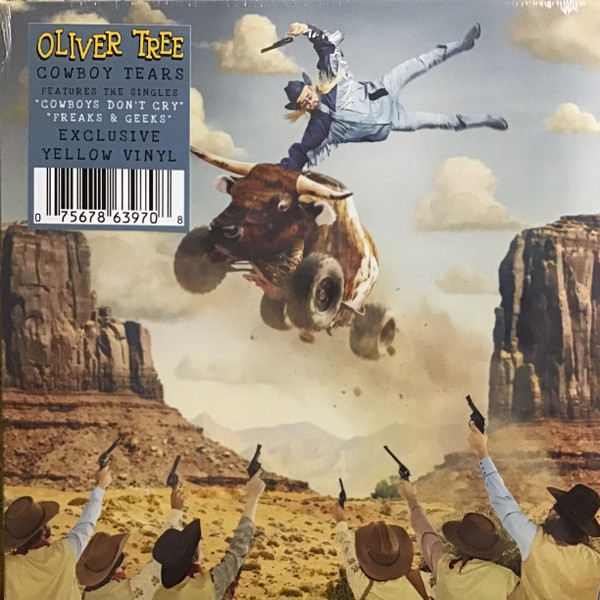
Cowboy Tears is an Alt/Indie album by Oliver Tree, originally released in 2022. On Gatefold: 13 pressings tracked, owned by 4 collectors.
About
In 2020, when the alt-pop artist Oliver Tree dropped his full-length debut album, <i>Ugly Is Beautiful</i>, he confused audiences: Was he the real deal? Or was he a meme? Turns out he was a little bit of both—a visionary with a keen sense of what goes viral. Now, on his second album (and first since his short-lived and self-induced retirement from the music business), it’s candor he’s after. That, and a new emo-country sound. “When I listen to this album, I cry my eyes out,” he tells Apple Music. “But the truth i, it’s important to cry. It’s so important for people to let it out and not hold it until it erupts in anger and violence. Everybody needs to cry, but especially men, the tough guy, and macho men. My grandfather was a cowboy. His grandfather was a cowboy. It's not ripping off another culture or something else that isn't true to my DNA.” Recorded at his grandparents’ California ranch during the COVID-19 pandemic, <i>Cowboy Tears</i> is a stark departure from Tree’s first album: full of twangy TikTok emo (“California,” “Cowboy Tears”) and echoes of ’90s arena rock (The Verve’s “Bitter Sweet Symphony” on “Swing & A Mi,” Sugar Ray’s “Every Morning” on “Freaks & Geeks”). It’s eclecticism at its most playful. Below, Oliver Tree walks Apple Music through <i>Cowboy Tears</i>’ theme, track by track. He only asks that listeners create their own meaning, too. <b>“Cowboys Don’t Cry”</b> “I could talk about, 'Oh yeah, I made it with this person and that person,' or 'I play this instrument,' but that's not important to me. The message is much more important: It's really the story of the end of a relationship, when two people are trying to make it work but there's no hope. It’s kind of this revolving door, and the opening is just closing a little more and a little more to the point where there isn't even an entrance. [It’s about] the acceptance of that and learning how to try to be happy on your own.” <b>“Swing & A Miss”</b> “This one is a song about a threesome that I was supposed to have that never happened. While I was recording <i>Cowboy Tears</i>, these two girls called me up to have a ménage à troi. I waited and I waited, and they never showed up. The next day I woke up and I had a voicemail from the LA county jail, and they asked me to bail them out. Instead, I recorded this song for them. Later on, I found out they were credit card scammer.” <b>“Get Well Soon”</b> “This is about trying to fix a broken person and realizing it's impossible. It's not your job. No matter how much you want to help someone else, no matter what you try to do for them and try to offer them, we can't put someone else back together again. They have to do the necessary work, internally, to fix themselve. We’re all so goddamn lonely—'well, might as well be lonely with someone else and hate myself with someone else who hates themselve.' That’s just not how it work. You need to work on yourself first and spend that necessary time to work on yourself, heal yourself.” <b>“Freaks & Geeks”</b> “This could be considered a sequel to themes on the last album. Being an outsider is something I will likely always identify with. No matter how much I break into the mainstream, I still don't feel like I fit into any genre of music, any specific scene of people. I don't look like anyone. I don't act like the other artists the way I present myself. And all the while, I'm not even unique. No one really is unique. We're all the same and we're all so different. This song is about me grappling with that concept.” <b>“Doormat”</b> “‘Doormat’ is about allowing someone to walk all over you and treat you like shit. I was in a relationship where I felt like I was a human punching bag. It wasn't until the end of the relationship that I could identify that I was too love-drunk and wanted to keep the fantasy going. But the reality was that I was being treated like shit. But it doesn’t have to just be a relationship: It could be the way your friend treated you. I try to keep my songs as open to interpretation as possible.” <b>“Suitcase Full of Cash”</b> “This song is about our society's obsession with money and greed. No matter how much we have, it will never be enough, and it will never really make us happier. That, to me, is a sequel off [my first album], <i>Ugly Is Beautiful</i>, the song 'Cash Machine.' Even though I already made a song that covers that, I didn't cover it all. Some might say, 'Oh man, he's running out of idea.' But to me, I'm like, 'No, I didn't get to say all thi.' I touched upon moments of it, but there's a whole lot more there.” <b>“Cigarettes”</b> “I've been battling with addiction since I was 15 years old. And this album, over the process of it, I got completely sober. And I struggle with addiction still. At the time I wrote it, I was chain-smoking cigarette after cigarette. I had just quit smoking weed. I was smoking a pound a month of weed—I'm talking Wiz Khalifa statu. I thought that it was helping keep me energized, but I realized as I removed it that I'm just a really energized person. Weed has nothing to do with that. Anyway, I realized while I was at the studio, I couldn't go more than 15 minutes until I had a craving to smoke another cig. So I wanted to make a song that reminded me that I was killing myself with every hit that I took: 'What am I doing here? I'm just trying to die from thi.'” <b>“Balloon Boy”</b> “This song is actually the saddest one to me. It’s the most personal one, in a way. It’s about the journey of choosing my life path and chasing my dreams and how I really had to give up my life, my family, my friend, girlfriend. It happens over and over again. I can't really be present; it's impossible. It’s very hard for me to stay close to anyone except for the people who are with me and my collaborator, because those are all my best friends; my team, everyone is with me. I float in the sky. I go wherever the wind takes me, and it takes my balloon. I'm just holding on by this little tiny thread of dental flo, and any second, it could snap.” <b>“Things We Used to Do”</b> “In a lot of way, this is about watching the time pass as you're waiting for someone. You'll never really see them again. That could be a person I was with, or it could be your friend or a loved one that died. For the relationship side of thing, it’s wondering, 'Is that person thinking about me? Am I even a blip in their imagination, because they're off doing their life.' Life is dense and there's a lot going on. Everyone is busy and everyone's just trying to get by.” <b>“California”</b> “‘California’ is a song about home. I lived in Santa Cruz for 19 year. I grew up there. Then I lived in San Francisco for a few year. I've spent most of my adult life living in Los Angeles when I wasn't traveling. California, this is my home, and when I do die, this is where my body will be sent. This is where the coffin is going to go when it's all over. There are so many cliché songs about California, but I felt like I haven't heard a song about dying and being brought back to California.” <b>“Playing With Fire”</b> “This song is about all the risks we take and how close we tiptoe around self-demise and death every single day. There are a lot of metaphors used, like tightrope-walking on a telephone wire butt naked, or the idea of self-harming, drug abuse, or normal day-to-day things like driving a car. Just by driving to work every day, we can all easily perish in flame. By existing, we’re playing with fire. It starts with that match lighting and blowing it out. It’s very symbolic of what it means to me, and by the end of it all, it bursts in flame.” <b>“The Villain”</b> “When love goes badly, it turns into hate, and hate quickly turns into war. We'll love someone so much and then we hate someone so much. Those two parts of our brain are right next to each other, they're very closely linked, and they're both tied with passion. When it comes to the war of love, there really isn't a good guy. Both sides have done things that contribute to the suffering of one another. I touch upon that in that song, but taking the concept of war and really applying it to the end of a relationship.” <b>“Cowboy Tears”</b> .
via Apple Music
The Clerk says
The Clerk knows this whole record — the pressing quirks, the credits, the take.
Tracklist
- 1Cowboys Don’t Cry3:09
- 2Swing & A Miss2:59
- 3Get Well Soon2:23
- 4Freaks & Geeks2:20
- 5Doormat2:51
- 6Suitcase Full of Cash2:29
- 7Cigarettes2:33
- 8Balloon Boy2:18
- 9Things We Used To Do2:37
- 10California2:53
- 11Playing With Fire2:28
- 12The Villain2:33
- 13Cowboy Tears2:57
- 14Cowboys Don’t Cry3:19
- 15Freaks & Geeks2:27
Sound DNA
- Alt/Indie
- Alternative Rock
- clean
- sarcastic
- urban
Credits
The people behind it.
Performers
- Oliver Tree NickellLEAD VOCALS, PERFORMER, WRITTEN-BY VOCALS WRITTEN-BY , VOCALS
- Ilan Rubin
4 collectors on Gatefold own this · 13 pressings tracked on Gatefold
Start your shelf.
Track your pressings of Cowboy Tears, get the Clerk's take, and see what the record is worth — free.
Start your shelf →Free forever. Works with 10 records or 10,000.