
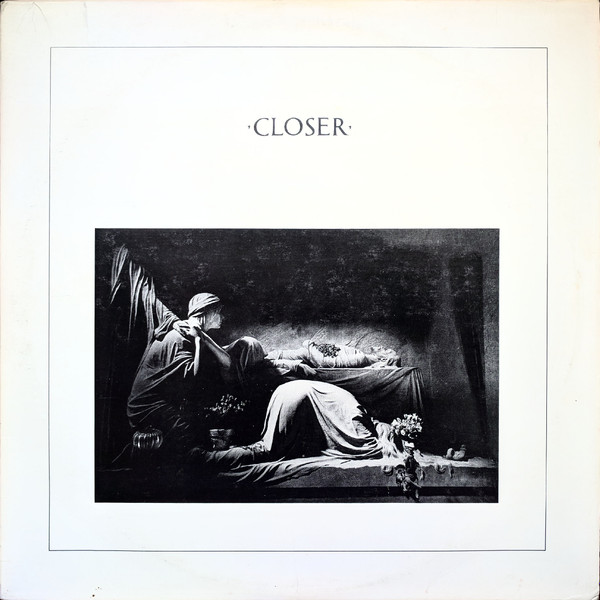
Closer is an Alt/Indie album by Joy Division, originally released in 1980. On Gatefold: 252 pressings tracked, owned by 121 collectors.
About
Joy Division bassist Peter Hook was at a wedding when producer Martin Hannett began mixing the band’s second album, <i>Closer</i>, in March 1980. By the time Hook returned to London, where they were making the record at Pink Floyd’s Britannia Row Studios, a couple of tracks were ready. “Barney [bandmate Bernard Sumner] took great delight in taking me in to play [them],” Hook tells Apple Music, “because he knew that I’d be as pissed off as he was. It was like, ‘Ohhhh...Martin.’ And Martin would just be, ‘Shut up, you pair of morons.’” This wasn’t a complete shock. A year earlier, Hook and Sumner had been similarly peeved when they first heard Hannett’s austere, haunted treatment for their debut album, 1979’s <i>Unknown Pleasures</i>. And Hannett was equally unmoved by their protests. Despite that record restating the sonic ambitions and emotional richness of British rock in the wake of punk, Hook still yearned to sound like the Pistols and The Clash on <i>Closer</i>. “I wanted to rip people’s heads off with my guitar,” he says. “And I was absolutely wrong. Thankfully, Martin Hannett recognized the maturity of our songwriting and the strength in our songs that he felt needed playing down, making more seductive.” The Manchester band arrived at Britannia Row with firm ideas for <i>Closer</i>’s nine songs, the product of jamming sessions fueled by what Hook calls a “wonderful chemistry” between himself, Sumner, singer Ian Curtis, and drummer Stephen Morris. Any enduring tension with Hannett—“He just thought Barney and I were a pair of idiots, but he felt very, very in tune with Ian”—was counterbalanced by what the studio offered in terms of sound, equipment, and catering. “I think we had £1.50 a day to spend, so, literally, you could either have a pint or a sandwich, and that was the whole day,” says Hook. “If Britannia Row hadn’t put sandwiches out at teatime for free, I think we probably would’ve starved to death, to be honest.” Hannett helped the band detach themselves from punk’s compressed rage by plugging in a growing arsenal of synths. With techniques cribbed from Motown’s recording processes, the producer explored the space within the music. Thrumming with reverb and ghostly tones, <i>Closer</i> is colder and more brutal than <i>Unknown Pleasures</i>, yet also more melodic. From the grotesque industrial clatter of “Atrocity Exhibition” to the doom-disco urgency of “Isolation,” it set new standards in bleak-hearted music—ones that legions of bands chase through the gloaming to this day. “To be cited as an inspiration for bands as varied as The 1975 to <i>anybody</i> is absolutely amazing,” says Hook. “And we didn't even know what we were doing. We had no idea. We were just a bunch of fucking idiots, all of us. It just shows you the magic of rock ’n’ roll.” Like Hook and Sumner, Curtis was seemingly unimpressed with what he heard when <i>Closer</i> was done. In a letter to the band’s manager Rob Gretton, he called it “a disaster” and took aim at Hook and Sumner as “a sneaky, japing load of tossers.” “We were still being very, very boisterous as a group, young boys,” says Hook. “We drove Ian and Annik [Honoré, Belgian journalist and friend of Curtis] mad, because they were in the flat opposite us [where the band were staying near Marylebone], so there was still a lot of boy japes going on, a lot of playfulness, which was sometimes misinterpreted, particularly by Annik. She just didn't get our northern sense of humor at all. But it was a wonderful experience recording <i>Closer</i>, apart from Ian's illness. And it came to such an awful end.” Curtis took his own life shortly after the album was completed, and these songs of disillusionment and despair have inevitably been seen as windows into his anguish. “You would say, taken in isolation, ‘Oh my god, this guy’s <i>crying</i> for help,’” says Hook. “It's a very melancholy end [to the album]. Looking back now, you could say, ‘Look at “The Eternal.” Look at “Decades.” This is a great band, a great man, disappearing.’ But these lyrics are hidden in such beautiful music for the most part—<i>positive</i>, <i>angry</i>, <i>strong</i> music—that you just listen to this LP and go, ‘Oh my god, this is a great record. Fantastic.’ He hid it well–which pretty much sums up his attitude to everything.” While making <i>Closer</i>, Curtis’ marriage was becoming increasingly strained, and his epilepsy was so severe he was afraid to hold his baby daughter. As a consequence, he was being prescribed a debilitating regime of medication. “The most telling thing was when they did the documentary <i>Joy Division</i> [2007], they took Ian's prescription to a modern-day epilepsy expert and asked him what he thought,” says Hook. “The guy said it was guaranteed to kill him.” <i>Closer</i> deserves to be regarded as more than a final statement, though. It’s a towering testament to the artistry of Curtis and Joy Division. Watching Curtis contend with his illness left the band with “an awful, awful feeling, the helplessness,” says Hook, but the singer’s drive often masked the depths of his suffering. Hook recalls finding him bloodied in the studio toilet one night after suffering a seizure and hitting his head. As Hook helped him clean up, Curtis insisted on getting straight back to recording. “He fought it tooth and nail, every moment,” says the bassist. “Ian was so ambitious, and he was so positive about Joy Division. Every gig that he had a fit and was carried off, in the dressing room afterwards, he wouldn’t want to go to hospital or go to bed. He wanted to go out and party. We were like, ‘Oh well, so do we.’ In an odd way, as a youngster, as a group member that looked like they were on their heady way to stardom, him turning round and letting you off the hook was what you wanted most.” Curtis died on May 18, 1980, at age 23. It would be a while before his bandmates could bring themselves to listen to <i>Closer</i>, having resolved to carry on as New Order. “All we were interested in was being together, and making sure New Order, in any way we could do, survived, flourished,” says Hook. “And we managed to do that by ignoring Joy Division completely. When you’re [that age], every minute, you keep thinking someone’s going to take everything off you, like a child, because you are no more than a child. It was important for us to carry on, to throw ourselves into what we were doing and push that painful memory away.” Hook says it was two or three years until he listened to <i>Closer</i>: “I found that I didn't have the connection with it that I had with <i>Unknown Pleasures</i>. I was able to listen to <i>Closer</i> and actually enjoy it—it became one of my favorite records. That’s how divorced I felt from the reality of what it was: I could listen to it and think it was somebody else.”
via Apple Music
The Clerk says
The Clerk knows this whole record — the pressing quirks, the credits, the take.
Tracklist
Side A
- A1Atrocity Exhibition6:03
- A2Isolation2:53
- A3Passover4:44
- A4Colony3:52
- A5A Means To An End4:04
Side B
- B1Heart And Soul5:48
- B2Twenty Four Hours4:26
- B3The Eternal6:01
- B4Decades6:08
Sound DNA
- Alt/Indie
- Post-Punk
- brittle
- mournful
- nocturnal
The second and final album by Joy Division, released on July 18, 1980 on Factory, two months after the suicide of lead singer Ian Curtis.
The album was recorded from 18 to 30 March 1980 at Britannia Row Studios, Islington, London.
The LP features a photograph taken by Bernard Pierre Wolff (1978) which was captured at the Staglieno Cemetery located in Genova, Italy. It is a large emotional work created & sculpted by Demetrio Paernio in 1910 for the Appiani family tomb.
The 1980 and 1981 UK pressings have A1 / B-1 matrices with ‘OLD BLUE?’ inscribed on side A.
They come in two different vinyl variants:
– opaque black
– translucent dark red or dark green
This can only be differentiated when held against a strong light source. The translucency was a hallmark of Tranco / PRT.
Additionally, they are differentiated by having:
– either rough or smooth card outer sleeves
– either rough or smooth card inner sleeves
– either rounded or square-cornered inner sleeves
Among Tranco / PRT pressings, there is no correlation between vinyl colour and paper part variants.
These pressings have an elevated outer stamper ring.
The CBS pressings have smooth outer and inner sleeves, and are pressed on opaque black vinyl only.
These pressings have a broad stamper ring of 6.5 cm diameter.
145,091 copies were pressed in total up to 17 July 1981.
260,000 copies were pressed by the end of 1982.
UK re-releases and re-pressings:
1983 - 1985: A2 / B2 Townhouse / GG matrix (MVS or Carlton Productions (some brown translucent) or Linguaphone (with 25mm pressing ring) pressings).
1985: A3 / B3 Rc matrix (Linguaphone pressings (25mm pressing rings).
December 1985: Cassettes (cat# FACT 25c) - plastic cases and deluxe boxed.
April 1986: CD (cat# FACD 25),
1986: LP repressings with A3/B3 Rc matrix by Adrenalin (25mm rings).
1988: A3 / B3 Rc matrix Immediate Sound pressings (32,5mm rings).
July 1993: LP, MC, CD (cat# 520 015-1 / 2 / 4), with repressings in 1994, 1996 and 1998. The LP edition was only released in Greece (1993).
September 1999: CD (cat# 39842 8219-2), with repressings in 2005.
September 2007: LP (cat# 25646 4014 1) - 180 gram remaster in original artwork.
September 2007: CD (cat# 25646 9779 1) - Collector's Edition.
June 2015: LP (FACT 25R / 25646 1839 1) - Vinyl Collector Edition.
July 2020: LP (FACTXXV MMXX) 40th Anni Ltd Edition 180g Crystal Clear vinyl.
US releases:
March 1981: LP (cat# FACTUS 6).
November 1981: MC (cat# FACTUS 6C).
1987: CD (cat# FACTUS 6 CD), with repressings in 1988.
March 1989: LP, MC (cat# 9 25840-1 / 4).
June 1989: CD (cat# 9 25840-2), with CD repressings in 1997, 2002, 2005.
September 2007: LP (cat# RHI1 73394) - 180 gram remaster in original artwork.
September 2007: CD (cat# R2 330876) - Collector's Edition.
June 2015: LP (cat# R1-56282) - Vinyl Collector Edition.
Japanese releases:
July 1984: LP (cat# YX-7338-AX).
February 1989: CD (cat# 25CY-3101).
November 1993: CD (cat# POCD-1880).
March 2000: CD (cat# AMCE-6109).
June 2005: CD (cat# WPCR-75048).
March 2008: CD (cat# WPCR-12840/41) - Collector's Edition.
Credits
The people behind it.
Performers
- Bernard AlbrechtGUITAR
- Ian CurtisVOCALS
- Peter HookBASS
- Stephen MorrisDRUMS
121 collectors on Gatefold own this · 252 pressings tracked on Gatefold
Start your shelf.
Track your pressings of Closer, get the Clerk's take, and see what the record is worth — free.
Start your shelf →Free forever. Works with 10 records or 10,000.