
Album
Black To The Future
2021 · Jazz
21 collectors on Gatefold own this
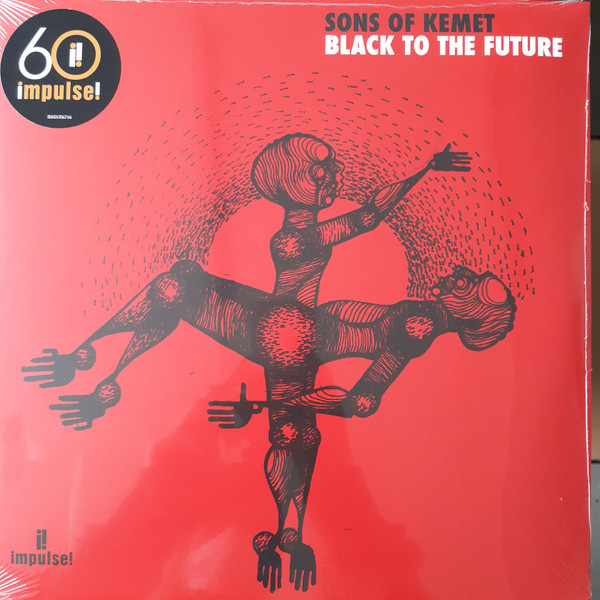
Black To The Future is a Soul & Funk album by Sons Of Kemet, originally released in 2021. On Gatefold: 9 pressings tracked, owned by 21 collectors.
About
“I wanted to get a better sense of how African traditional cosmologies can inform my life in a modern-day context,” Sons of Kemet frontman Shabaka Hutchings tells Apple Music about the concept behind the British jazz group’s fourth LP. “Then, try to get some sense of those forms of knowledge and put it into the art that’s being produced.” Since their 2013 debut LP <i>Burn</i>, the Barbados-raised saxophonist/clarinetist and his bandmates (tuba player Theon Cross and drummers Tom Skinner and Eddie Hick) have been at the forefront of the new London jazz scene—deconstructing its conventions by weaving a rich sonic tapestry that fuses together elements of modal and free jazz, grime, dub, ’60s and ’70s Ethiopian jazz, and Afro-Caribbean music. On <i>Black to the Future</i>, the Mercury Prize-nominated quartet is at their most direct and confrontational with their sociopolitical message—welcoming to the fold a wide array of guest collaborators (most notably poet Joshua Idehen, who also collaborated with the group on 2018’s <i>Your Queen Is a Reptile</i>) to further contextualize the album’s themes of Black oppression and colonialism, heritage and ancestry, and the power of memory. If you look closely at the song titles, you’ll discover that each of them makes up a singular poem—a clever way for Hutchings to clue in listeners before they begin their musical journey. “It’s a sonic poem, in that the words and the music are the same thing,” Hutchings says. “Poetry isn't meant to be descriptive on the surface level, it's descriptive on a deep level. So if you read the line of poetry, and then you listen to the music, a picture should emerge that's more than what you'd have if you considered the music or the line separately.” Here, Hutchings gives insight into each of the tracks. <b>“Field Negus” (feat. Joshua Idehen)</b> “This track was written in the midst of the Black Lives Matter protests in London, and it was a time that was charged with an energy of searching for meaning. People were actually starting to talk about Black experience and Black history as it related to the present, in a way that hadn't really been done in Britain before. The point of artists is to be able to document these moments in history and time, and be able to actually find a way of contextualizing them in a way that's poetic. The aim of this track is to keep that conversation going and keep the reflections happening. I've been working with Joshua for 15 years and I really appreciate his perspective on the political realm. He's got a way of describing reality in a manner which makes you think deeply. He never loses humor and he never loses his sense of sharpness.” <b>“Pick Up Your Burning Cross” (feat. Moor Mother & Angel Bat Dawid)</b> “It started off with me writing the bassline, which I thought was going to be a grime bassline. But then in the pandemic lockdown, I added layers of horns and woodwinds. It took it completely out of the grime space and put it more in that Antillean-Caribbean atmosphere. It really showed me that there's a lot of intersecting links between these musics that sometimes you're not even aware of until you start really diving into their potential and start adding and taking away things. It was really great to actually discover that the tune had more to offer than I envisioned in the beginning. Angel Bat Dawid and Moor Mother are both on this one, and the only thing I asked them to do was to listen to the track and just give their honest interpretation of what the music brings out of them.” <b>“Think of Home”</b> “If you're thinking poetically, you've got that frantic energy of 'Burning Cross,' which signifies dealing with those issues of oppression. Then at the end of that process of dealing with them, you've got to still remember the place that you come from. You've got to think about the utopia, think about that serene tranquil place so that you're not consumed in the battle. It's not really trying to be a Caribbean track per se, but I was trying to get that feeling of when I think back to my days growing up in Barbados. This is the feeling I had when I remember the music that was made at that time.” <b>“Hustle” (feat. Kojey Radical)</b> “The title of the track links back to the title of our second album, <i>Lest We Forget What We Came Here to Do</i>. The answer to that question is to hustle. Our grandparents came and migrated to Britain, not to just be British per se, but so that they could then create a better life for themselves and their families and have the future be one with dignity and pride. I gave these words to Kojey and he said that he finds it difficult to depict these types of struggles considering that he's not in the present moment within the same struggle that he grew up in. He felt it was disingenuous for him to talk about the struggle. I told him that he's a storyteller, and storytelling isn't always autobiographical. His gift is to be able to tell stories for his community, and to remember that he's also an orator of their history regardless of where his personal journey has led him.” <b>“For the Culture” (feat. D Double E)</b> “Originally, we'd intended D Double E to be on 'Pick Up Your Burning Cross.' But he came into the studio and it really wasn't the vibe that he was in. We played him the demo of this track and his face lit up. He was like, 'Let's go into the studio. I know what to do.' It was one take and that was it. I think this might be one of my favorite tunes on the album. The reason I called it 'For the Culture' is that it puts me back into what it felt like to be a teenager in Barbados in the '90s, going into the dance halls and really learning what it is to dance. It's not just all about it being hard and struggling and striving; there is that fun element of celebrating what it is to be sensual and to be alive and love music and partying and just joyfulness.” <b>“To Never Forget the Source”</b> “I gave this really short melody to the band, maybe like four bars for the melody and a very repeated bassline. We played it for about half an hour, where the drums and bass entered slowly and I played the melody again and again. The idea of this, when we recorded in the studio, is that it needs to be the vibe and spirit of how we are playing together. So it wasn't about stopping and starting and being anxious. We need to play it until the feeling is right. The clarinets and the flutes on this one is maybe the one I'm most proud of in terms of adding a counterpoint line, which really offsets and emphasizes the original saxophone and tuba line.” <b>“In Remembrance of Those Fallen”</b> “The idea of 'In Remembrance of Those Fallen' is to give homage to those people that have been fighting for liberation and freedom within all those anti-colonial movements, and remember the ongoing struggle for dignity within especially the Black world in Africa. It's trying to get that feeling of 'We can do this. We can go forward, regardless of what hurdles have been done and of what hurdles we've encountered.' But, musically, there's so many layers to this. I was excited with how, on one side, the drums are doing what you'd describe as Afro-jazz, and on the other one, it's doing a really primal sound—but mixing it in a way where you feel the impact of those two contrasting drum patterns. This is at the heart of what I like about the drums in Kemet. Regardless of what they're doing, the end result becomes one pulsating, forward-moving machine.” <b>“Let the Circle Be Unbroken”</b> “I was listening to a lot of [Brazilian composer] Hermeto Pascoal while making the album, and my mind was going onto those beautiful melodies that Hermeto sometimes makes. Songs that feel like you remember them, but they've got a level of harmonic intricacy, which means that there's something disorienting too. It's like you're hearing a nursery rhyme in a dream, hearing the basic contour of the melody, but there's just something below the surface that disorientates you and throws you off what you know of it. It's one of the only times I've ever heard that midtempo soca descend into brutal free jazz.” <b>“Envision Yourself Levitating”</b> “This one also features one of my heroes on the saxophone, Kebbi Williams, who does the first saxophone solo on the track. His music has got that real New Orleans communal vibe to it. For me, this is the height of music making—when you can make music that's easy enough to play its constituent parts, but when it all pieces together, it becomes a complex tapestry. It's the first point in the album where I do an actual solo with backing parts. This is, in essence, what a lot of calypso bands do in Barbados. So when you've got traditional calypso music, you'll get a performer who is singing their melody and then you've got these horn section parts that intersect and interact with the melody that the calypsonian is singing. It's that idea of an interchange between the band backing the chief melodic line.” <b>“Throughout the Madness, Stay Strong”</b> “It's about optimism, but not an optimism where you have a smile on your face. An optimism where you're resigned to the place of defeat within the big spectrum of things. It's having to actually resign yourself to what has happened in the continued dismantling of Black civilization, and how Black people are regarded as a whole in the world within a certain light; but then understanding that it's part of a broader process of rising to something else, rising to a new era. Also, on the more technical side of the recording of this tune, this was the first tune that we recorded for the whole session. It's the first take of the first tune on the first day.” <b>“Black” (feat. Joshua Idehen)</b> “There was a point where we all got into the studio and I asked that we go into these breathing exercises where we essentially just breathe in really deeply about 30 times, and at the end of 30, we breathe out and hold it for as long as you can with nothing inside. We did one of these exercises while lying on the floor with our eyes shut in pitch blackness. I asked everyone to scream as hard as we can, really just let it out. No one could have anything in their ears apart from the track, so no one was aware of how anyone else sounded. It was complete no-self-awareness, no shyness. It's like a cathartic ritual to really just let it out, however you want.”
via Apple Music
The Clerk says
The Clerk knows this whole record — the pressing quirks, the credits, the take.
Tracklist
Side A
- A1Field Negus3:03
- A2Pick Up Your Burning Cross3:44
- A3Think Of Home3:32
Side B
- B1Hustle5:18
- B2For The Culture4:01
- B3To Never Forget The Source2:55
Side C
- C1In Rememberance Of Those Fallen5:06
- C2Let The Circle Be Unbroken6:29
Side D
- D1Envision Yourself Levitating8:23
- D2Throughout The Madness, Stay Strong5:53
- D3Black2:42
Sound DNA
- Soul & Funk
- Afrobeat
- layered
- triumphant
- political
Notes from the original pressing. Later editions may differ.
Angel Bat Dawid appears courtesy of Angel Bat Dawid.
Moor Mother appears courtesy of Don Giovanni Records.
60 Impulse! sticker on shrinkwrap.
Sterling stamp etched in runouts.
Credits
The people behind it.
Performers
- Eddie HickDRUMS
- Theon CrossTUBA
- Tom SkinnerDRUMS
- Angel Bat DawidFEATURING FEATURING, VOCALS, LYRICS BY VOCALS
- Cassie KinoshiALTO SAXOPHONE
- D Double EFEATURING FEATURING, VOCALS, LYRICS BY VOCALS
- Ife OgunjobiTRUMPET
- Joshua IdehenFEATURING FEATURING, VOCALS, LYRICS BY VOCALS
- Kebbi WilliamsTENOR SAXOPHONE
- Kojey RadicalFEATURING FEATURING, VOCALS, LYRICS BY VOCALS
- Moor MotherFEATURING FEATURING, VOCALS, LYRICS BY VOCALS
- Nathaniel CrossTROMBONE
- Steve WilliamsonTENOR SAXOPHONE
21 collectors on Gatefold own this · 9 pressings tracked on Gatefold
Start your shelf.
Track your pressings of Black To The Future, get the Clerk's take, and see what the record is worth — free.
Start your shelf →Free forever. Works with 10 records or 10,000.