
Album
Ashes Of The Wake
2004 · Rock
24 collectors on Gatefold own this
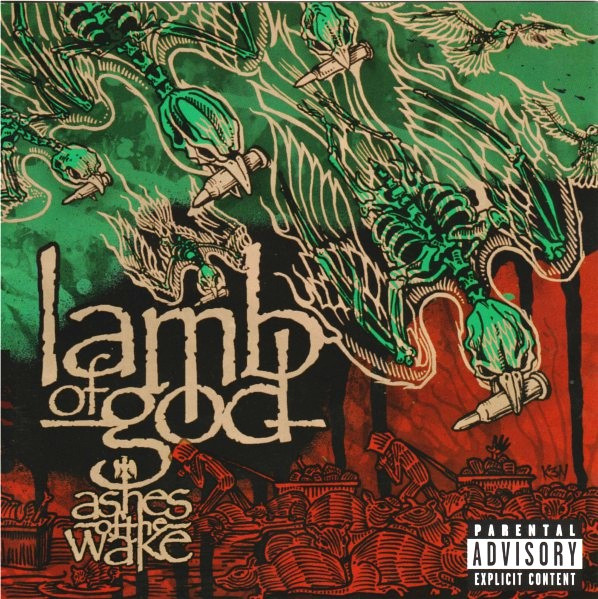
Ashes Of The Wake is a Metal album by Lamb Of God, originally released in 2004. On Gatefold: 29 pressings tracked, owned by 24 collectors.
About
Originally released in 2004, <i>Ashes of the Wake</i> was Lamb of God’s breakthrough album. Their first for a major label after three indie releases (two as Lamb of God; one under their original name, Burn the Priest), <i>Ashes</i> propelled the Richmond, Virginia-based metal band to the forefront of the New Wave of American Heavy Metal movement on the strength of aggressive crowd-pleasers “Laid to Rest,” “Omerta,” and “Now You’ve Got Something to Die For.” Certified gold in the US, it’s become their best-selling album to date. Not that any of the band members—vocalist Randy Blythe, guitarists Mark Morton and Willie Adler, bassist John Campbell, or then-drummer Chris Adler—had any sense of its significance at the time. “We had no idea that it would have the kind of impact and legacy that it’s had for us,” Morton tells Apple Music. “That wasn't really a notion or consideration at all. Being our first major-label record, I didn’t really know what that meant in terms of expectations, creatively or commercially. We had some conversations with label people about that stuff, and it was a very steep learning curve for me in terms of what it meant to be on a major label and what kind of things would change with that situation being in place.” The band felt added pressure to deliver because they had only recently written their previous album, <i>As the Palaces Burn</i>. “As a songwriter, I personally felt pretty tapped at that point,” Morton recalls. “I had been so accustomed to just collecting music as the ideas came and not really dedicating myself to sitting down and writing songs as an activity. But with this album, we had a time window. The new label wanted their new record, so we had to abbreviate the touring we would’ve normally done so we could write a new record—essentially right after we had just written one.” Despite the time crunch, LOG delivered what became their most popular album. “I understand why it’s the record that most people go to,” Morton says. “But I don’t revere this record any more than some of our other ones. For me, I think we’ve made better albums. I think we’ve probably made worse albums. There’s some really cool songs on here, and there’s some I wouldn’t write today. The cliché is that it’s just a snapshot of where we were at the time, but it’s true. And I love the record for what it is.” The 20th Anniversary Edition of <i>Ashes of the Wake</i> includes preproduction demos, special guest remixes, live tracks, and a reimagined version of “Another Nail for Your Coffin,” which originally appeared as a bonus track on the Japanese edition of the album. Below, Morton comments on the 11 original album tracks. <b>“Laid to Rest”</b> “I don't recall us feeling like we had written one of the biggest songs of our career, but it’s a cool song. I've been on record saying this before, but I didn't realize how derivative from Testament it was at time. But that makes total sense, because I've been a huge Testament fan my whole life. Lyrically, I think it was loosely rooted in some personal relationship conflict stuff and just a general kind of dismissive song about isolating oneself from conflict—just kind of a fuck-you song. Nothing super profound there, but definitely rooted in some real-life experience at the time. I think more than anything, it’s got a fire in it that really connects with people. We play it every night, and it’s still a blast.” <b>“Hourglass”</b> “‘Hourglass’ is a really good example of the interplay and the dynamic between me and Willie, guitar-wise. I think it's a really exciting guitar song. Lyrically, I think it’s an example of us touching on the doomsday feeling of the war in the Middle East at the time, and just kind of this real post-9/11 feeling of a scary new world that we were in.” <b>“Now You've Got Something to Die For”</b> “This is a good example of our different perspectives on how to put a song together. Listen to the second riff, where the drum part picks up really fast. If you take that riff away from the drum part, it's very reminiscent of ‘Cowboys From Hell’ by Pantera, a Dimebag [Darrell] kind of riff. But when Chris Adler put his uptempo, fast, sort of European-style death metal drumbeat on top of it, it became this amalgamation of Pantera meets At The Gates. And that was a unique sound within the context of heavy metal, these different angles of influence coming together.” <b>“The Faded Line”</b> “This is another pretty acrobatic guitar song. On this album, I think Willie and I were still coming from the earlier albums where we were very often trying to one-up each other in terms of guitar technique, and ‘The Faded Line’ is rooted in that. It's a pretty exciting guitar song with some difficult parts, but there's also chord progressions that are less abstract than some of our earlier work. So you can really see us kind of developing a songwriting technique within this guitar-centric landscape. I wrote most of the lyrics for this one, and it’s just about this bleak feeling of disconnection and disassociation from one's peers or from what's really going on around one.” <b>“Omerta”</b> “Randy wrote the lyrics for ‘Omerta,’ and I would imagine he was just intrigued by the idea of a code of silence. I don’t want to speak for him, and I’m not going to attribute it directly to any group or organization at all, but I do know it was a reference to a code of silence. Musically, this song started out at probably three times the tempo that it is. It was the same riff but played really fast when Willie brought it in. I think it was probably our producer that suggested we slow it way, way down. So we did, and we really liked how that felt completely different than everything else in the batch of songs that we were putting together.” <b>“Blood of the Scribe”</b> “This is one that I didn't personally have a whole lot to do with. I may have a riff or two in there, but it's a great example of Willie Adler's very unique and very adept guitar riffing. I’ve always assumed the lyrics were Randy’s commentary on what I was talking about earlier, where we felt like we were running on fumes creatively. We were digging deep inside ourselves to come up with something inspired and to find a way to trust our own artistry.” <b>“One Gun”</b> “I was inspired by the rapper Nas for this one. He has a song called ‘One Mic,’ and in that song, he's talking about how one mic can change the world. I sort of twisted that into a very dark, sinister version: If one mic can change the world, so can one gun. It's a pretty bold creative statement, I guess. I don't think I would write that song today, but that's where the idea came from. These days, I’m much more intentional and deliberate about the energy that I put out through my lyrics. I don’t think I’m as reckless with ideas, and I don’t want that kind of energy attached to me.” <b>“Break You”</b> “I didn't have a whole lot to do with this one, creatively. It’s a Willie Adler composition and Randy wrote the lyrics. We're playing it now on tour and it's a blast. Willie's songs are always tricky for me because his style is so different. I've played with him now for about 25 years, so I'm used to it, but it's still sometimes challenging to play some of Willie's riffs. I don't know who Randy was writing about in the lyrics, but it was obviously someone he was very unhappy with.” <b>“What I've Become”</b> “This was an attempt to infuse a more traditional kind of punk rock element into what we were doing. We would continue to tinker with that on albums after <i>Ashes of the Wake</i>, and I think probably to more developed results. But ‘What I've Become’ is an early version of us weaving a punk rock thread through what we were doing. Lyrically, I was writing about the sort of resentments and discontent that build up within a touring band when you've been elbow to elbow, shoulder to shoulder for a thousand miles and way too many months.” <b>“Ashes of the Wake”</b> “That was a song that Willie brought in. For whatever reason, it was really difficult to figure out how to put vocals on it. Nothing really repeated, and it had a cadence that just wasn't really locked into where we were feeling vocal matches at the time. It wasn't a huge stretch for us to consider putting an instrumental on the album. We started out as an instrumental band, so that wasn't some novel idea for us. And it was a cool opportunity to reach out to some of our heroes and influences—Alex Skolnick and Chris Poland in particular—to hop on. We were really excited that they were interested in doing that.” <b>“Remorse Is for the Dead”</b> “This is an early example of doing a kind of ballad-y, soft intro for a heavy track. We’d done it on ‘Vigil’ for the album before, and ‘Remorse Is for the Dead’ is running with that idea. We would continue to do it on other songs—'September Song’ most recently. But ‘Remorse Is for the Dead’ has been a sleeper, because as we've gotten these songs back up and running for the 20th anniversary tour, that's one that just connects so well and it's really great to play live.”
via Apple Music
The Clerk says
The Clerk knows this whole record — the pressing quirks, the credits, the take.
Tracklist
- 1Laid To Rest3:50
- 2Hourglass4:00
- 3Now You've Got Something To Die For3:40
- 4The Faded Line4:37
- 5Omerta4:46
- 6Blood Of The Scribe4:24
- 7One Gun3:59
- 8Break You3:36
- 9What I've Become3:29
- 10Ashes Of The Wake5:45
- 11Remorse Is For The Dead5:40
Side VIDEO
- VideoLaid To Rest (Demo)4:22
Sound DNA
- Metal
- Heavy Metal
- heavy
- aggressive
- primal
Notes from the original pressing. Later editions may differ.
Drums recorded at Water Music Studios, Hoboken, NJ.
Guitars and vocal recorded at Sound Of Music, Richmond, VA.
Additional production & editing recorded in LOG Merch Room, Richmond, VA.
Mixed at The Machine Shop, Hoboken, NJ.
Enhanced section (Sony CD-Extra) is a Quicktime movie 320x240 at 29.97 fps.
Issued in a standard jewel case with a transparent tray, and an 8-page folded booklet.
Credits
The people behind it.
Performers
- Chris AdlerBAND, DRUMS DRUMS
- John CampbellBAND, BASS BASS
- Mark MortonBAND, LEAD GUITAR, RHYTHM GUITAR GUITAR LEAD GUITAR , GUITAR
- Randy BlytheBAND, VOCALS VOCALS
- Willie AdlerBAND, LEAD GUITAR, RHYTHM GUITAR GUITAR LEAD GUITAR , GUITAR
- Alex SkolnickGUEST, SOLOIST, LEAD GUITAR
- Chris PolandGUEST, SOLOIST, LEAD GUITAR
- Kublai KhanFEATURING
- MalevolenceFEATURING
24 collectors on Gatefold own this · 29 pressings tracked on Gatefold
Start your shelf.
Track your pressings of Ashes Of The Wake, get the Clerk's take, and see what the record is worth — free.
Start your shelf →Free forever. Works with 10 records or 10,000.